Fast-Flux DNS: Detect Rotating Attack Infrastructure
Learn how to detect fast-flux DNS using TTL, passive DNS, ASN diversity, reputation signals, and a repeatable SOC investigation workflow.
 IsMalicious Team
Fast-flux DNS turns a domain into a moving target. Instead of resolving to one stable server, the name cycles through many IP addresses, sometimes across several autonomous systems and countries within minutes. Attackers use this resilience for phishing pages, malware delivery and command-and-control infrastructure.
An isolated IP block is quickly obsolete. A useful defense must identify the behavior of the domain, enrich every observed address and preserve enough history to distinguish criminal rotation from a legitimate content delivery network.
What Fast Flux Looks Like
MITRE ATT&CK classifies fast-flux DNS as T1568.001, a dynamic-resolution technique used to hide command-and-control destinations. The common patterns are:
- Single flux: one domain rotates through a large pool of A or AAAA records.
- Double flux: both the service addresses and authoritative name servers change.
- Proxy flux: compromised devices relay traffic to a smaller, protected backend.
- Short-lived campaigns: domains, certificates and redirect paths are replaced together.
The visible nodes may be victims themselves. A residential router participating in a botnet is suspicious infrastructure, but its owner is not necessarily the attacker. Preserve that distinction in reports and takedown requests.
Detection Signals That Matter
No single feature proves maliciousness. Build a score from independent observations:
- Address churn: count unique A and AAAA answers over 15 minutes, one hour and 24 hours.
- Low TTL: compare observed TTLs with the normal range for the organization and hosting model.
- Network diversity: measure the number of ASNs, prefixes and countries behind the name.
- Node reputation: enrich every address with malware, proxy, botnet, scanning and abuse history.
- Domain context: inspect registration age, registrar, nameservers, certificate history and related domains.
- Traffic behavior: correlate DNS activity with beaconing, redirects, downloads or authentication attempts.
A new domain that resolves to 40 low-reputation residential IPs across 18 ASNs is materially different from a well-established CDN hostname with documented ownership and stable certificate patterns.
A Practical SOC Workflow
Start with the alerting domain and save the exact timestamp. Use DNS history to reconstruct its answers, then send the observed nodes through the bulk IP and domain checker. Group the results by ASN, country, reputation category and first-seen time.
Next, pivot outward:
- search for sibling domains on the same addresses;
- inspect certificates and nameserver reuse;
- compare redirect paths and page fingerprints;
- check whether internal hosts queried several related domains;
- identify the first endpoint and process responsible for the lookup.
This turns a volatile hostname into a campaign-sized set of evidence. Store the domain as the primary indicator and the rotating IPs as time-bounded observations.
Blocking Without Breaking Legitimate Services
Fast-flux detection produces false positives when teams overvalue low TTL or geographic spread. Major SaaS, anti-DDoS and CDN platforms also move traffic rapidly. Before blocking, verify ownership, domain age, certificate consistency and whether the service is expected in your environment.
Use response tiers:
- High confidence: block the domain at DNS, proxy and email controls; isolate affected endpoints.
- Medium confidence: sinkhole or monitor the domain, alert on connections and collect payloads.
- Low confidence: retain the observation, increase enrichment and avoid network-wide IP blocks.
Shared IP addresses require extra care. Blocking an address used by a hosting provider can disrupt unrelated tenants, while domain-level controls usually preserve more precision.
Metrics for a Fast-Flux Detection Program
Track time to identify the domain, unique nodes discovered, percentage of nodes already known as malicious, affected endpoints and time from detection to containment. Measure false positives by service category, not only as one global rate.
The most useful quality metric is campaign expansion: how many related domains or endpoints the workflow discovers beyond the original alert. This shows whether threat intelligence is helping analysts understand infrastructure rather than merely label one IP.
Conclusion
Fast flux defeats static IP blocking by design. Defenders regain the advantage by combining passive DNS history, network diversity, domain context and reputation evidence. Begin with the domain reputation checker, enrich every rotating node through IP reputation, and feed confirmed infrastructure into a governed operational threat intelligence program.
Frequently asked questions
- What is fast-flux DNS?
- Fast-flux DNS rapidly rotates the IP addresses behind a domain, often across compromised hosts, to make phishing, malware delivery, and command-and-control infrastructure harder to block or dismantle.
- Is a short DNS TTL proof of fast flux?
- No. CDNs and resilient cloud services also use short TTLs. Defenders should combine TTL, IP churn, ASN diversity, reputation, domain age, and observed behavior before escalating.
- Should a SOC block the domain or its IP addresses?
- The domain is usually the more durable control point, while current IPs can support short-lived containment. Blocking should reflect confidence and account for shared hosting and compromised residential nodes.
Related articles
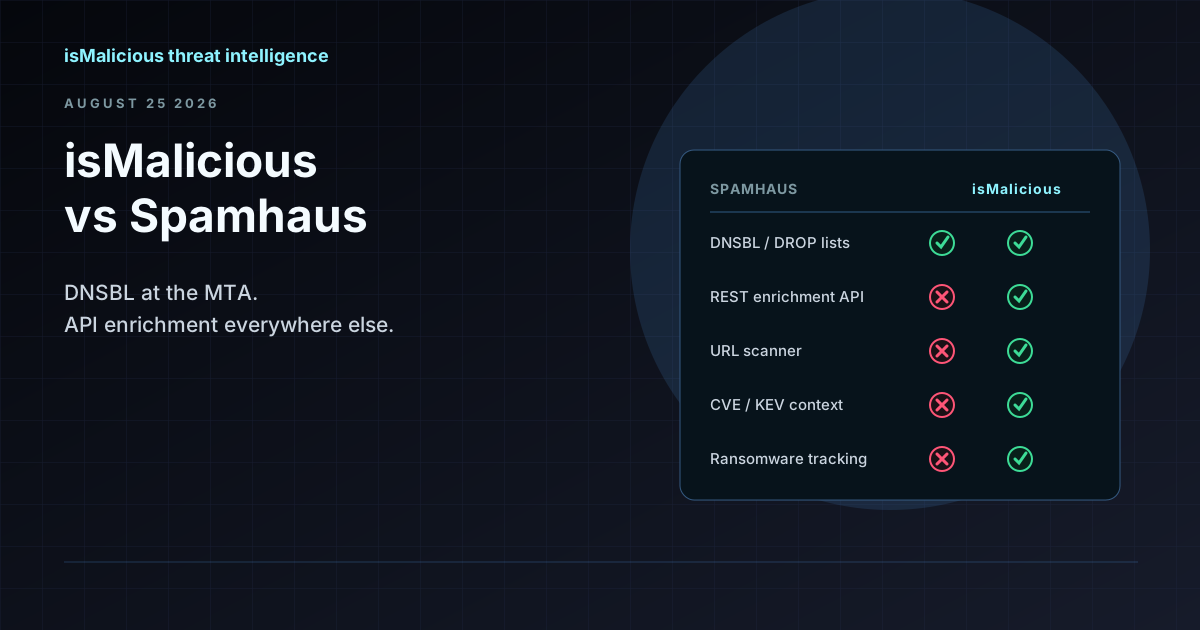 isMalicious vs Spamhaus: DNSBL Blocklists and Threat Enrichment Serve Different Layers
Spamhaus DROP and SBL are the standard for mail and network DNSBL blocking. isMalicious adds REST enrichment, URL scoring, CVE context, and STIX feeds. Most mature stacks use both at different layers.
 Domain Shadowing: Detect Compromised DNS at Scale
Detect domain shadowing by monitoring DNS changes, certificate issuance, subdomain behavior, account security, and infrastructure relationships.
 DGA Detection: Find Algorithmically Generated Domains
Detect domain generation algorithms with lexical, DNS, endpoint, and reputation signals while controlling false positives in production.
Protect Your Infrastructure
Check any IP or domain against our threat intelligence database with indexed records.
Try the IP / Domain Checker