Domain Shadowing: Detect Compromised DNS at Scale
Detect domain shadowing by monitoring DNS changes, certificate issuance, subdomain behavior, account security, and infrastructure relationships.
 IsMalicious Team
Most phishing guidance focuses on newly registered domains. Domain shadowing takes the opposite route: an attacker compromises a legitimate domain account and creates malicious subdomains underneath a trusted parent.
The parent’s age and reputation can help the attacker bypass controls. Defenders must therefore score the complete hostname and its recent behavior, not inherit trust from the registrable domain.
How Domain Shadowing Works
An attacker obtains access to a registrar, DNS provider, hosting panel or delegated account. They add many subdomains, often with automated names, and point them to redirectors, phishing pages, exploit delivery or command-and-control infrastructure.
This behavior aligns with the broader MITRE ATT&CK concept of compromised domain infrastructure. Common properties include:
- an old parent domain with very new subdomains;
- DNS answers outside the owner’s normal providers;
- rapid record changes or short TTLs;
- unauthorized certificate issuance;
- multi-stage redirects to a final malicious page;
- dozens of sibling hosts created in a short window.
One compromise can support multiple campaigns, so treating each subdomain as an isolated IOC wastes valuable context.
Detection From the Domain Owner’s View
Enable strong, phishing-resistant authentication on registrar and DNS accounts. Restrict API tokens, separate production zones, log every change and alert on new records, nameserver changes and credential creation.
Maintain an inventory that maps each hostname to an owner, environment and purpose. Diff the live zone against infrastructure-as-code or another known-good source. Monitor Certificate Transparency for unexpected names.
High-priority owner alerts include:
- many records created by one identity;
- changes from a new country, ASN or device;
- records pointing outside approved infrastructure;
- disabled DNSSEC, registry lock or audit settings;
- a new API key followed immediately by zone changes.
Detection From the Defender’s View
Security teams investigating external traffic may not own the parent domain. Evaluate the full FQDN:
- identify first-seen time for the subdomain;
- compare its IP and ASN with sibling hosts;
- inspect historical DNS changes;
- review certificate issuance and redirect chains;
- search for other subdomains with similar labels or paths;
- correlate email, proxy and endpoint sightings.
Use the subdomain finder, DNS history and URL scanner. Parent-domain reputation is context, never a reason to skip full-host analysis.
Build a Shadowing Score
Useful features include subdomain age, sibling creation velocity, lexical randomness, TTL, provider deviation, certificate timing, redirect depth and page similarity. Add internal prevalence: a hostname queried by one mailbox immediately after a phishing message has different risk from a widely used SaaS host.
Avoid overfitting to random labels. Marketing platforms and customer-isolation systems legitimately create many subdomains. Verified ownership and a stable infrastructure pattern reduce risk.
Incident Response for the Domain Owner
Treat the DNS account as compromised until disproved:
- revoke sessions, rotate passwords and API tokens;
- enforce phishing-resistant MFA;
- remove unauthorized records and certificates;
- review nameservers, DS records, contacts and recovery methods;
- preserve provider logs and identify the initial access path;
- monitor for re-creation and related domains.
Coordinate blocking and abuse reporting, but avoid taking the parent domain offline unless the blast radius is understood. A precise hostname block may protect users while the zone is repaired.
Metrics
Track unknown subdomains, time from record creation to alert, changes without an owner, malicious siblings discovered per incident and time to secure the DNS account. For external monitoring, measure how often full-host analysis changes a benign parent-domain verdict.
Conclusion
Domain shadowing exploits inherited trust. Defeat it with change auditing, certificate monitoring, full-host reputation and sibling analysis. Combine contextual threat intelligence with rigorous DNS account security so an old domain cannot silently become new attacker infrastructure.
Frequently asked questions
- What is domain shadowing?
- Domain shadowing occurs when an attacker compromises a legitimate domain or DNS account and creates unauthorized subdomains for phishing, redirects, malware delivery, or command and control.
- Why can domain reputation miss shadowed subdomains?
- The parent domain may be old and trusted. Detection must evaluate the full hostname, recent DNS changes, hosting, certificate issuance, path behavior, and account audit events.
- What is the first response to domain shadowing?
- Secure the registrar and DNS accounts, revoke unauthorized access, remove malicious records, review all zone changes, preserve logs, and block the malicious hostnames while monitoring for replacements.
Related articles
 DGA Detection: Find Algorithmically Generated Domains
Detect domain generation algorithms with lexical, DNS, endpoint, and reputation signals while controlling false positives in production.
 Fast-Flux DNS: Detect Rotating Attack Infrastructure
Learn how to detect fast-flux DNS using TTL, passive DNS, ASN diversity, reputation signals, and a repeatable SOC investigation workflow.
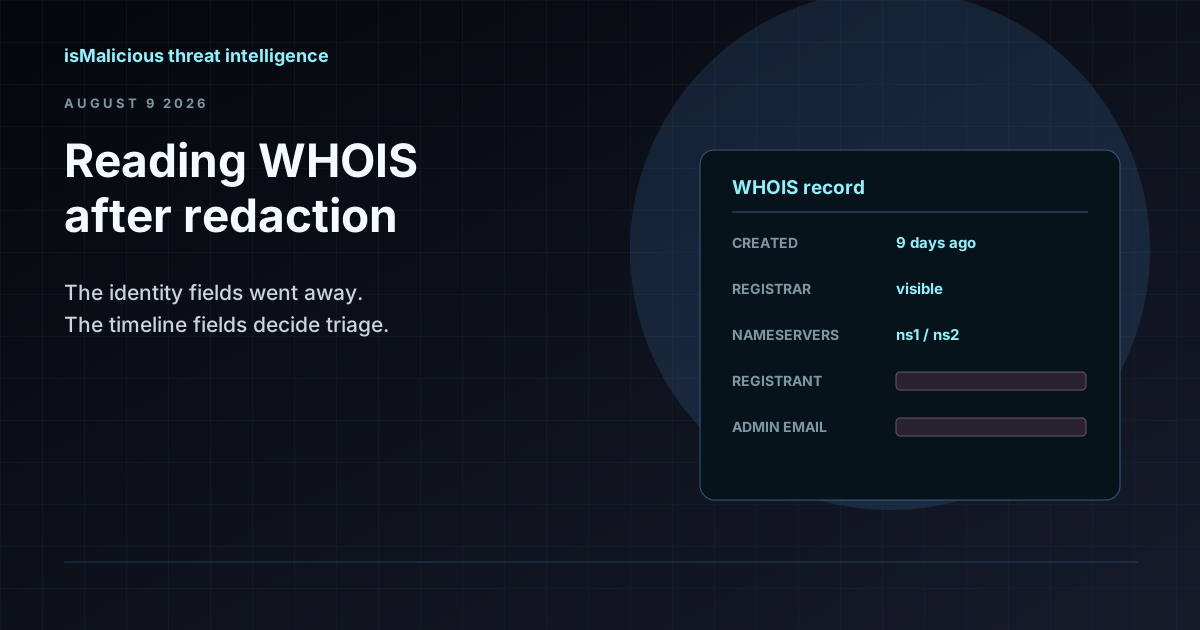 WHOIS Lookup for Security Investigations: Reading a Record After Redaction
Privacy services stripped the registrant name out of most WHOIS records, but the fields that matter for triage survived. Here is what a WHOIS record still tells an analyst, and how to read it.
Protect Your Infrastructure
Check any IP or domain against our threat intelligence database with indexed records.
Try the IP / Domain Checker