Contextual Threat Intelligence: Moving Beyond Static Blacklists
Static IP blacklists are no longer enough. Discover the power of contextual threat intelligence—connecting IPs, domains, and behavior to see the full attack picture.


For years, the standard defense against malicious traffic was the blacklist. If an IP was bad, it went on a list. Firewalls downloaded the list and blocked the IP. Simple.
But today's threat landscape is too dynamic for static lists. IPs rotate, legitimate sites get compromised, and attackers use residential proxies to hide in plain sight. To stay ahead, analysts need Contextual Threat Intelligence.
The Problem with Binary Decisions
A binary "Good/Bad" decision fails because it lacks nuance.
- Shared Hosting: An IP might host 100 legitimate websites and 1 phishing site. Blocking the IP blocks everyone.
- Compromised Devices: A residential IP might be part of a botnet today but clean tomorrow after the user runs an antivirus scan.
- Ephemeral Infrastructure: Cloud IPs change hands in minutes. A blacklist updated daily is already obsolete.
What is Context?
Context answers the "Why?" and "How?" behind an indicator.
- Associated Domains: What domains are resolving to this IP right now? Are they high-risk?
- ASN/ISP: Is this IP belonging to a consumer ISP (Verizon, Comcast) or a cloud provider (AWS, DigitalOcean)? A login attempt from a cloud server is suspicious; a login from a residential IP is normal.
- Behavioral History: Has this IP been seen scanning ports? Brute-forcing SSH? Or just sending spam?
- Passive DNS: What used to be here?
The Graph Approach
Imagine threat intelligence not as a list, but as a graph.
- Node A: Malicious File Hash
- Node B: C2 Domain
- Node C: Hosting IP
By seeing the connections, you can pivot. "This file talks to this domain, which resolves to this IP." Now you can block the IP proactively, even if it hasn't attacked you yet.
Using isMalicious for Context
isMalicious doesn't just give you a "Yes/No." It provides the metadata you need to make intelligent decisions.
- Confidence Scores: How sure are we?
- Threat Types: Is it a scanner? A bot? A phisher?
- Geolocation: Does it match your user's expected profile?
Conclusion
Stop playing whack-a-mole with static blacklists. Embrace contextual intelligence to understand the nature of the threat, not just its address. This reduces false positives and catches sophisticated attacks that slip through simple filters.
Related articles
 Government Threat Intelligence Procurement: A Practical Guide
Specify a public-sector threat intelligence service with clear evidence, data-handling rules, acceptance tests and an exit plan for UK and European teams.
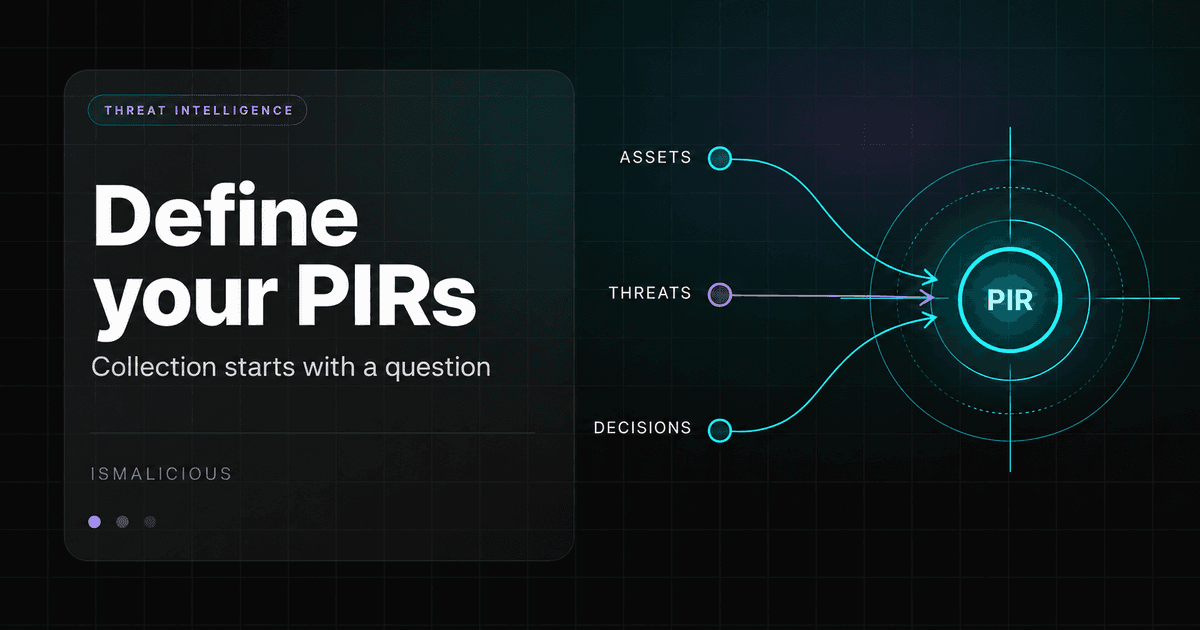 Threat Intelligence PIRs: A Workbook and Collection Plan
Turn threat intelligence requests into useful PIRs with a decision worksheet, collection plan, evidence requirements, ownership, and practical stopping rules.
 IPv6 Threat Intelligence: Reputation Beyond IPv4
Build IPv6 threat intelligence with correct normalization, prefix context, dual-stack logging, enrichment, and reputation decisions that avoid overblocking.
Protect Your Infrastructure
Check any IP or domain against our threat intelligence database with indexed records.
Try the IP / Domain Checker