Ransomware Revenue Is Rising: Initial Access Brokers Make Threat Intelligence Urgent
Q1 2026 ransomware revenue reporting points to a mature access market. Defenders need ransomware intelligence, domain monitoring, blocklists, and API enrichment before encryption begins.
 IsMalicious Team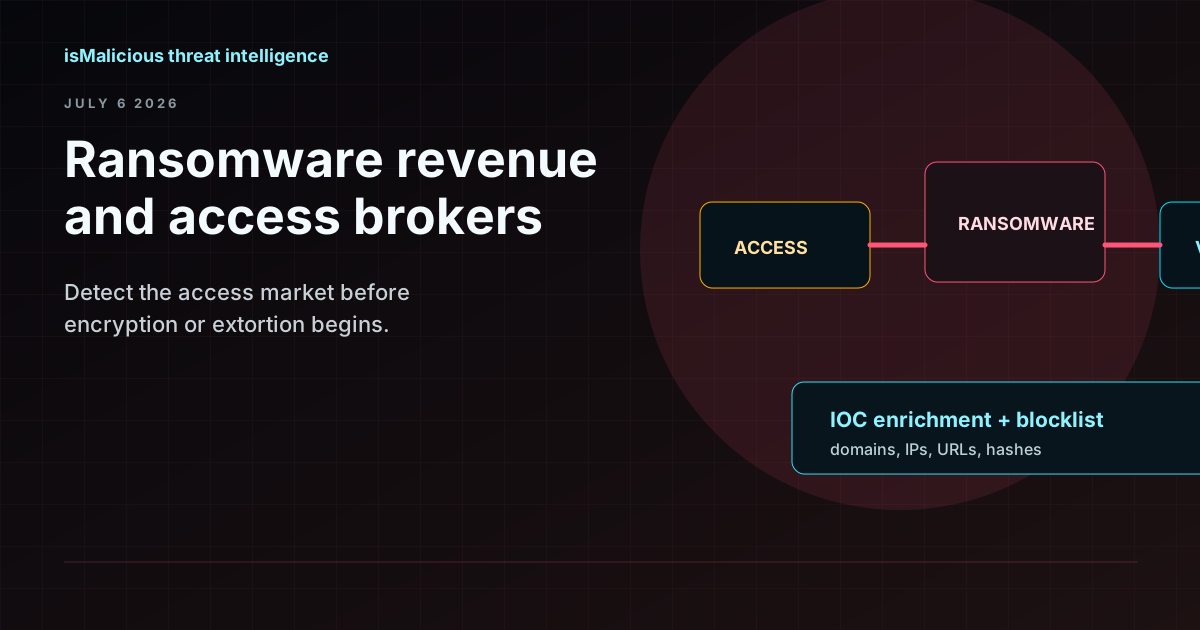
Ransomware is not just malware. It is a market. Reporting on Rapid7 research, TechRadar said ransomware groups saw a sharp Q1 2026 revenue increase, with initial access brokers playing an important role in the criminal supply chain. The exact revenue number matters less than the operational lesson: ransomware crews are buying access, outsourcing pieces of the attack, and recovering from disruption like a distributed business.
That changes how defenders should use threat intelligence. Waiting for an encryption binary is too late. The better window is before deployment: stolen credentials, suspicious remote access, phishing domains, exfiltration staging, commodity tooling, and command infrastructure.
Access Is The Product
Initial access brokers sell what ransomware operators need most: a way in. That access might be a VPN credential, RDP session, cloud admin token, web shell, exposed remote monitoring tool, SSO session, or compromised contractor account. Once access is sold, the buyer can move quickly to discovery, privilege escalation, lateral movement, data theft, and extortion.
That is why ransomware defense starts with access intelligence:
- domains used for credential harvesting;
- IPs tied to proxy, VPN, or brute-force abuse;
- URLs used in fake login flows;
- infostealer logs exposing corporate accounts;
- file hashes for loaders and remote access tools;
- DNS and certificate links between campaigns.
Use a domain reputation check, IP reputation lookup, and URL scanner as early triage tools. If the same infrastructure touches multiple users, promote it from alert to campaign.
Ransomware Intelligence Must Include Pre-Encryption Signals
Traditional ransomware playbooks focus on encryption events, ransom notes, and recovery. Modern extortion often begins earlier. Data theft may happen before encryption, and some groups may skip encryption entirely if data pressure is enough.
Useful ransomware intelligence includes:
- actor names and confidence levels;
- common initial access methods;
- sectors and regions targeted;
- leak-site and extortion patterns;
- infrastructure and tooling;
- data staging behavior;
- known affiliates and access broker overlap.
This intelligence helps incident commanders decide whether a suspicious login is routine, credential theft, or a possible ransomware precursor.
Turn Indicators Into Controls
Indicators should move quickly from investigation to enforcement. Confirmed malicious domains, URLs, and IPs should feed blocklists, DNS filtering, proxy rules, firewall controls, and SIEM correlation. Use the isMalicious API to automate repetitive enrichment instead of asking analysts to check each observable by hand.
The workflow is straightforward:
- collect observables from alerts and logs;
- enrich IPs, domains, URLs, and hashes;
- preserve source confidence and freshness;
- add confirmed indicators to blocklists;
- open an incident when indicators match privileged access, data staging, or lateral movement;
- document all enrichment in the case.
Board Metrics Should Track Access Risk
Executives often ask whether ransomware backups are ready. That is important, but it is only one part of resilience. The more useful board-level metrics track whether the organization is reducing the access paths ransomware crews buy:
- percentage of exposed remote access services with MFA;
- number of high-risk credentials found in stealer logs;
- time to disable suspicious VPN or SSO sessions;
- number of confirmed malicious domains blocked;
- time from indicator discovery to control update;
- ransomware-related incidents closed before encryption.
These metrics make ransomware readiness measurable before the ransom note appears. They also force alignment between identity, network, endpoint, cloud, and SOC teams.
Using These Signals Today
With isMalicious, that means connecting SOC workflows, SIEM enrichment, incident response, and ransomware data. Ransomware operators have industrialized access. Defenders need to industrialize enrichment and blocking.
Operational CTA
Monitor domains, URLs, IPs, and file hashes tied to access broker behavior. Review API Docs, connect enrichment to your SIEM/SOAR, and use blocklists to move confirmed ransomware infrastructure from intelligence to prevention.
Frequently asked questions
- Why do initial access brokers matter to ransomware defense?
- Initial access brokers sell footholds, credentials, VPN access, and cloud sessions. That lets ransomware operators skip the hardest entry step and focus on extortion.
- What indicators should teams monitor before ransomware deployment?
- Monitor suspicious VPN logins, phishing domains, remote access tools, credential-theft infrastructure, anomalous DNS, new admin activity, and outbound staging or exfiltration destinations.
- How does ransomware intelligence differ from generic malware intelligence?
- Ransomware intelligence must include actor behavior, access patterns, extortion infrastructure, leak-site activity, victimology, and pre-encryption signals, not only payload hashes.
- How does isMalicious support ransomware readiness?
- isMalicious provides ransomware data, IP and domain enrichment, URL scanning, file hash checks, blocklists, and API workflows for SOC and incident response teams.
Related articles
 Mobile Smishing Defense: URL Scanners And Domain Reputation For July 2026
Mobile phishing keeps gaining operational relevance. Security teams need URL scanning, domain reputation checks, DNS pivots, and employee reporting workflows built for SMS and chat.
 BlueHammer Defender Exploitation: July 2026 Patch SLA For Windows Fleets
BlueHammer coverage shows why endpoint patching, CISA KEV context, CVE Watch, and IOC enrichment have to work together when local privilege escalation becomes ransomware tradecraft.
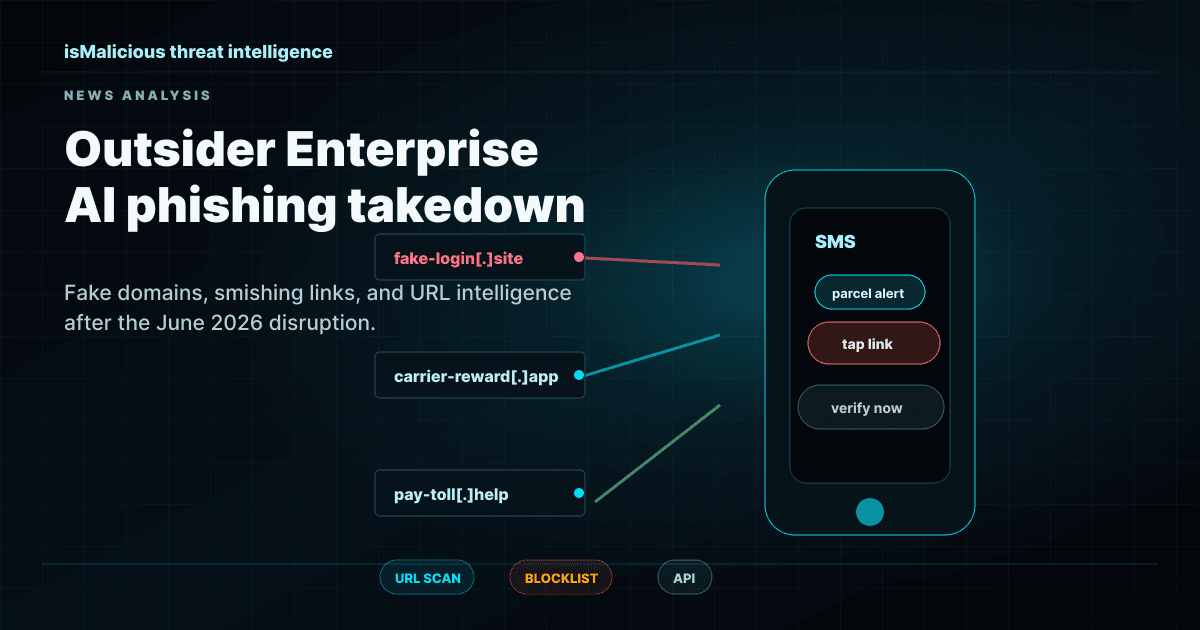 Outsider Enterprise Takedown: AI Phishing Infrastructure Is Now A Domain Reputation Problem
The FBI, Google, and Black Lotus Labs disruption of Outsider Enterprise shows why AI phishing defense needs URL scanning, domain reputation checks, blocklists, and fast API enrichment.
Protect Your Infrastructure
Check any IP or domain against our threat intelligence database with indexed records.
Try the IP / Domain Checker