Outsider Enterprise Takedown: AI Phishing Infrastructure Is Now A Domain Reputation Problem
The FBI, Google, and Black Lotus Labs disruption of Outsider Enterprise shows why AI phishing defense needs URL scanning, domain reputation checks, blocklists, and fast API enrichment.
 IsMalicious Team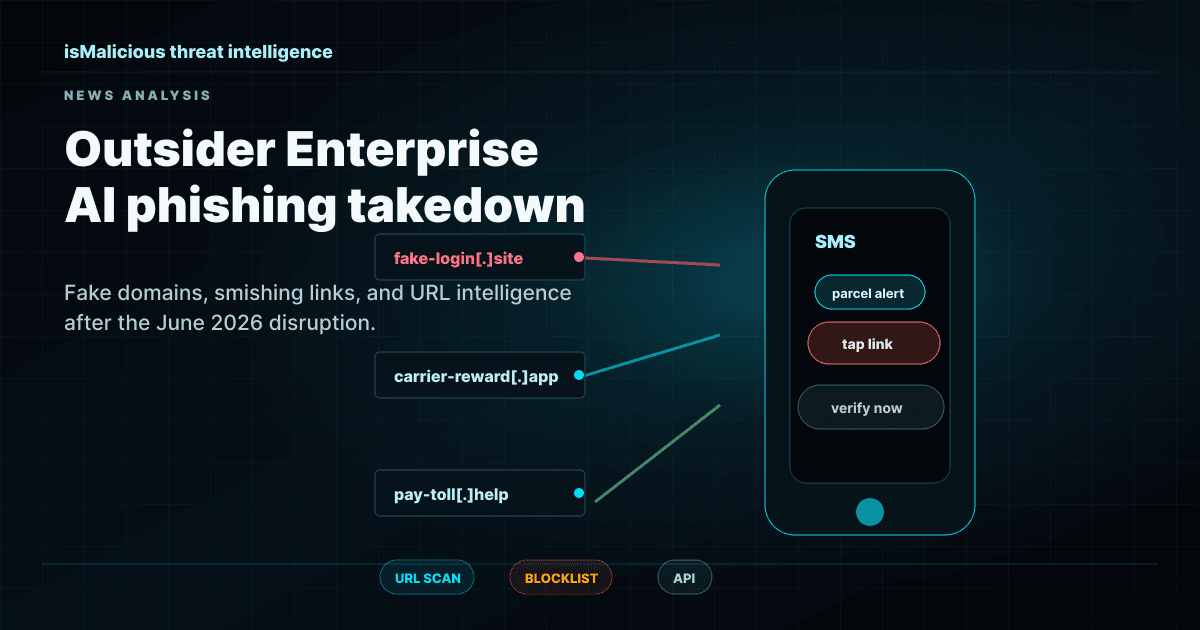
The June 2026 disruption of Outsider Enterprise is a useful warning for every security team that still treats phishing as mainly a training problem. According to BleepingComputer, the FBI worked with Google and Lumen's Black Lotus Labs to disrupt a Chinese phishing-as-a-service operation tied to thousands of fake sites and a very large URL footprint. TechCrunch reported that Google accused the group of using AI in campaigns that impersonated trusted brands and pushed scam texts at scale.
The important lesson is not simply that criminals are using AI. The more practical lesson is that AI makes the content layer cheaper while the infrastructure layer remains observable. A phishing page can be generated faster, localized better, and varied more often, but the campaign still needs domains, URLs, DNS, certificates, redirects, hosting, and collection endpoints. Those are the signals a domain reputation check, URL scanner, DNS history lookup, and threat intelligence API can turn into workflow.
For isMalicious users, this is exactly the kind of incident that argues for automation. Analysts should not have to manually decide whether each text-message link deserves attention. A security program needs a repeatable pipeline that receives a suspicious URL, expands the surrounding infrastructure, scores the domain, checks blocklist evidence, and pushes the result into SIEM, SOAR, email security, help desk, and incident response queues.
Why This Takedown Matters For Defenders
Phishing kits used to feel small and disposable: one fake login page, one compromised host, one short campaign. Outsider Enterprise shows a different model. The modern kit is a service business. It can include templates, payment flows, message distribution, dashboards, automation, and infrastructure reuse. That makes it easier for lower-skill criminals to launch high-volume campaigns.
AI adds another force multiplier. It can generate cleaner copy, translate lures, adapt brand language, and produce variations that avoid exact-match filters. But that does not remove the need for infrastructure. Every campaign leaves some trail:
- newly registered or newly repurposed domains;
- URL paths that imitate brands, shipping firms, banks, telecoms, or government portals;
- certificate issuance patterns;
- hosting clusters and autonomous systems;
- redirect chains;
- payment collection pages;
- repeated HTML resources and page structures;
- inbound reports from users, gateways, and mobile devices.
Security awareness training still matters, but it cannot be the control of last resort. A user should not have to perfectly spot every AI-polished scam. The organization should be able to check a URL before it causes damage, enrich it after it is reported, and block related infrastructure once the campaign is confirmed.
AI Phishing Is Still A URL Scanner Problem
The phrase "AI phishing" can make the issue sound abstract. In practice, most investigations start with a string: a URL in an SMS, email, chat message, QR code, browser history item, proxy event, or user report. That string is the fastest path to evidence.
A good URL scanner should answer questions that content analysis alone cannot:
- Does the URL redirect through suspicious infrastructure?
- Is the final domain newly registered or already known for abuse?
- Does the host share certificates or DNS history with other suspicious domains?
- Has the IP been associated with phishing, malware, proxy abuse, or spam?
- Is the page collecting credentials or payment data?
- Does the URL appear on blocklists or internal deny lists?
- Are there related domains that should be blocked before users click them?
This is where isMalicious helps SOC teams avoid the one-link-at-a-time trap. A single reported lure can become a cluster of related indicators. The analyst can check the domain, scan the URL, pivot through DNS history, enrich the hosting IP, and feed confirmed indicators into a blocklist or case workflow.
Domain Reputation Beats Copywriting Clues
Many legacy anti-phishing programs taught users to look for bad grammar, awkward branding, and low-quality page design. That advice is weaker now. AI can produce convincing text, and phishing kits can clone front-end design quickly. Domain and infrastructure context is harder to fake at scale.
Useful domain reputation signals include:
- domain age and first-seen date;
- recent DNS changes;
- registrar and nameserver patterns;
- certificate transparency records;
- hosting reputation;
- lookalike distance from protected brands;
- passive DNS relationships;
- blocklist hits and source diversity;
- prior malicious activity tied to the same infrastructure.
The best signal is rarely one field. A two-day-old domain on bulletproof hosting with a payment-themed path and a redirect chain deserves a different triage path than a long-lived corporate domain with a benign history. The isMalicious data quality model is built around this idea: verdicts should be explainable, source-backed, and fresh enough for operations.
What A SOC Playbook Should Do
When a suspicious SMS or email link arrives, the SOC playbook should be short and repeatable:
- Normalize the observable. Extract the full URL, domain, subdomain, redirector, and visible brand claim.
- Run a malicious domain checker and URL scan.
- Enrich the IP and hosting context with IP threat intelligence.
- Pivot through DNS history and certificate reuse.
- Compare against internal and external blocklists.
- Decide action: allow, monitor, block, notify, or escalate.
- Send confirmed indicators to SIEM/SOAR using the API docs.
This playbook should be wired to the places where phishing appears: email security tools, browser reports, Slack or Teams security channels, ticketing queues, EDR telemetry, web gateways, and mobile threat defense platforms. The goal is not to make every analyst faster by willpower. The goal is to move repetitive enrichment out of the analyst's head and into a reliable pipeline.
Why Blocklists Still Matter After A Takedown
Takedowns are important, but they do not make every related risk disappear. Some infrastructure may remain live. Copycat operators may reuse templates. Victim data may already be sold. Adjacent domains may be registered before defenders learn about the campaign. And criminals can relaunch under a new brand or provider.
That means defenders should treat a takedown as a starting point for cleanup:
- identify domains and URLs already seen in your environment;
- block confirmed indicators;
- monitor for lookalike re-registrations;
- review user clicks and credential submissions;
- reset affected credentials;
- watch payment and account-takeover signals;
- document the case for future detection engineering.
The isMalicious blocklist and API can support this loop by moving indicators from investigation to enforcement. A URL that is confirmed malicious should not remain trapped in a ticket comment. It should become a control signal.
The SEO Reality: Users Search For Checkers During Incidents
During a live phishing wave, defenders, IT staff, fraud teams, and even executives search for practical tools. They type queries like "malicious domain checker," "domain reputation check," "URL scanner," and "is this link malicious." That search behavior reflects the operational moment: someone has a link and needs a decision.
Product-led content should meet that need without pretending the product is magic. The answer is a workflow:
- try the IP / Domain Checker;
- scan suspicious URLs with the URL scanner;
- review source confidence in data quality;
- connect enrichment to your SIEM/SOAR;
- use the threat intelligence API for repetitive cases.
This is how a news story becomes operational SEO. The article explains the trend, gives defenders a process, and points to the relevant tools at the moment they need them.
What To Monitor Next
Outsider Enterprise should push teams to monitor phishing infrastructure in a more continuous way. Watch for brand lookalikes, payment-themed paths, fake shipping and toll messages, new domains using trusted logos, and high-volume SMS reports. If your organization is a frequently impersonated brand, monitor domains, URLs, and certificates before users start reporting links.
The key shift is simple: AI may change how phishing content is produced, but defenders can still win on infrastructure evidence. Fast enrichment, source-backed verdicts, and automated blocklist updates turn a suspicious link into a security decision.
Conclusion
The Outsider Enterprise takedown is not just another phishing headline. It is a preview of how AI-assisted fraud services will scale: cleaner lures, more variants, and more outsourced infrastructure. Defenders should respond with the same kind of scale. Use domain reputation, URL scanning, DNS pivots, blocklists, and API enrichment to turn scattered user reports into fast, evidence-based action.
Frequently asked questions
- What was Outsider Enterprise?
- Outsider Enterprise was reported as a phishing-as-a-service operation that used AI-assisted tooling, fake websites, and SMS lures to steal credentials and payment data at scale.
- Why does AI phishing still depend on domain intelligence?
- Even polished AI-generated phishing pages need domains, URLs, redirects, DNS, hosting, certificates, and infrastructure. Those observables can be scanned, enriched, clustered, and blocked.
- How can SOC teams react faster to phishing kits?
- SOC teams should enrich reported URLs, inspect domain reputation, pivot through DNS and certificate history, push confirmed indicators into blocklists, and automate those steps with an API.
- How does isMalicious help with phishing infrastructure?
- isMalicious provides domain reputation checks, URL scanning, DNS history, blocklist intelligence, and API enrichment so analysts can move from suspicious link to action quickly.
Related articles
 SSO Vishing And SaaS Data Theft: Domain Monitoring Before The Helpdesk Call
ShinyHunters-style SSO vishing shows how fake login domains, MFA enrollment abuse, and SaaS access can become data theft. Domain monitoring gives defenders early warning.
 Mobile Smishing Defense: URL Scanners And Domain Reputation For July 2026
Mobile phishing keeps gaining operational relevance. Security teams need URL scanning, domain reputation checks, DNS pivots, and employee reporting workflows built for SMS and chat.
 Ransomware Revenue Is Rising: Initial Access Brokers Make Threat Intelligence Urgent
Q1 2026 ransomware revenue reporting points to a mature access market. Defenders need ransomware intelligence, domain monitoring, blocklists, and API enrichment before encryption begins.
Protect Your Infrastructure
Check any IP or domain against our threat intelligence database with indexed records.
Try the IP / Domain Checker