BlueHammer Defender Exploitation: July 2026 Patch SLA For Windows Fleets
BlueHammer coverage shows why endpoint patching, CISA KEV context, CVE Watch, and IOC enrichment have to work together when local privilege escalation becomes ransomware tradecraft.
 IsMalicious Team
July 2026 starts with a familiar problem: a patched vulnerability is still dangerous because patch deployment is uneven. Recent coverage from TechRadar and Tom's Hardware framed BlueHammer as a Microsoft Defender issue that moved from disclosure into exploitation pressure. The detail that matters for defenders is not the nickname. It is the response pattern: local privilege escalation, public attention, slow patching, and ransomware operators looking for reliable post-compromise use.
Endpoint teams often triage local privilege escalation below remote code execution. That is reasonable when the bug is theoretical. It is risky when attackers already have many ways to land on a workstation: phishing, malicious ads, VPN credentials, helpdesk social engineering, remote monitoring tools, and infostealer logs. Once an attacker has user-level execution, a local privilege escalation can decide whether the incident remains contained or becomes a full host takeover.
When an exploit becomes operational, the useful question for security teams is how to turn that urgency into a repeatable workflow.
Start With Exposure, Not Headlines
The first step is asset scoping. A Defender or Windows endpoint vulnerability should be mapped against:
- Windows version and patch level;
- Defender engine and platform version;
- endpoint management coverage;
- unmanaged laptops and contractor devices;
- privileged user workstations;
- servers where Defender is enabled;
- locations with delayed reboot or maintenance windows.
Use CVE Watch to track the vulnerability, then separate assets into exposed, patched, exception, and unknown groups. Unknown endpoints should not quietly disappear from the response plan. They are often where incidents start.
Hunt For Post-Exploitation Evidence
Patching removes future risk. It does not prove the endpoint was never abused. SOC teams should look for activity that often follows local privilege escalation:
- new services or scheduled tasks;
- suspicious Defender exclusions;
- disabled security controls;
- credential dumping tools;
- unusual child processes from Office, browser, terminal, or scripting hosts;
- outbound connections to suspicious domains or IPs;
- ransomware staging, archive utilities, or lateral movement tools.
This is where IP threat intelligence, domain reputation checks, URL scanning, and file hash reputation become useful. A suspicious binary hash or outbound callback should be enriched inside the case, not pasted into a private spreadsheet.
Build A Patch SLA That Includes KEV
If a vulnerability enters the CISA Known Exploited Vulnerabilities catalog, the SLA should change. A simple model works:
- internet-facing exploitable service: immediate mitigation or emergency patch;
- exploited endpoint privilege escalation: accelerated patch plus hunting;
- public proof of concept: rapid exposure review and monitoring;
- high severity without exploitation: normal maintenance window with owner tracking.
The goal is not to panic every time a CVE trends. The goal is to reserve urgency for cases where exploitation evidence changes probability.
Connect Patch Data To SIEM And SOAR
Endpoint patching is usually owned by IT. Exploitation detection is usually owned by the SOC. BlueHammer-style incidents expose the gap between them. The SOC needs patch state in alert context; endpoint teams need threat context to justify faster rollout.
Use the isMalicious API and API docs to enrich observables from EDR, proxy, DNS, and SIEM alerts. Connect enrichment to SIEM workflows so analysts can see whether a source IP, command-and-control domain, or dropped file has known malicious context.
Operational CTA
If BlueHammer-style exploitation appears in your environment, do three things today: Explore CVE Watch, Try the IP / Domain Checker, and connect enrichment to your SOC workflow. A patch is necessary. Evidence-based triage is what keeps the patch window from becoming an incident window.
Frequently asked questions
- What is the practical risk of BlueHammer-style Defender exploitation?
- The operational risk is privilege escalation after initial access. If an attacker already has code execution on a Windows endpoint, a Defender bypass or local privilege escalation can turn a foothold into SYSTEM-level control.
- Should a local privilege escalation be treated as urgent?
- Yes when exploitation is public, confirmed, or tied to ransomware activity. Local bugs matter when phishing, VPN compromise, infostealers, or remote management abuse can provide the first foothold.
- How should SOC teams use CVE Watch for endpoint flaws?
- Map the CVE to managed endpoint versions, check KEV and public-exploit context, hunt for related post-exploitation behavior, and document patch coverage by business unit.
- How does isMalicious help during a BlueHammer-style response?
- isMalicious supports CVE Watch, IP and domain enrichment, file hash lookup, ransomware intelligence, and API workflows that connect endpoint findings to SOC triage.
Related articles
 When Vulnerability Exploitation Overtakes Credentials: CVE Prioritization In 2026
Verizon DBIR reporting highlights vulnerability exploitation as a top breach path. CVE Watch, KEV, EPSS, and exposure context help teams patch what attackers actually use.
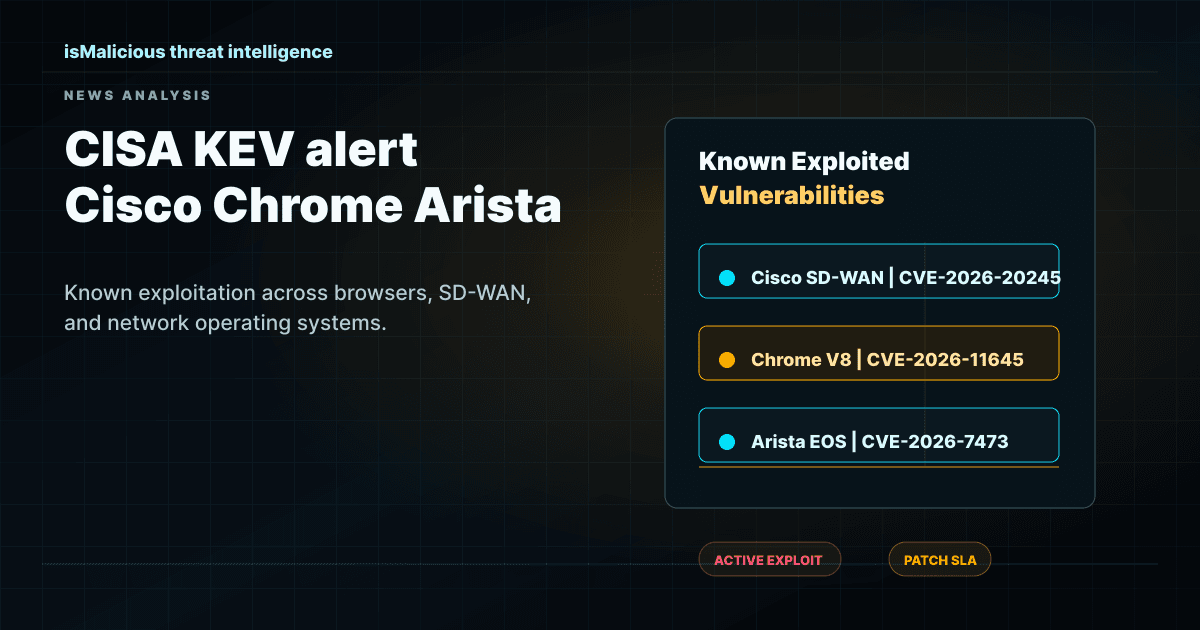 CISA KEV Adds Cisco, Chrome, And Arista Flaws: How To Prioritize Active Exploitation
CISA added Cisco SD-WAN, Google Chromium V8, and Arista EOS vulnerabilities to KEV in June 2026. Here is how SOC and vulnerability teams should turn that signal into action.
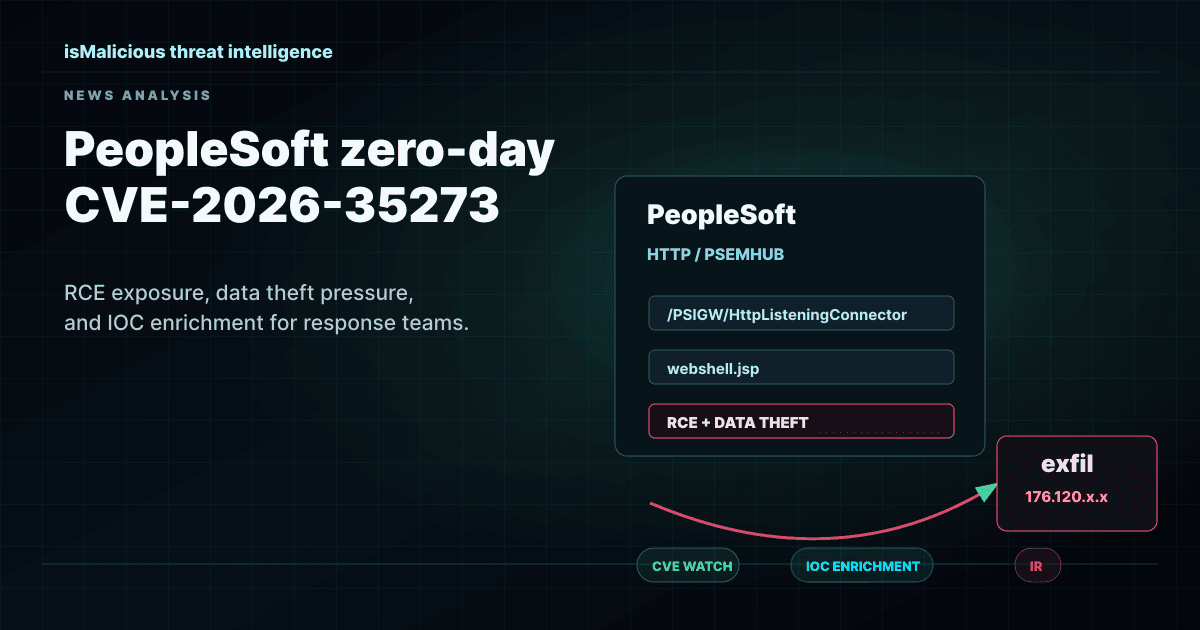 Oracle PeopleSoft Zero-Day: CVE-2026-35273 Shows Why CVE Watch Needs IOC Enrichment
The PeopleSoft CVE-2026-35273 exploitation reports show how vulnerability response, ransomware intelligence, IP enrichment, and incident response must work together.
Protect Your Infrastructure
Check any IP or domain against our threat intelligence database with indexed records.
Try the IP / Domain Checker