Microsoft June 2026 Patch Tuesday: Turning 206 Vulnerabilities Into A SOC Priority Queue
Microsoft patched 206 vulnerabilities in June 2026, including publicly disclosed zero-days. Security teams need CVE Watch, KEV context, exploit evidence, and enrichment to avoid patch fatigue.
 IsMalicious Team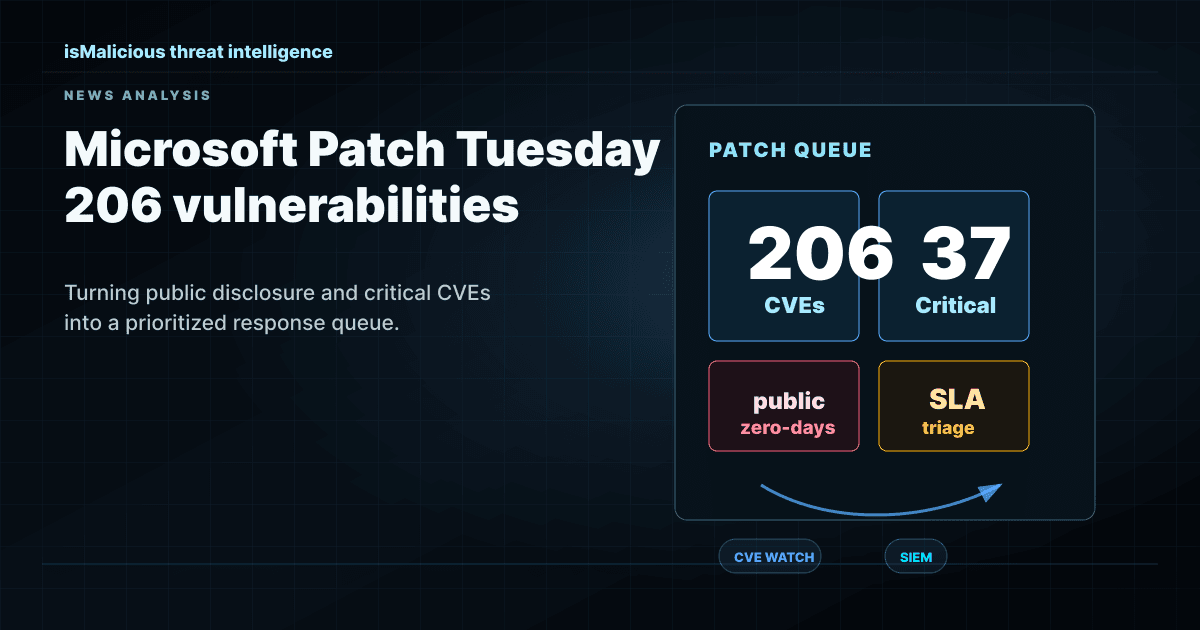
June 2026 Patch Tuesday was a stress test for vulnerability operations. CrowdStrike reported that Microsoft addressed 206 vulnerabilities, including three publicly disclosed zero-days and 37 Critical issues. KrebsOnSecurity described the release as a record-breaking Patch Tuesday and noted the growing pressure that high patch volumes place on defenders.
For a SOC or vulnerability team, a number like 206 is not a plan. It is a workload. The practical question is how to turn a flood of CVEs into a priority queue that asset owners can actually execute. That requires more than CVSS. Teams need exposure, exploit evidence, public disclosure context, affected product mapping, business criticality, and post-exploitation indicators.
This is where isMalicious CVE Watch becomes useful. A Patch Tuesday release should not create a spreadsheet that dies in email. It should create a monitored set of findings connected to assets, exploit signals, owners, remediation status, and SOC enrichment.
Patch Volume Is Now A Security Signal
Large patch releases are not new, but the volume trend matters. A heavy Microsoft month touches endpoints, servers, Office, identity-adjacent components, browsers, drivers, Windows internals, and enterprise workflows. When dozens of fixes are marked Critical and several issues are publicly disclosed, teams can quickly fall into two bad modes:
- treating every CVE as equally urgent and exhausting the organization;
- treating the whole release as routine and missing the few issues that matter most.
Neither works. The right answer is risk-based triage with a bias toward exploitation evidence.
A good first-pass priority model asks:
- Is the affected product present?
- Is it internet-facing or reachable by untrusted users?
- Is exploitation known, likely, or publicly discussed?
- Is the flaw remotely exploitable or useful after initial access?
- Does it affect identity, encryption, management, or privilege boundaries?
- Does the business depend on the affected system?
- Can the patch be applied safely, and what temporary controls exist?
Public Disclosure Changes The Clock
CrowdStrike highlighted multiple publicly disclosed issues in the June 2026 release, including a BitLocker security feature bypass tracked as CVE-2026-50507 and a CTFMON elevation-of-privilege issue tracked as CVE-2026-45586. Public disclosure does not always mean active exploitation, but it can compress attacker research time.
The operational response should be:
- identify exposed or high-value assets affected by the disclosed issues;
- confirm whether exploit code, technical writeups, or proof-of-concept details exist;
- check whether CISA KEV, vendor advisories, or trusted researchers report exploitation;
- increase monitoring during the vulnerable window;
- document patch status and exceptions.
The earlier YellowKey BitLocker analysis is relevant here because stolen-device protection assumptions are fragile. A BitLocker bypass is not the same as remote code execution, but it can matter deeply for asset-loss response, laptop theft, executive devices, and forensic assumptions.
Critical Does Not Always Mean First
Critical severity deserves attention, but "Critical" is too broad for scheduling. A Critical RCE on an exposed server may deserve immediate remediation. A Critical issue in a feature not deployed may be lower priority. A high-severity privilege escalation on systems with active exploitation may outrank a theoretical Critical bug in practice.
For Patch Tuesday, build priority from layered signals:
- Presence: the product and version exist in inventory.
- Exposure: the vulnerable path is reachable.
- Exploitability: attacker requirements are low.
- Exploitation: KEV, vendor, or trusted reports confirm activity.
- Disclosure: public technical details are available.
- Business impact: the system supports identity, revenue, regulated data, or operations.
- Mitigation: compensating controls can reduce risk before full patching.
The isMalicious CVE Watch workflow helps attach these signals to findings instead of leaving them as side conversations.
SOC Enrichment During Patch Windows
Patch Tuesday is not only for IT operations. It is also a hunting window for the SOC. Attackers often test recently disclosed vulnerabilities, scan for unpatched systems, and reuse commodity infrastructure.
SOC teams should enrich:
- scanner IPs hitting newly relevant services;
- domains and URLs from exploitation attempts or phishing lures;
- hashes for payloads delivered after exploitation;
- outbound callbacks from systems under investigation;
- suspicious authentication attempts after an initial exploit path.
Use IP threat intelligence, domain intelligence, URL scanning, and file hash analysis to separate routine scanning from stronger evidence. Then connect the results into SIEM workflows so enrichment appears in alerts and cases.
Why API Automation Matters
A 206-CVE release cannot be handled with manual browser tabs alone. The organization needs automation for repetitive enrichment and evidence collection.
The isMalicious API can support Patch Tuesday operations by:
- enriching observables from SIEM alerts;
- checking suspicious domains and URLs linked to exploit attempts;
- validating IP reputation for scanning sources;
- enriching file hashes from EDR detections;
- adding source-backed verdicts to SOAR playbooks;
- feeding block decisions into firewall or proxy workflows.
The API docs are the practical next step for teams that want CVE and IOC intelligence connected to their own systems.
Communicating Patch Tuesday Without Noise
Security leaders should avoid forwarding giant vendor lists without interpretation. A better executive summary includes:
- total Microsoft volume for the month;
- number of Critical and publicly disclosed issues;
- top affected product groups in the environment;
- highest-priority CVEs based on exposure and exploitation signals;
- patch coverage target dates;
- exceptions with compensating controls;
- SOC hunting status.
This turns "Microsoft released 206 fixes" into "these are the systems we must remediate first, these are being monitored, and these are the owners."
Build A Reusable Patch Tuesday Workflow
Every Patch Tuesday should follow the same structure:
- Import vendor advisories and CVEs.
- Match products to asset inventory.
- Apply exploit evidence and KEV context.
- Rank by exposure and business impact.
- Assign remediation owners.
- Push observables to SOC hunting.
- Track exceptions and compensating controls.
- Report closure with evidence.
The point is not to make June 2026 a one-off heroic sprint. The point is to improve the system so the next high-volume month is easier to manage.
Conclusion
Microsoft's June 2026 Patch Tuesday shows why vulnerability operations need prioritization, not just volume. Use CVE Watch to connect vulnerabilities to assets and exploit signals. Use threat intelligence enrichment to investigate activity during the patch window. Use SIEM/SOAR automation to keep analysts out of repetitive lookup work. When the patch list gets huge, the quality of the priority queue becomes the control.
Frequently asked questions
- How many vulnerabilities did Microsoft address in June 2026?
- CrowdStrike reported that Microsoft addressed 206 vulnerabilities in the June 2026 Patch Tuesday release, including three publicly disclosed zero-days and 37 Critical issues.
- Why is a large Patch Tuesday hard for SOC teams?
- A large patch release creates triage pressure. Teams must separate exposed, exploited, and business-critical issues from lower-risk backlog items.
- How should teams prioritize Patch Tuesday CVEs?
- Prioritize by affected assets, exposure, exploitability, public disclosure, KEV status, available patches, business criticality, and evidence from logs or threat intelligence.
- How does isMalicious help with Patch Tuesday?
- isMalicious CVE Watch tracks relevant CVEs and exploit signals, while the API enriches observables seen during exploitation attempts or post-patch hunting.
Related articles
 When Vulnerability Exploitation Overtakes Credentials: CVE Prioritization In 2026
Verizon DBIR reporting highlights vulnerability exploitation as a top breach path. CVE Watch, KEV, EPSS, and exposure context help teams patch what attackers actually use.
 BlueHammer Defender Exploitation: July 2026 Patch SLA For Windows Fleets
BlueHammer coverage shows why endpoint patching, CISA KEV context, CVE Watch, and IOC enrichment have to work together when local privilege escalation becomes ransomware tradecraft.
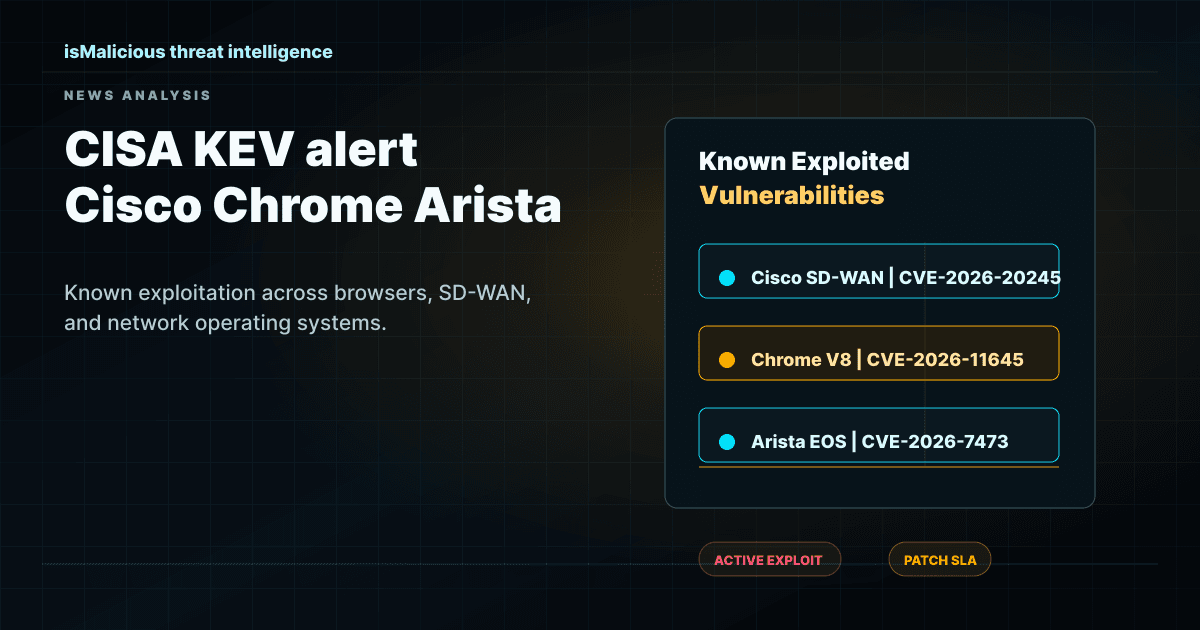 CISA KEV Adds Cisco, Chrome, And Arista Flaws: How To Prioritize Active Exploitation
CISA added Cisco SD-WAN, Google Chromium V8, and Arista EOS vulnerabilities to KEV in June 2026. Here is how SOC and vulnerability teams should turn that signal into action.
Protect Your Infrastructure
Check any IP or domain against our threat intelligence database with indexed records.
Try the IP / Domain Checker