CISA KEV Adds Cisco, Chrome, And Arista Flaws: How To Prioritize Active Exploitation
CISA added Cisco SD-WAN, Google Chromium V8, and Arista EOS vulnerabilities to KEV in June 2026. Here is how SOC and vulnerability teams should turn that signal into action.
 IsMalicious Team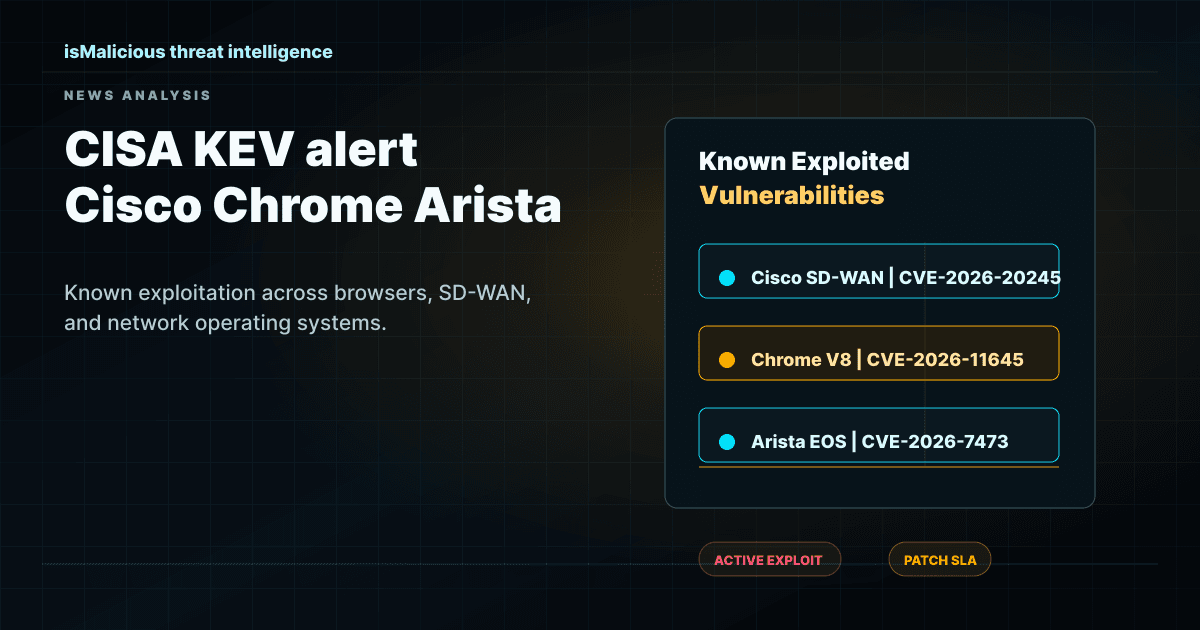
On June 9, 2026, CISA added three known exploited vulnerabilities to the KEV catalog: CVE-2026-20245 for Cisco Catalyst SD-WAN Manager, CVE-2026-11645 for Google Chromium V8, and CVE-2026-7473 for Arista EOS. The cluster matters because it spans three very different layers of enterprise risk: network management, user browsers, and network operating systems.
That mix is exactly why KEV-aware vulnerability management needs context. A browser zero-day, a network management command execution flaw, and a switch tunnel behavior issue do not use the same response path. But they share one essential property: CISA has evidence of exploitation. For teams using CVE Watch, that should raise the issue from backlog noise to operational triage.
BleepingComputer reported that Google patched CVE-2026-11645, a high-severity V8 issue exploited in the wild. The Hacker News summarized the CISA additions and the affected technologies. The operational question now is not "are these severe?" It is "where are we exposed, and what evidence should we hunt for?"
KEV Is A Decision Signal
Many vulnerability programs still begin and end with CVSS. That is understandable, but incomplete. CVSS describes severity characteristics. KEV adds a different dimension: confirmed exploitation. Once a CVE enters KEV, the organization should assume attackers know how to use it somewhere in the real world.
That does not mean every KEV item is equally urgent for every organization. It means every KEV item deserves fast scoping:
- Do we run the affected product?
- Is the vulnerable component exposed?
- Is exploitation possible against our configuration?
- Is a patch, mitigation, or upgrade available?
- Do we have logs that can show attempted exploitation?
- Are there related IOCs to enrich through IP, domain, URL, or file-hash intelligence?
This is the model behind CISA KEV and exploited vulnerability intelligence. KEV should change the SLA, but the final priority still depends on asset criticality and exposure.
Chrome CVE-2026-11645: Endpoint Coverage Is The First Metric
Browser zero-days are uncomfortable because the vulnerable surface is everywhere. Users browse the web, open links from email, click ads, and visit sites through chat, search, and mobile workflows. A Chrome V8 bug exploited through crafted HTML can become an initial-access path before the SOC sees a traditional perimeter event.
For CVE-2026-11645, vulnerability teams should measure:
- Chrome version coverage across managed endpoints;
- unmanaged or BYOD browser exposure;
- update latency after the stable-channel fix;
- user groups with higher exposure to untrusted links;
- EDR detections near browser crashes, child processes, or suspicious downloads;
- proxy and DNS events around suspicious URLs.
The URL scanner and domain reputation check matter here because browser exploitation often begins with a link. Even when exploit details are restricted, suspicious delivery infrastructure can still be checked and blocked.
Cisco And Arista: Infrastructure Flaws Need Ownership Clarity
Network-device and network-management vulnerabilities introduce a different set of problems. The systems are often high impact, but ownership is split across network engineering, security operations, infrastructure, vendors, and change-control boards. If the asset inventory is incomplete, KEV triage turns into a scavenger hunt.
For Cisco Catalyst SD-WAN Manager and Arista EOS items, teams should immediately clarify:
- which devices, managers, and versions exist;
- who owns remediation;
- whether management interfaces are exposed beyond trusted admin networks;
- whether admin authentication and authorization are tightly scoped;
- which logs capture command execution, configuration changes, and tunnel behavior;
- whether vendor mitigations can be applied before full upgrade windows.
This is where SOC threat intelligence has to meet infrastructure operations. A SOC can flag exploitation risk, but remediation needs asset owners, maintenance windows, and rollback plans.
Use CVE Watch To Split The Work
The biggest mistake during a KEV spike is assigning every item to the same queue. CVE Watch should help split work by technology and exposure:
- Endpoint team: confirm Chrome patch coverage and browser fleet exceptions.
- Network team: assess Cisco and Arista versions, configuration, and management-plane exposure.
- SOC: hunt for exploitation attempts, suspicious source IPs, domains, URLs, and unusual device logs.
- Incident response: define escalation criteria if exploitation evidence appears.
- Risk owners: track temporary exceptions and compensating controls.
In isMalicious CVE Watch, the important fields are not only CVE ID and severity. Teams should track product mapping, perimeter ownership, exploit evidence, remediation status, and notes that connect the vulnerability to observed indicators.
Enrich The Evidence Around Exploitation Attempts
KEV tells you exploitation exists in the wild. Your logs tell you whether it may have touched you. The bridge is enrichment.
For browser cases, enrich:
- suspicious URLs opened before crashes or EDR alerts;
- domains from phishing reports;
- IPs serving exploit pages or redirects;
- file hashes for downloaded payloads.
For network-device cases, enrich:
- source IPs hitting management interfaces;
- domains or IPs in command logs or callbacks;
- external hosts contacted after configuration changes;
- files or scripts uploaded to management systems.
The isMalicious threat intelligence API can enrich these observables inside SIEM and SOAR, while data quality views help analysts understand source agreement and freshness. This reduces alert fatigue by turning "unknown external IP" into a more useful case note.
Patch Urgency Without Panic
KEV is serious, but panic still creates bad decisions. A good KEV process creates short deadlines and clear exceptions:
- patch or mitigate internet-facing exploited vulnerabilities first;
- prioritize identity, network access, and management-plane systems;
- document systems that cannot be patched immediately;
- apply compensating controls such as access restrictions or monitoring;
- hunt during the vulnerable window;
- verify patch coverage with inventory and telemetry, not screenshots.
For Chrome, coverage verification may come from endpoint management. For Cisco and Arista, it may come from network inventory and device queries. For all three, the SOC should watch for suspicious infrastructure and enrich observables as they appear.
What To Report Upward
Executives do not need a list of every CVE field. They need a concise operational status:
- CISA confirmed known exploitation.
- The affected technologies span browsers and network infrastructure.
- We are checking asset exposure and patch coverage.
- Internet-facing and management-plane systems are highest priority.
- SOC is hunting for exploitation attempts and enriching indicators.
- Exceptions will be documented with compensating controls.
That message is more credible when backed by CVE Watch dashboards, enrichment evidence, and SIEM case data.
Conclusion
The June 2026 CISA KEV additions show why vulnerability management cannot be a single severity queue. Active exploitation changes the response, but each technology needs its own path. Use CVE Watch to identify exposure, use domain and IP enrichment to investigate attempts, and use SIEM/SOAR integration to move from KEV headline to documented action.
Frequently asked questions
- What did CISA add to KEV on June 9, 2026?
- CISA added CVE-2026-20245 for Cisco Catalyst SD-WAN Manager, CVE-2026-11645 for Google Chromium V8, and CVE-2026-7473 for Arista EOS based on evidence of active exploitation.
- Why is KEV important for vulnerability prioritization?
- The KEV catalog indicates known exploitation in the wild, so affected assets usually deserve faster triage than vulnerabilities that are only theoretically severe.
- Should Chrome zero-days and network-device flaws be handled the same way?
- No. Browser flaws need endpoint update coverage and user exposure analysis, while network-device flaws need asset ownership, management-plane exposure, logs, and configuration review.
- How does isMalicious support KEV response?
- isMalicious CVE Watch tracks exploited vulnerabilities, while IP, domain, URL, and API enrichment help SOC teams investigate exploitation attempts and related infrastructure.
Related articles
 When Vulnerability Exploitation Overtakes Credentials: CVE Prioritization In 2026
Verizon DBIR reporting highlights vulnerability exploitation as a top breach path. CVE Watch, KEV, EPSS, and exposure context help teams patch what attackers actually use.
 BlueHammer Defender Exploitation: July 2026 Patch SLA For Windows Fleets
BlueHammer coverage shows why endpoint patching, CISA KEV context, CVE Watch, and IOC enrichment have to work together when local privilege escalation becomes ransomware tradecraft.
 Microsoft June 2026 Patch Tuesday: Turning 206 Vulnerabilities Into A SOC Priority Queue
Microsoft patched 206 vulnerabilities in June 2026, including publicly disclosed zero-days. Security teams need CVE Watch, KEV context, exploit evidence, and enrichment to avoid patch fatigue.
Protect Your Infrastructure
Check any IP or domain against our threat intelligence database with indexed records.
Try the IP / Domain Checker