When Vulnerability Exploitation Overtakes Credentials: CVE Prioritization In 2026
Verizon DBIR reporting highlights vulnerability exploitation as a top breach path. CVE Watch, KEV, EPSS, and exposure context help teams patch what attackers actually use.
 IsMalicious Team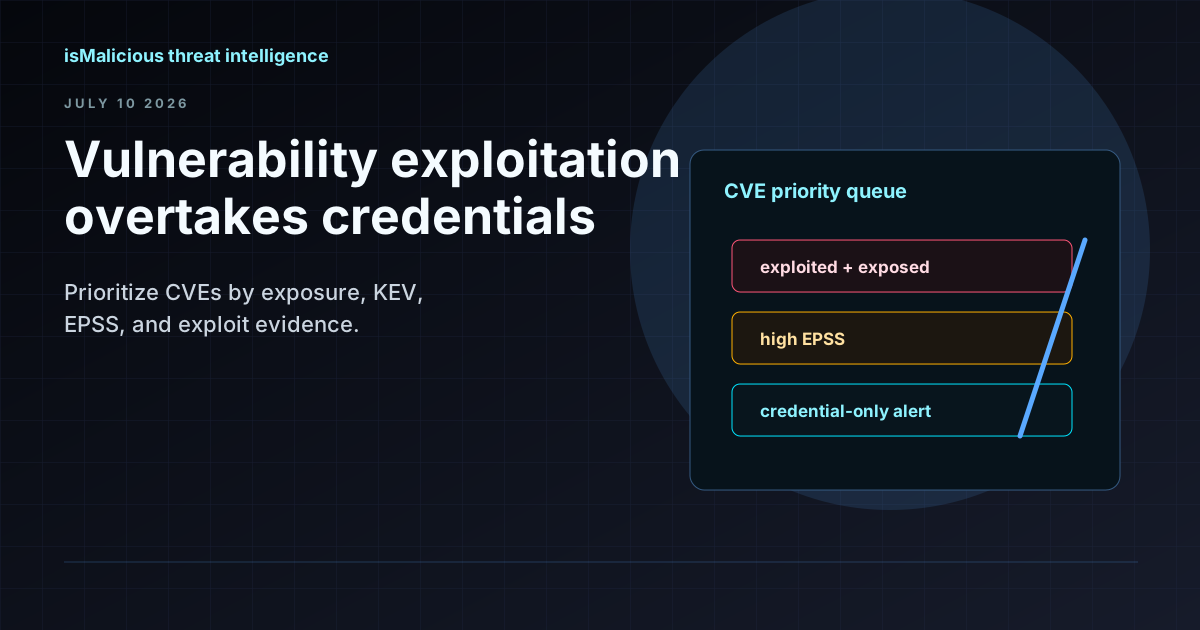
The 2026 Verizon Data Breach Investigations Report has pushed a hard message into the market: vulnerability exploitation is no longer a background concern behind stolen credentials. Reporting on the DBIR has emphasized exploitation, ransomware, shadow AI, mobile phishing, and third-party risk as recurring pressure points. For security teams, the takeaway is direct: CVE prioritization has to reflect how attackers move now.
Most organizations already have more vulnerabilities than they can patch immediately. The failure mode is not lack of CVE data. It is lack of decision quality. Teams need to know which CVEs affect real assets, which assets are exposed, which vulnerabilities are exploited, and which fixes reduce risk fastest.
Build The Priority Queue From Multiple Signals
Do not let one score dominate the process. A useful CVE priority queue combines:
- asset presence and product version;
- internet exposure and reachable attack paths;
- CVSS severity;
- EPSS probability;
- CISA KEV status;
- public proof-of-concept availability;
- ransomware or botnet use;
- business criticality;
- compensating controls;
- observed scanning or exploitation attempts.
The isMalicious CVE Watch workflow exists for this reason. It connects vulnerability data to perimeter context and operational notes. The priority should be "this exploitable CVE affects this exposed system", not "this CVE has a scary score."
Use KEV For SLA Acceleration
The CISA Known Exploited Vulnerabilities catalog is a strong trigger because it represents known exploitation. If a KEV item touches an exposed or critical asset, it should move into an accelerated SLA. The response should include patching, mitigation, and hunting during the vulnerable window.
The isMalicious guide on KEV and exploited vulnerability intelligence covers the broader model. In July 2026, the priority is operational: identify which exploited CVEs are present in your environment and prove closure.
Exceptions Need Compensating Controls
Every vulnerability program has systems that cannot be patched immediately. The mistake is treating an exception as a passive note. A useful exception requires:
- named asset owner;
- reason the patch cannot be applied;
- exposed service and network path;
- temporary mitigation;
- monitoring rule or hunting query;
- expiration date;
- business risk acceptance.
Examples of compensating controls include firewall restrictions, WAF rules, feature disablement, VPN-only access, temporary service shutdown, enhanced logging, and outbound egress monitoring. The control should match the exploit path. A web RCE needs different mitigation than a local privilege escalation or browser bug.
Practitioners are rarely looking for theory. They need a model for the messy reality of delayed change windows.
Enrich Exploitation Attempts
Vulnerability exploitation often creates observable infrastructure:
- scanner IPs;
- exploit delivery URLs;
- callback domains;
- payload hashes;
- staging hosts;
- credential theft infrastructure.
Use IP reputation, domain intelligence, URL scanning, and file hash reputation to enrich these artifacts. Then send the evidence into SIEM workflows with the threat intelligence API.
Report Closure With Evidence
A CVE should not be marked closed only because a ticket status changed. Closure should show patch version, asset scope, exception list, scan result, and any hunting performed during the exposure window. If exploitation attempts were observed, include the enriched indicators and case IDs.
Operational CTA
Explore CVE Watch, connect enrichment through the API Docs, and use data quality to keep CVE decisions defensible. When exploitation becomes a primary breach path, prioritization is the control.
Frequently asked questions
- Why does vulnerability exploitation change prioritization?
- When exploitation is a leading breach path, vulnerability teams must prioritize exposure and exploit evidence, not only theoretical severity.
- What signals should be combined for CVE prioritization?
- Combine asset presence, exposure, CVSS, EPSS, KEV status, public exploit availability, vendor guidance, business criticality, and observed attack telemetry.
- Does KEV replace CVSS or EPSS?
- No. KEV confirms known exploitation, CVSS describes severity, and EPSS estimates exploitation probability. They are stronger together than alone.
- How does isMalicious help with vulnerability exploitation risk?
- isMalicious CVE Watch tracks relevant vulnerabilities and exploit context, while API enrichment helps SOC teams investigate indicators tied to exploitation attempts.
Related articles
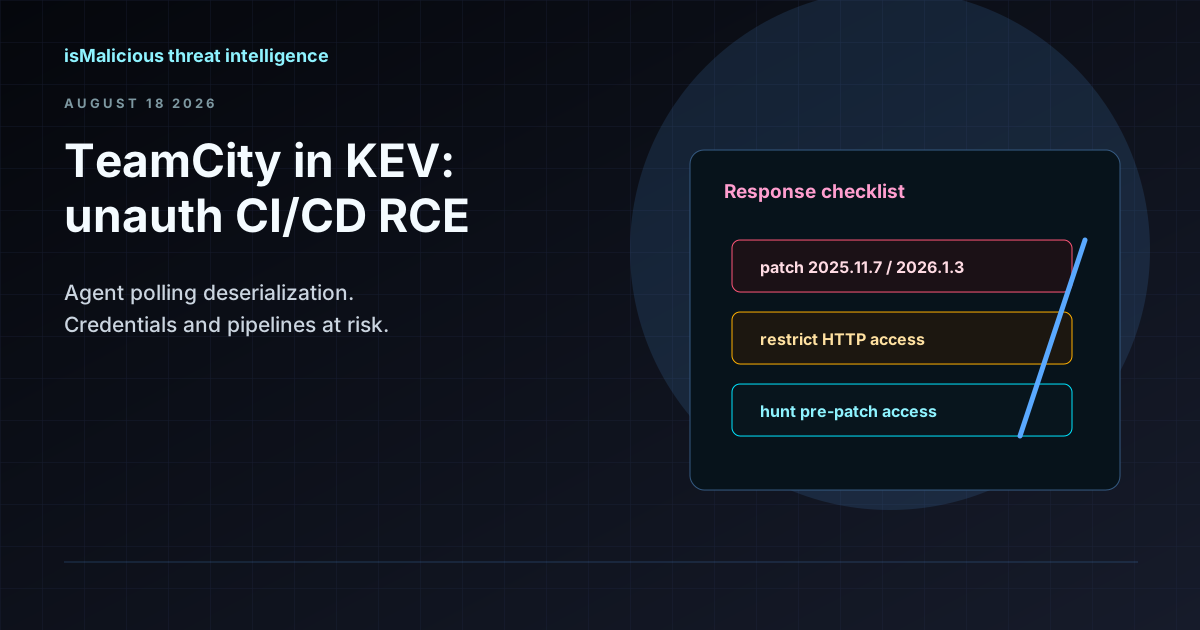 CVE-2026-63077 Puts Unauthenticated RCE on Every TeamCity On-Premises Server
A deserialization flaw in the agent polling protocol gives attackers TeamCity server privileges without credentials. JetBrains patched in 2025.11.7 and 2026.1.3 — CISA KEV and a 3-day federal deadline mean hunt now, not after the next release train.
 BlueHammer Defender Exploitation: July 2026 Patch SLA For Windows Fleets
BlueHammer coverage shows why endpoint patching, CISA KEV context, CVE Watch, and IOC enrichment have to work together when local privilege escalation becomes ransomware tradecraft.
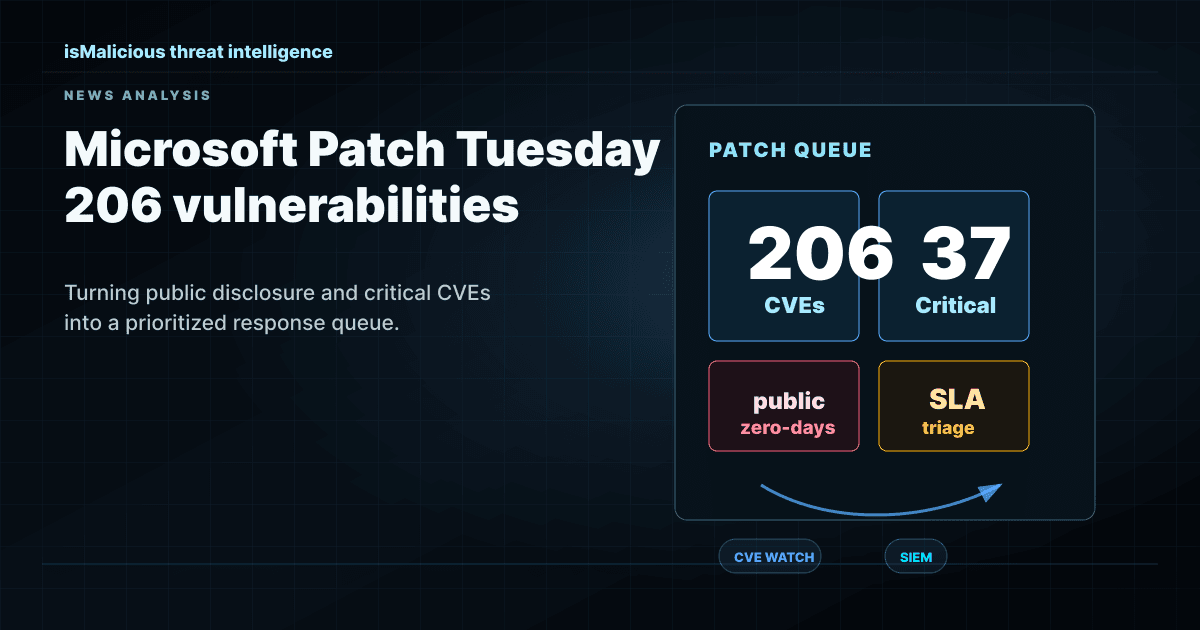 Microsoft June 2026 Patch Tuesday: Turning 206 Vulnerabilities Into A SOC Priority Queue
Microsoft patched 206 vulnerabilities in June 2026, including publicly disclosed zero-days. Security teams need CVE Watch, KEV context, exploit evidence, and enrichment to avoid patch fatigue.
Protect Your Infrastructure
Check any IP or domain against our threat intelligence database with indexed records.
Try the IP / Domain Checker