IPv6 Threat Intelligence: Reputation Beyond IPv4
Build IPv6 threat intelligence with correct normalization, prefix context, dual-stack logging, enrichment, and reputation decisions that avoid overblocking.
 IsMalicious Team
Many security programs still treat IPv6 as an edge case. Attackers do not need to. If a workload, VPN, resolver or cloud service is dual stack, malicious traffic can use the protocol that has weaker logging and less mature reputation coverage.
IPv6 threat intelligence cannot be a larger copy of an IPv4 deny list. The address space, allocation model, temporary addresses and prefix semantics require different storage, enrichment and response decisions.
Why IPv6 Changes the Reputation Model
An IPv4 address often remains a practical unit for enrichment, even when NAT and shared hosting complicate attribution. IPv6 introduces additional realities:
- one interface can use several addresses at once;
- privacy extensions rotate interface identifiers;
- cloud and access providers allocate large prefixes;
- textual representations can differ while identifying the same address;
- a single /64 contains an enormous address range;
- dual-stack connections may switch protocols without changing the user or workload.
NIST SP 800-119 recommends deliberate planning for secure IPv6 deployment. For threat intelligence teams, that planning begins with complete telemetry and canonical data.
Normalize Before You Correlate
Parse addresses with an IPv6-aware library, not string rules. Expand or compress only for display; store a canonical binary representation. Remove brackets used around literals in URLs and preserve the port separately. Recognize IPv4-mapped IPv6 addresses and document whether your pipeline converts them.
Always retain:
- the full observed address;
- the routed prefix and allocation owner;
- ASN and network organization;
- first-seen and last-seen timestamps;
- source telemetry and confidence;
- the related user, device, workload or session when legally appropriate.
String comparison without canonicalization fragments one actor into several records and breaks deduplication.
From Address Reputation to Prefix Context
Individual-address evidence still matters: a confirmed C2 connection or scanner observation should remain attached to the exact source. But decisions should also consider the surrounding prefix.
Ask:
- Are multiple addresses in the same /64 or larger routed prefix showing the same behavior?
- Is the prefix residential, mobile, cloud, education or hosting?
- Does the ASN normally appear in the service’s user population?
- Are malicious observations concentrated or sparse?
- Is the address temporary, stable or tied to a known workload?
Never automatically inherit one malicious address verdict across an entire /64. Prefix aggregation is a hypothesis and prioritization tool, not proof that every address is hostile.
Close the Dual-Stack Visibility Gap
Inventory every control that sees IPv4 and verify its IPv6 equivalent: firewall, WAF, CDN, load balancer, VPN, EDR, resolver, proxy, SIEM parser and threat-intelligence enrichment. Test whether each layer logs the original client address and whether dashboards accept 128-bit values.
Create detections for:
- a session alternating between IPv4 and IPv6 to evade rate limits;
- an IPv6 connection to a domain already flagged as malicious;
- outbound IPv6 where the equivalent IPv4 path is restricted;
- extension-header anomalies or unexpected transition tunnels;
- an internal asset using IPv6 without appearing in the inventory.
Use IP reputation for individual observations and bulk lookup for campaign-sized sets. Pair address intelligence with domain and DNS context because attackers can rotate addresses faster than names or certificates.
Blocking and Rate Limiting Safely
Begin with the narrowest reliable control. Block an exact address when evidence is strong and the address is stable enough for the action to matter. Use domain, account, device or workload controls when the interface identifier rotates.
Prefix-level blocks require a review of legitimate traffic, tenancy and duration. For ambiguous residential or mobile ranges, prefer rate limits, challenges and behavioral monitoring. Add an expiry to every emergency block and require evidence before renewal.
Metrics for IPv6 Readiness
Measure IPv6 share by telemetry source, enrichment success rate, parser failures, dual-stack identity correlation and time to contain an IPv6 incident. Compare alert precision with IPv4 and track controls that still drop or truncate addresses.
The most dangerous metric is a blank one. If a business unit reports zero IPv6 traffic while its cloud platform is dual stack, verify collection before concluding there is no exposure.
Conclusion
IPv6 reputation is a context problem: exact address, prefix, ASN, workload and time all matter. Normalize every observation, close dual-stack logging gaps and avoid turning broad prefixes into permanent blocklists. A mature IP threat intelligence workflow treats IPv6 as a first-class protocol, not an exception path.
Frequently asked questions
- Can IPv6 addresses use the same reputation model as IPv4?
- Not safely. IPv6 has a much larger address space, multiple addresses per interface, privacy addresses, and different allocation patterns. Reputation must use prefix and network context as well as the individual address.
- Should defenders block an entire IPv6 /64?
- Only with strong evidence and a documented blast-radius assessment. A /64 may contain many legitimate devices, while an attacker may move addresses within it. Detection and rate controls are often safer first actions.
- Why do dual-stack environments create security gaps?
- Controls and logs are often mature for IPv4 but incomplete for IPv6. Attackers can exploit the protocol path with weaker inspection, inconsistent identity mapping, or missing enrichment.
Related articles
 Threats Dashboard: Turn Current Intelligence into Priorities
Use the isMalicious Threats dashboard to move from a broad threat picture to the sectors, ransomware groups, malware, victims, and evidence that matter to your team.
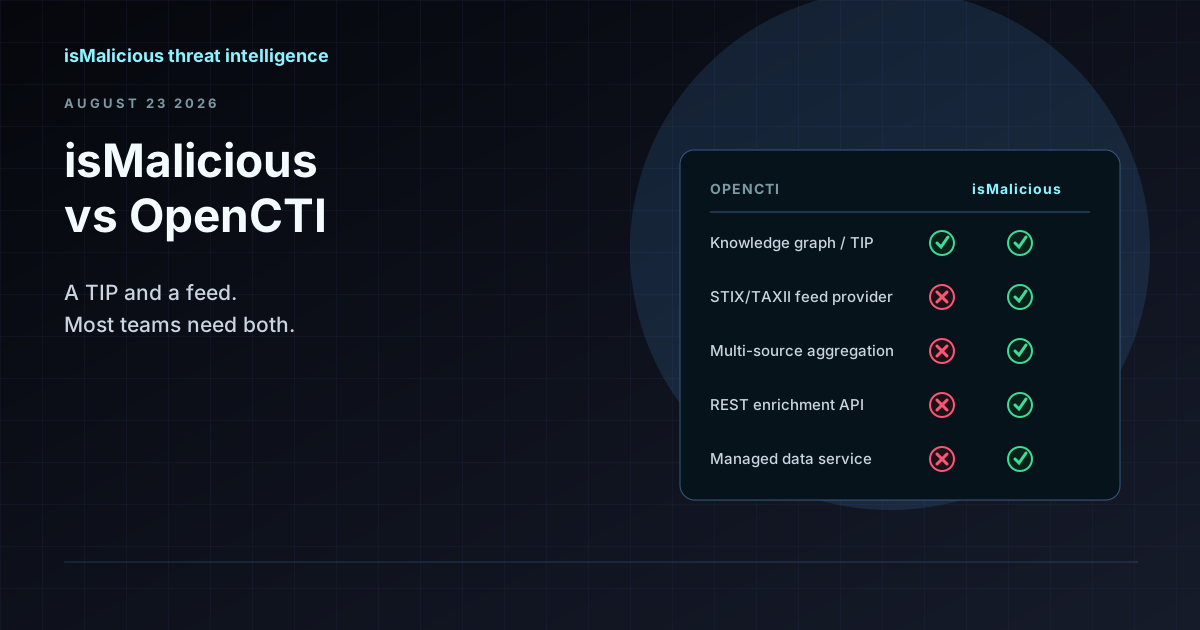 isMalicious vs OpenCTI: Why This Is the Wrong Comparison (and How They Work Together)
OpenCTI is a threat intelligence platform and knowledge graph. isMalicious is a data provider that feeds it. Teams searching for an OpenCTI alternative usually need a feed, not a replacement TIP.
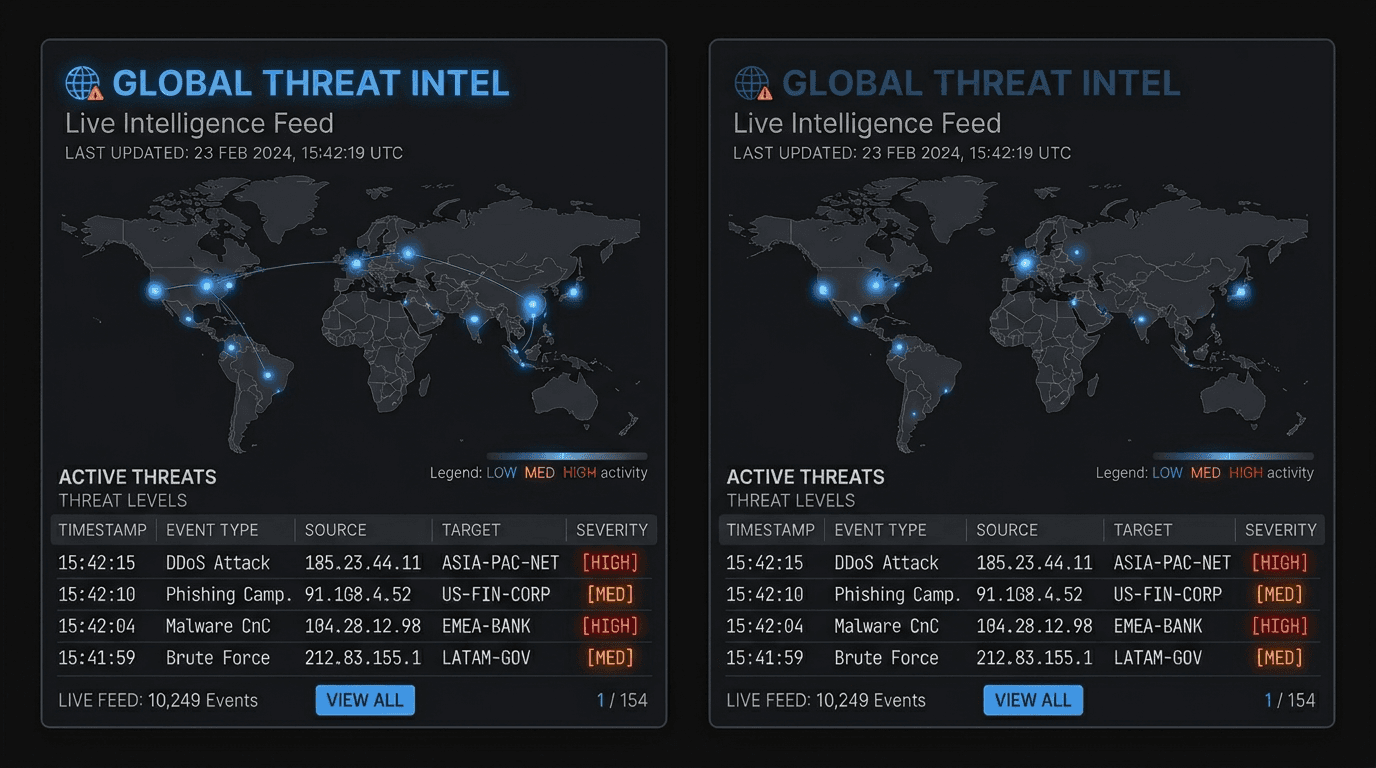 ASN Reputation for Threat Intelligence: How Autonomous System Intelligence Improves Prioritization and Hunt Programs
An IP address is a snapshot; an autonomous system (ASN) is a neighborhood. Learn how to use ASN context safely for triage, fraud, and security operations—without mistaking a giant cloud for a monolithic "bad host".
Protect Your Infrastructure
Check any IP or domain against our threat intelligence database with indexed records.
Try the IP / Domain Checker