Cyber Extortion Now Includes Physical Threats: What Incident Response Teams Must Change
Cyber incidents are no longer always contained to systems and data. As extortion crews add physical threats, responders need ransomware intelligence, safety escalation, IOC enrichment, and executive-ready evidence.
 IsMalicious Team
Cyber extortion used to be framed as a digital crisis: encrypted servers, stolen data, ransom notes, leak sites, and business interruption. That frame is now too small. Reporting from the BBC highlighted a disturbing pattern: cybercriminals are increasingly adding threats of physical harm to victims and employees. Whether those threats are credible in a specific case is a matter for legal, law enforcement, and physical security teams, but the operational consequence is immediate. The incident is no longer only about systems.
This changes the response model. A ransomware case with physical threats is not just a malware investigation. It is a crisis event involving employee safety, communications, legal exposure, insurance, executive decision-making, and technical containment. The SOC still matters, but it should not carry the whole response alone.
Threat intelligence becomes more important, not less. When emotions and pressure rise, responders need fast evidence: who might be behind the extortion, what infrastructure is involved, whether the indicators match known ransomware behavior, and what risk the organization can document with confidence.
What Changed
Extortion crews have always used pressure. They threaten data leaks, customer notifications, regulatory complaints, DDoS, partner outreach, and public embarrassment. Physical threats add a new layer. They can target executives, employees, families, facilities, or local offices. Even if a threat is ultimately a bluff, it changes duty of care.
The response team now needs to answer two tracks at once.
The safety track asks:
- who received the threat;
- whether personal information was exposed;
- whether facilities, travel, or home addresses are implicated;
- whether law enforcement or physical security should be engaged;
- what communications should go to employees.
The technical track asks:
- which systems are affected;
- whether data was exfiltrated;
- which IOCs are present;
- whether the activity matches ransomware group behavior;
- what containment, restoration, and monitoring steps are needed.
Both tracks need evidence. Neither should wait for perfect certainty.
Do Not Let The SOC Become The Safety Desk
SOC analysts are trained to handle alerts, logs, IOCs, and technical triage. They are not the right team to decide whether an employee needs physical protection or whether a threat should be reported to law enforcement. That decision belongs in a prepared escalation path involving legal, HR, physical security, executives, and external counsel where appropriate.
The SOC role is still critical:
- preserve the extortion messages and headers;
- enrich domains, IPs, URLs, and file hashes;
- search for related internal activity;
- identify ransomware group links if evidence supports it;
- support containment and monitoring;
- document uncertainty clearly.
The mistake is treating a physical threat as just another note in a ticket. It should trigger a separate safety escalation while the technical investigation continues.
Use Ransomware Intelligence To Scope Faster
Ransomware intelligence helps response teams avoid starting from zero. It can show whether a named group is active, which sectors it targets, what leak-site behavior it uses, which infrastructure patterns appear in past campaigns, and whether current indicators overlap with known activity.
isMalicious maintains ransomware-focused data surfaces for ransomware intelligence, group profiles, victim tracking, sector patterns, and IOC matching. During an extortion case, this context supports three decisions.
First, it helps identify whether the claimed actor is plausible. Extortion crews lie. They borrow names, exaggerate access, and imitate known brands. Group intelligence does not prove attribution by itself, but it helps separate a credible pattern from a generic scare tactic.
Second, it informs urgency. A group with recent leak activity in the same sector may require faster executive escalation than a vague message with no supporting evidence. The same is true if indicators match known C2, phishing, or malware infrastructure.
Third, it supports communication. Executives need a concise risk brief, not a raw feed dump. "This message claims X; the infrastructure overlaps with Y; the group has targeted similar organizations; we have or have not found exfiltration evidence" is much more useful than "ransomware possible."
For broader preparation, review the ransomware detection and prevention guide and incident response playbook essentials.
Enrich IOCs Before The Story Hardens
In fast-moving incidents, early assumptions can become sticky. If the first briefing says "known ransomware group," every later update may be interpreted through that lens. If the first briefing says "hoax," the team may underreact. IOC enrichment helps keep the response evidence-led.
Run every observable through a consistent workflow:
- IP addresses from login, VPN, email, and firewall logs;
- domains and URLs in extortion messages;
- file hashes from ransom notes, tools, archives, or malware;
- email domains used for negotiation;
- infrastructure found in DNS, proxy, or EDR logs.
The isMalicious API and bulk check workflow are useful when a case contains hundreds of indicators from SIEM exports, EDR timelines, or mail logs. For suspicious links, use the URL scanner. For domains that may have shifted infrastructure over time, use DNS history. For network blocks, validate confidence carefully before updating a blocklist.
This evidence should feed the case, not live in an analyst's browser history. Store the enrichment result, timestamp, and source context so legal and executive stakeholders can understand the basis for decisions later.
Executive Response Needs A Different Packet
Technical teams often provide too much detail to executives during a crisis. Executives then ask for simple answers, and the nuance gets lost. A better pattern is a two-layer packet.
The first layer is the executive brief:
- what happened;
- who or what is threatened;
- current operational impact;
- safety escalation status;
- data exposure status;
- known attacker or group context;
- decisions needed in the next hour;
- confidence level and open questions.
The second layer is the technical appendix:
- IOCs and enrichment results;
- affected assets;
- timeline;
- detection rules;
- containment actions;
- ransomware group intelligence;
- evidence preservation notes.
isMalicious supports this split through fast enrichment, saved reports, ransomware context, and API outputs that can be attached to cases. For structured workflows, connect enrichment to your SIEM or incident response tooling so the packet can be generated from the same evidence base.
Physical Threats Increase Insurance And Compliance Pressure
Cyber insurance, breach notification, employment law, and crisis communications all become more complex when physical threats enter the case. The organization may need to show that it acted reasonably to protect employees while also preserving technical evidence and avoiding unsupported claims.
That is another reason to avoid overclaiming. Do not write "credible threat actor" unless the evidence supports it. Do not write "no exfiltration" when the correct statement is "no exfiltration evidence found so far." Do not write "blocked all malicious infrastructure" when shared cloud infrastructure or unknown indicators remain.
Threat intelligence can reduce uncertainty, but it should not erase uncertainty. Good reporting states confidence honestly.
Build A Combined Playbook
Update the playbook before the next case. A practical cyber-extortion-with-physical-threats workflow should include:
- Safety escalation trigger language.
- Evidence preservation for messages, calls, emails, and chat.
- IOC extraction and enrichment.
- Ransomware group intelligence review.
- Identity and access review for targeted employees.
- External counsel and law enforcement decision points.
- Employee communications owner.
- Executive brief template.
- Blocklist and monitoring policy.
- Post-incident review requirements.
This does not mean every extortion email becomes a full crisis. It means the decision to treat it as low risk is documented, not improvised.
What Good Evidence Looks Like In The Case File
The case file should be useful after the emergency ends. That means it must capture more than the final decision. It should preserve the path the organization took to reach that decision.
For the threat message, store screenshots, raw headers, delivery channel, recipient, timestamp, and any attached files or links. For the technical investigation, store the enriched IOCs with source names, confidence, and retrieval time. For ransomware intelligence, store the claimed group, any matching group profile, overlap with known infrastructure, and whether the group has recent activity in the same sector or geography.
For safety escalation, record who was notified and when. Do not bury that in a malware-analysis note. If physical security, HR, legal, executive leadership, or law enforcement are engaged, the case should show that path clearly. For communications, store approved language and the audience it reached.
The case file also needs negative findings. If no exfiltration evidence was found, say where the team looked. If no malicious infrastructure was confirmed, say which indicators were checked. If attribution is uncertain, state that uncertainty plainly. A clean, humble case file is more valuable than an overconfident one.
This evidence discipline protects employees, helps leadership make decisions, and gives post-incident review something concrete to improve.
Bottom Line
When cyber extortion includes physical threats, the response must expand beyond malware containment. The SOC should enrich indicators, scope technical impact, and preserve evidence. Leadership should own safety escalation, legal decisions, and communications.
Use ransomware intelligence to understand actor patterns, use the IP / Domain Checker to validate infrastructure, and monitor domains, URLs, and certificates tied to the case through the isMalicious platform.
FAQ
Frequently asked questions
Why do physical threats change cyber incident response?
They move the incident beyond data, uptime, and ransom exposure into employee safety, executive protection, legal escalation, and crisis communications.
Should SOC teams investigate physical threats themselves?
No. SOC teams should preserve evidence, enrich technical indicators, and escalate through legal, HR, physical security, and law enforcement channels according to policy.
How does ransomware intelligence help during extortion?
It helps identify groups, victimology, leak-site behavior, infrastructure, sector targeting, and related IOCs so the response team can scope the threat faster.
What should be documented in an extortion case?
Document messages, timestamps, accounts contacted, infrastructure indicators, affected assets, known group links, safety escalations, and decisions made by legal and executive stakeholders.
Related articles
 INC Ransomware Chains Two SonicWall SMA Zero-Days (CVE-2026-15409, CVE-2026-15410)
INC affiliates are weaponizing an SSRF and a post-authentication code injection in SonicWall SMA 1000 to reach internal networks. Exploitation started weeks before the July 14 patch — here is how to hunt and triage.
 Cl0p Is Exploiting PTC Windchill (CVE-2026-12569) to Steal Engineering Data
A Cl0p affiliate is chaining a FlexPLM information disclosure with an unauthenticated RCE in PTC Windchill to plant JSP web shells and run double-extortion data theft. Here are the detection signals and the triage workflow.
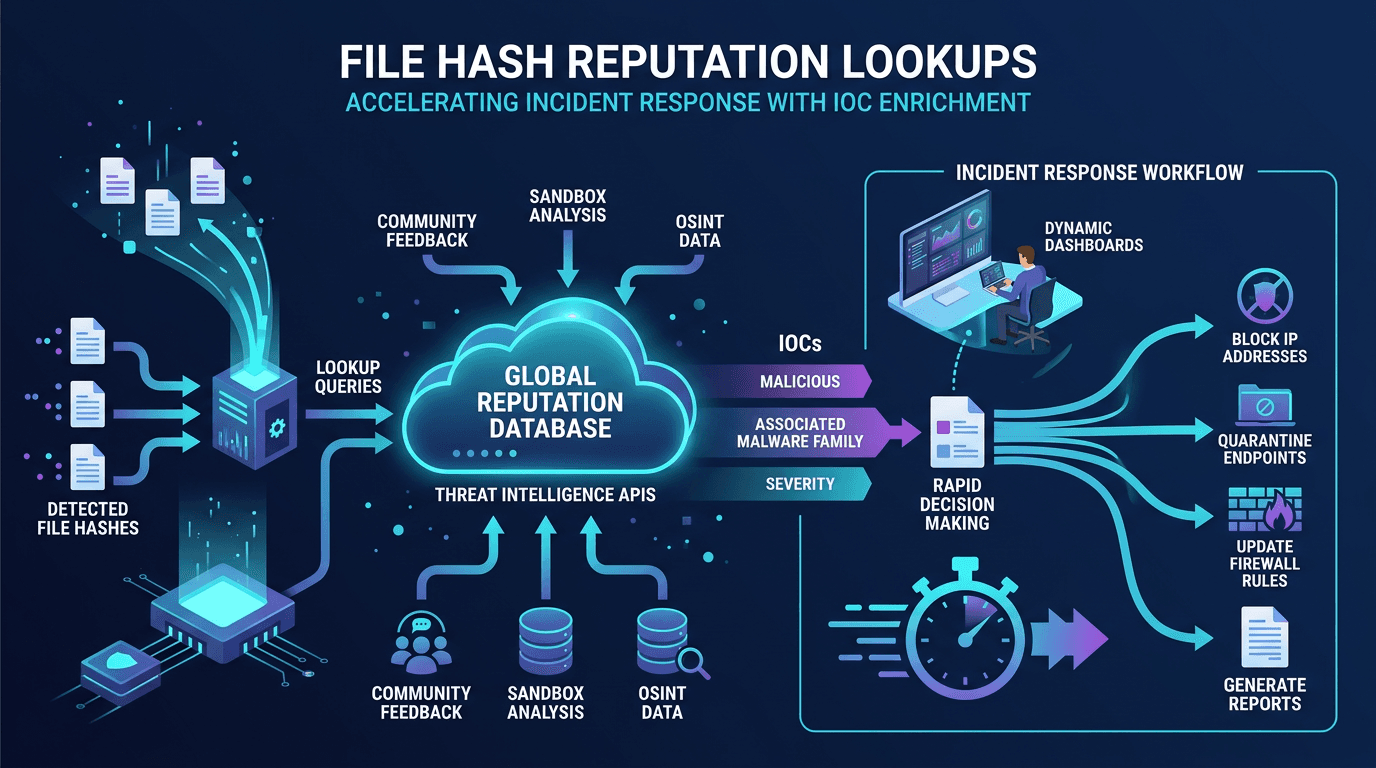 File Hash Reputation Lookups: Accelerating Incident Response With IOC Enrichment
A practitioner's guide to file hash reputation lookups—how they work, which data sources power them, how to build automated IOC enrichment pipelines, and how to integrate hash intelligence into SOC, SOAR, and incident response workflows.
Check any IP or domain
See what our indexed threat intelligence records say about it.
Try the IP / Domain Checker