AI-Enabled Cyberattacks and MITRE ATT&CK: Turning New Threat Maps Into SOC Action
AI-enabled threats are being mapped into ATT&CK language, but mapping is only useful when it drives enrichment, detection, triage, and response workflows.
 IsMalicious Team
AI-enabled cyberattacks are no longer a vague future concern. They are becoming concrete enough to map. Anthropic's June 2026 research on AI-enabled cyber threats and MITRE ATT&CK is important because it gives defenders a practical language for a fast-moving problem. Instead of arguing about whether AI is "new," it asks where AI changes attacker behavior inside familiar tactics and techniques.
That is the right framing. AI does not make phishing, reconnaissance, scripting, exploitation, or evasion magically new. It makes some of them faster, cheaper, more personalized, and easier to chain. For a SOC, the key question is not "was AI used?" The useful question is "which behaviors accelerated, and where can we add context or friction?"
Threat intelligence is one of the places where that question becomes operational. AI-generated phishing may look polished, but it still needs domains, URLs, infrastructure, credentials, payloads, and command channels. If defenders can enrich those observables quickly and map the surrounding behavior to ATT&CK, the investigation becomes less mysterious.
ATT&CK Mapping Is A Starting Point, Not The Response
MITRE ATT&CK is useful because it gives teams shared language. A detection engineer, SOC analyst, red teamer, and executive can all discuss technique clusters without inventing local vocabulary. But ATT&CK mapping alone does not block an attack, close a ticket, or protect a user.
The value appears when mapping drives action:
- update detection hypotheses;
- enrich IOCs tied to a technique;
- prioritize controls by attacker path;
- explain incidents in a familiar model;
- compare observed behavior against known campaigns;
- create tabletop exercises that match realistic sequences.
For AI-enabled operations, mapping helps prevent two bad reactions. The first is panic: treating every AI mention as a novel class of threat. The second is complacency: assuming AI is just another buzzword and ignoring how automation changes attacker economics.
The middle path is practical. Use ATT&CK to describe the behavior. Use threat intelligence to validate the infrastructure. Use response workflows to decide what happens next.
Where AI Changes The Defender's Workload
AI affects defenders most where attackers can use speed and variation. Phishing is the obvious example. LLMs can generate cleaner copy, localize messages, imitate tone, and produce many variants. That does not guarantee success, but it reduces the number of obvious mistakes that old filters and training relied on.
Reconnaissance also changes. AI can summarize public information, build target lists, infer technologies, and prepare tailored lures. Scripting and payload adaptation can become faster. Social engineering can become more personalized. Some attackers may use AI to interpret tool output or choose next steps during intrusion.
At the same time, infrastructure still matters. A malicious link still resolves somewhere. A payload still has a hash. A command channel still needs a domain, IP, or service. A fake login page still has hosting, certificates, redirects, and resources. This is where a threat intelligence API remains useful even as content generation improves.
The defender's job shifts from spotting bad grammar to validating behavior and infrastructure.
Use Enrichment As Ground Truth For AI Summaries
LLMs can help analysts summarize complex cases, but they should not become the source of truth. A model can write a convincing explanation for an indicator that has no evidence behind it. That is dangerous in security operations.
The better pattern is evidence-first AI:
- Collect observables from alerts, logs, messages, files, and user reports.
- Enrich the observables through trusted sources.
- Record verdict, source agreement, freshness, and confidence.
- Ask the AI layer to summarize the evidence and map possible ATT&CK techniques.
- Keep the raw evidence attached to the case.
isMalicious supports this pattern through real-time IP, domain, URL, and file-hash enrichment, plus AI-generated assessment and MITRE mapping in the platform. The model's job is to explain the result, not to hallucinate a verdict. For implementation guidance, see security LLM agents and malicious URL/domain checks.
AI-Enabled Phishing Still Leaves Infrastructure Trails
AI-generated phishing content may defeat some awareness cues, but it rarely removes all infrastructure signals. Security teams should inspect:
- domain age and registration patterns;
- lookalike or typosquatted domains;
- DNS history and hosting changes;
- URL redirects and embedded resources;
- TLS certificate reuse;
- file hashes and attachment behavior;
- IP reputation and ASN context;
- related infrastructure discovered through pivots.
The isMalicious domain reputation check, URL scanner, and DNS history pages cover the most common investigation paths. When a campaign generates many variants, use bulk lookup instead of checking one domain at a time.
This matters because AI-enabled campaigns may produce more near-duplicate indicators. Defenders need fast grouping, not only fast lookup.
AI Also Raises The Nation-State Anxiety Level
AI-enabled threats do not exist in a vacuum. The Record reported that Dutch intelligence assessed China's cyber capabilities as now matching the United States in some respects, based on the Dutch services' public annual report coverage. That kind of nation-state concern changes the mood around AI because defenders worry not only about commodity criminals but also about well-resourced teams using AI to scale research, targeting, and operations.
For most organizations, the practical answer is still not to build a nation-state lab overnight. It is to harden the basics that scale across adversaries:
- reduce exposed attack surface;
- monitor identity and cloud control planes;
- enrich external infrastructure;
- prioritize exploitable CVEs;
- improve phishing and URL analysis;
- connect SIEM/SOAR workflows to reliable threat intelligence;
- map incidents to ATT&CK for repeatable learning.
The CVE Watch workflow is especially relevant when AI accelerates exploit research or vulnerability triage. Teams need to know which CVEs matter to their perimeter, not only which CVEs are loud on the internet.
Build AI-Aware Detection Without AI Theater
Do not create a detection rule that simply says "AI phishing." That is not observable. Create rules for behaviors and infrastructure patterns that AI-enabled campaigns may amplify:
- newly registered domains in authentication flows;
- brand lookalike domains with recent DNS changes;
- unusual OAuth consent requests;
- login attempts from proxy or hosting IPs after email interaction;
- repeated URL variants across many recipients;
- attachment hashes with mixed or recent detections;
- command-line or scripting behavior after suspicious download.
Then map these detections to ATT&CK where appropriate. That gives the SOC a consistent language without pretending to know exactly which model the attacker used.
For teams building automations, Review API Docs and make sure enrichment responses are stored in searchable fields. The goal is to let analysts ask: "show me all recent alerts involving newly registered domains, suspicious URL scan results, and credential access techniques."
A Practical Workflow For SOC Teams
An AI-aware SOC workflow can be simple:
- Ingest email, URL, DNS, identity, endpoint, and proxy events.
- Extract observables and deduplicate them.
- Enrich domains, URLs, IPs, and hashes with isMalicious.
- Attach confidence, source agreement, freshness, and recommended action to the alert.
- Ask the AI-generated assessment layer to summarize the evidence and propose MITRE mappings.
- Use human review for ambiguous or customer-impacting actions.
- Feed confirmed cases back into detection engineering.
This flow keeps AI useful and bounded. It helps analysts reason faster without giving a model unchecked authority.
What To Put In The Detection Backlog
AI-enabled threat planning should produce backlog items, not only research notes. A useful backlog item names the behavior, data source, enrichment need, expected ATT&CK mapping, and success metric.
For example, a phishing backlog item might say: detect newly registered domains in inbound email that redirect to credential forms, enrich with domain age and URL scan context, map likely behavior to credential access, and measure confirmed phishing rate after analyst review. A cloud identity backlog item might say: detect OAuth consent to unapproved AI or productivity applications, enrich the app domain and publisher infrastructure, map to initial access or persistence where appropriate, and measure risky grants removed.
This approach prevents AI security work from becoming abstract. It also helps detection engineers avoid fragile rules. The detection is not "AI wrote the email." The detection is a visible behavior that AI-enabled campaigns can scale: new domains, suspicious redirects, consent abuse, script execution, or infrastructure reuse.
Review the backlog monthly. AI tooling, attacker workflows, and defensive telemetry are changing quickly. A rule that worked for one quarter may become noisy or irrelevant in the next. Tie every rule back to evidence and analyst outcomes.
The backlog should also name the owner. Phishing controls, identity controls, endpoint detections, and vulnerability workflows often live in different teams. AI-enabled attack paths cross those boundaries, so backlog items should make the handoff explicit before an incident forces the issue.
Bottom Line
AI-enabled threats matter because they can increase attacker speed, variation, and personalization. MITRE ATT&CK helps defenders describe the behavior, but the response still depends on evidence.
Use isMalicious to enrich the infrastructure behind AI-enabled campaigns, map findings into SOC language, and connect enrichment to your SIEM/SOAR. The goal is not to chase every AI headline. The goal is to make every suspicious domain, URL, IP, and hash easier to decide.
FAQ
Frequently asked questions
Does AI change the MITRE ATT&CK framework?
AI does not replace ATT&CK, but it changes how quickly adversaries can perform familiar behaviors such as phishing, reconnaissance, scripting, evasion, and infrastructure setup.
What should SOC teams do with AI-enabled threat maps?
Use them to update detection hypotheses, enrich IOCs, map observed behavior to techniques, and prioritize controls that reduce attacker speed and scale.
Can LLMs decide whether an indicator is malicious?
LLMs should summarize and map evidence, not invent verdicts. The verdict should come from trusted telemetry, threat intelligence, and documented confidence signals.
How does isMalicious help with AI-enabled attacks?
isMalicious provides IP, domain, URL, and hash enrichment, AI-generated analysis, MITRE mapping, streaming responses, and API workflows for SOC and automation use cases.
Related articles
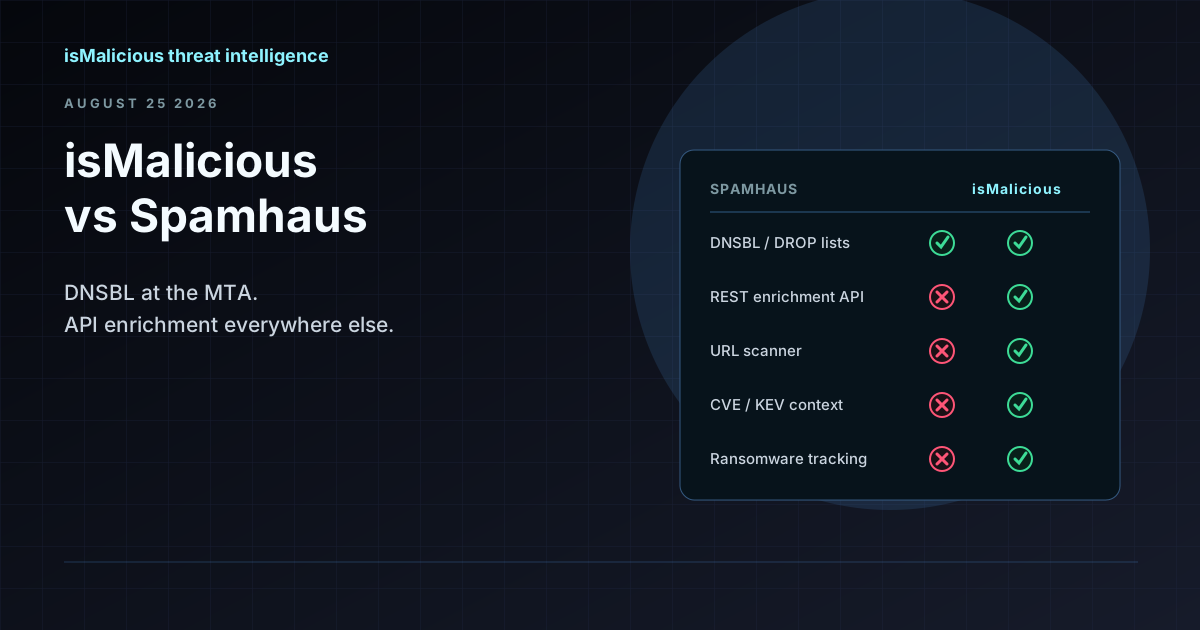 isMalicious vs Spamhaus: DNSBL Blocklists and Threat Enrichment Serve Different Layers
Spamhaus DROP and SBL are the standard for mail and network DNSBL blocking. isMalicious adds REST enrichment, URL scoring, CVE context, and STIX feeds. Most mature stacks use both at different layers.
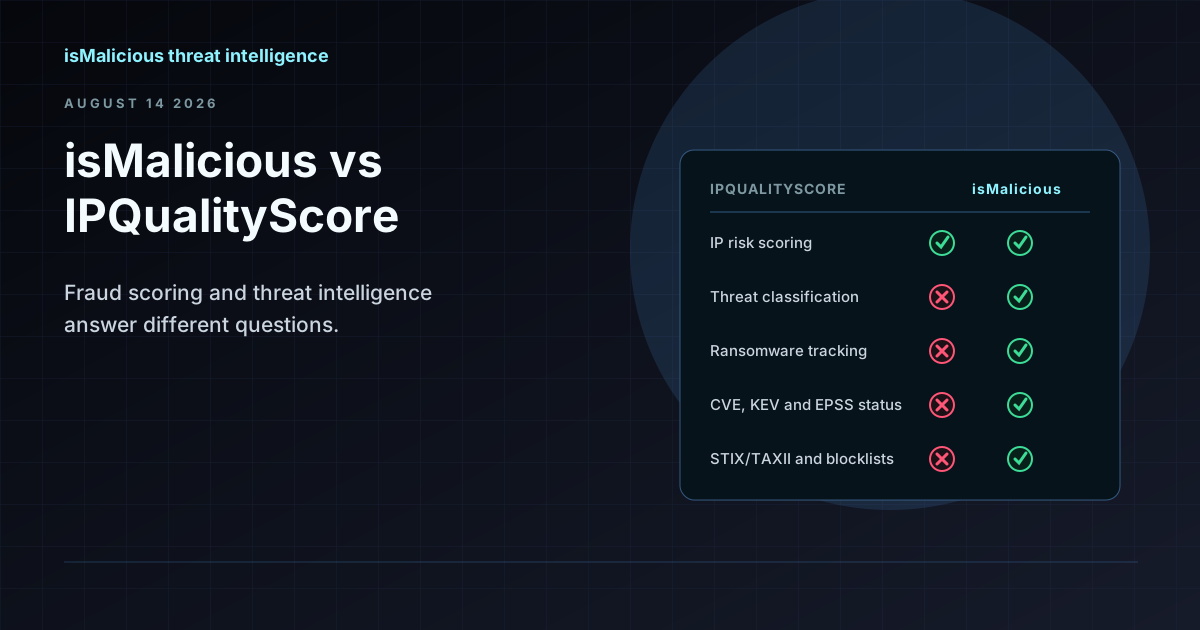 isMalicious vs IPQualityScore: Fraud Scoring and Threat Intelligence Are Different Jobs
IPQS scores whether a signup is fraudulent. isMalicious scores whether infrastructure is malicious. The two get compared constantly because both return a number about an IP address — and they answer different questions.
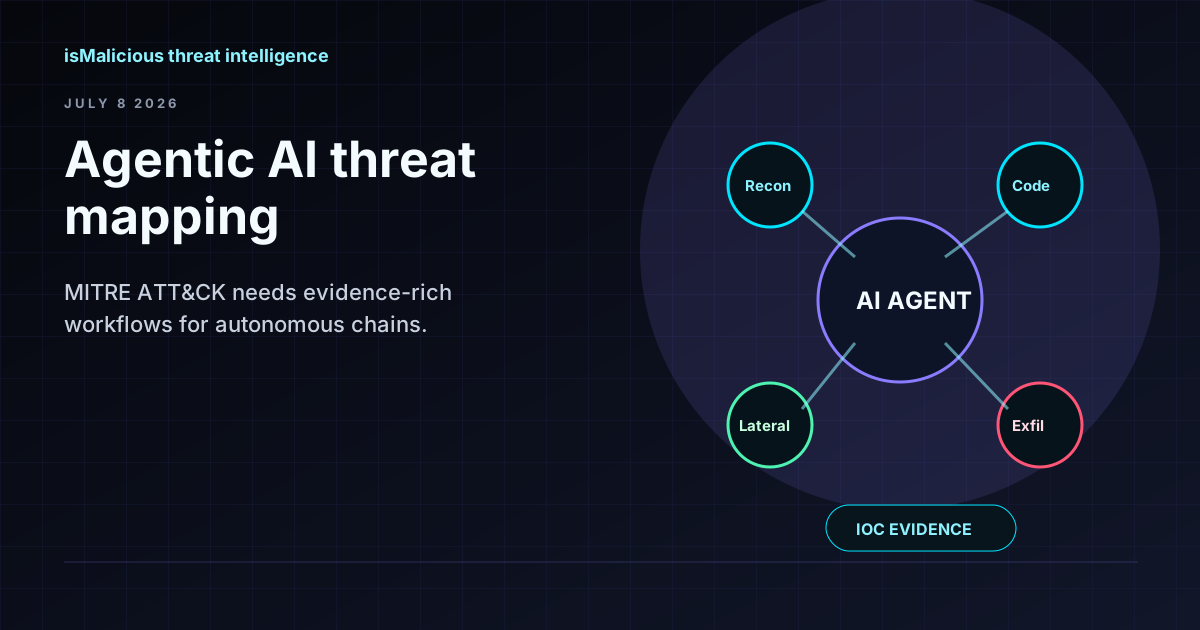 Agentic AI Threat Mapping: MITRE ATT&CK Needs Evidence-Rich Workflows
Anthropic mapped AI-enabled cyber activity to MITRE ATT&CK and found gaps around autonomous orchestration. SOC teams need AI summaries tied to evidence, not unsupported verdicts.
Check any IP or domain
See what our indexed threat intelligence records say about it.
Try the IP / Domain Checker