Residential Proxy Abuse: Detect Fraud Without Blocking Users
Detect residential proxy abuse by combining IP reputation, identity, velocity, device, and behavioral signals without penalizing legitimate users.
 IsMalicious Team
Residential proxies give attackers something a datacenter VPN cannot: traffic that appears to originate from an ordinary household or mobile customer. That makes them attractive for credential stuffing, account creation, payment fraud, scraping and ad abuse.
The same property makes detection difficult. A residential IP can belong to a legitimate user, a commercial proxy subscriber or an unwitting device infected with proxyware. Mature defenses therefore treat residential proxy abuse as a risk decision, not a binary IP label.
Why Attackers Prefer Residential Networks
Fraud controls often trust consumer networks more than hosting providers. Residential proxies exploit that assumption by providing:
- local geolocation close to the victim or payment address;
- high IP rotation across many autonomous systems;
- shared browser automation across apparently unrelated households;
- access to services that block known VPN and datacenter ranges;
- enough reputation turnover to outlive static deny lists.
A public policy report hosted by CISA discusses the abuse of VPNs and residential proxies. The operational lesson is simple: origin type is useful context, but it is not identity.
Signals That Separate Abuse From Normal Use
Network and reputation
Enrich the IP with ASN, prefix, connection type, proxy observations, abuse categories, first-seen and last-seen dates. Sudden movement across residential ASNs during one authenticated session is more valuable than a single proxy flag.
Identity and session
Compare the IP country and timezone with account history, recovery events, MFA changes and session age. A residential proxy becomes high risk when it appears immediately after a password reset or leaked credential match.
Device integrity
Use a privacy-conscious device identifier, browser capabilities and app attestation where appropriate. One device creating dozens of accounts through unrelated residential IPs is a strong automation signal.
Velocity and behavior
Measure login attempts, account creation, inventory checks, checkout failures and navigation timing. Bots can rotate IPs faster than they can convincingly reproduce human behavior.
A Risk-Based Decision Matrix
Avoid one-rule blocking. Combine evidence into actions:
- Low risk: known device, normal behavior, residential IP with no abuse history — allow.
- Elevated: new IP and device with moderate velocity — rate-limit or request stronger authentication.
- High: proxy observation, credential stuffing pattern and many account targets — block and investigate.
- Critical: confirmed account takeover followed by payout or profile changes — stop the transaction and revoke sessions.
Check current evidence with IP reputation. For a large pool, use bulk lookup to identify shared ASNs, categories and time patterns.
Detection Engineering for Authentication and Fraud
Log the original client IP through trusted proxy headers, the authentication result, account identifier, device identifier, session identifier and action outcome. Keep raw values access-controlled and apply your retention policy.
Build correlations that survive rotation:
- one device across many IPs and accounts;
- one account changing countries faster than travel permits;
- many residential IPs sharing identical automation timing;
- a proxy-classified IP paired with a leaked credential or disposable email;
- multiple sessions converging on the same payment instrument.
This is the same layered approach used in bot and account-takeover prevention: reputation narrows the queue, while behavior confirms abuse.
False Positives and Customer Experience
Carrier-grade NAT, mobile handoffs, privacy relays and corporate remote access can resemble proxy rotation. Do not punish a user solely because the IP changed. Prefer progressive friction: rate limiting, number matching, WebAuthn, reauthentication for sensitive actions or delayed settlement.
Document why each control fired. Analysts and support teams need an explainable decision such as “new device, 14 account targets and known proxy node,” not “bad IP.”
Metrics That Expose Blind Spots
Measure confirmed fraud rate by network type, challenge completion, false-positive appeals, unique accounts per device and unique IPs per abusive session. Track how quickly new proxy nodes enter and leave the reputation dataset.
If block rates rise while confirmed fraud does not fall, attackers may be rotating around an overly narrow rule. If support contacts spike, legitimate mobile or privacy traffic may be taking the hit.
Conclusion
Residential proxy abuse is an identity and behavior problem expressed through network infrastructure. Combine real-time IP reputation with device continuity, account history and action velocity. The goal is not to eliminate privacy tools; it is to make criminal rotation too expensive to scale.
Frequently asked questions
- What is a residential proxy?
- A residential proxy routes traffic through an IP assigned to a consumer network. Legitimate privacy and testing services use them, but criminals also use residential nodes to resemble normal customers.
- Can IP reputation reliably identify every residential proxy?
- No. Pools change quickly and some nodes are compromised without the owner knowing. IP intelligence should influence a risk score alongside device, identity, velocity, and transaction evidence.
- Should businesses block all residential proxy traffic?
- Usually not. A universal block can harm legitimate users and mobile networks. Step-up verification, rate limits, transaction holds, and targeted blocking are safer responses for most services.
Related articles
 IPv6 Threat Intelligence: Reputation Beyond IPv4
Build IPv6 threat intelligence with correct normalization, prefix context, dual-stack logging, enrichment, and reputation decisions that avoid overblocking.
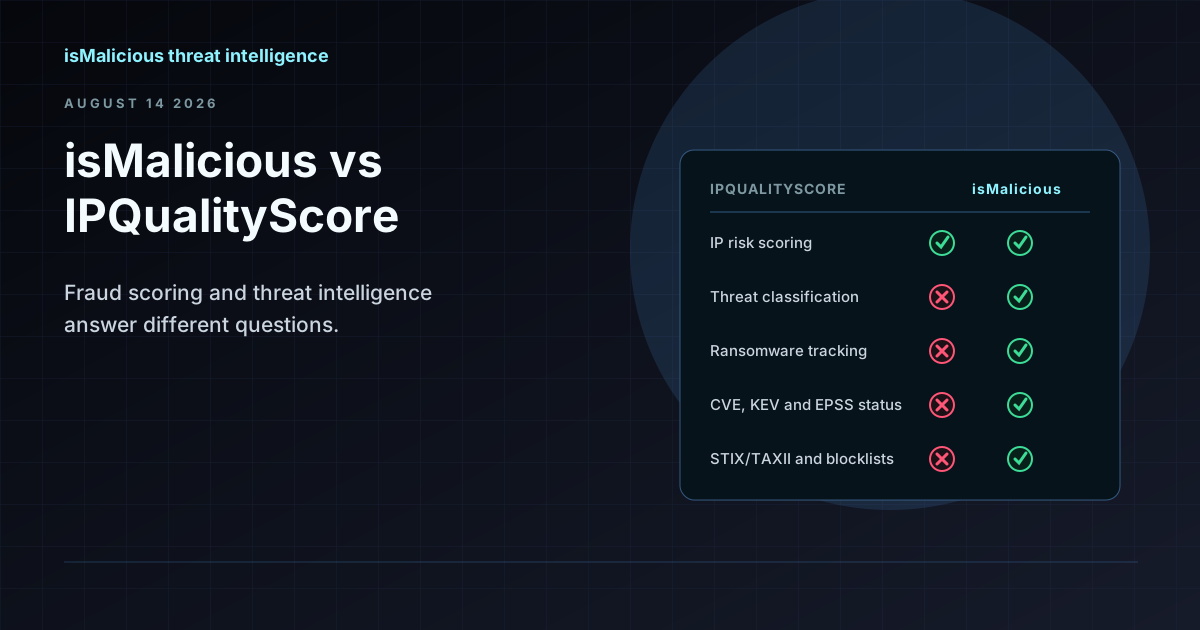 isMalicious vs IPQualityScore: Fraud Scoring and Threat Intelligence Are Different Jobs
IPQS scores whether a signup is fraudulent. isMalicious scores whether infrastructure is malicious. The two get compared constantly because both return a number about an IP address — and they answer different questions.
 Session Token Theft: Why Infostealers Bypass MFA and How Defenders Respond
Infostealers increasingly target browser cookies, session tokens, and refresh tokens. Learn why MFA is not enough, what token theft looks like, and how to detect replay.
Protect Your Infrastructure
Check any IP or domain against our threat intelligence database with indexed records.
Try the IP / Domain Checker