WHOIS Lookup for Security Investigations: Reading a Record After Redaction
Privacy services stripped the registrant name out of most WHOIS records, but the fields that matter for triage survived. Here is what a WHOIS record still tells an analyst, and how to read it.
 IsMalicious Team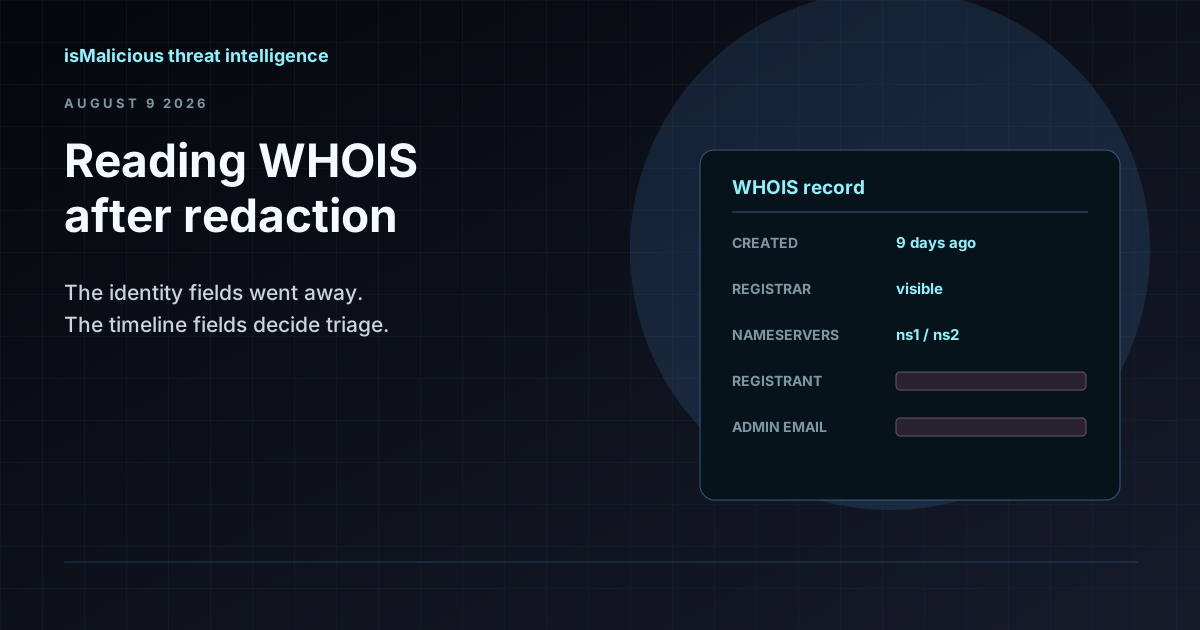
The most common complaint about WHOIS is that privacy services ruined it. Registrant names, emails, and phone numbers are redacted on the large majority of domains, and the technique of pivoting from a registrant email to every other domain that person registered mostly stopped working.
That is true, and it matters less than it sounds. Redaction removed the identity fields. It left the timeline fields, the registrar, the nameservers, and the status codes intact — and those carry most of what an analyst actually uses WHOIS for during triage. A record that tells you a domain was created nine days ago on a registrar with a poor abuse history is doing useful work whether or not you know who owns it.
This guide covers what remains in a WHOIS record, how to read it during an investigation, and where it stops being enough.
What a WHOIS Record Contains
Strip away the formatting differences between registries and every record offers roughly the same fields:
- Sponsoring registrar — the company through which the domain was registered.
- Creation date — when the domain was first registered. The single highest-value field for security triage.
- Expiration date — when the registration lapses without renewal.
- Last updated — when any registration detail last changed, including nameservers and registrar.
- Nameservers — the authoritative DNS servers the domain delegates to.
- Domain status codes — EPP status values such as
clientTransferProhibited,serverHold, orpendingDelete. - Registrant, admin, and technical contacts — often redacted, replaced with a privacy service, or reduced to a forwarding address.
A note on protocol: RDAP is the structured successor to WHOIS, returning JSON with consistent field names rather than free-form text that varies per registry. Registries are migrating to it progressively. For investigative purposes the data is broadly the same; RDAP is simply less painful to parse.
Reading a Record Like an Investigator
The fields are not equally informative. In rough order of triage value:
Creation date is the strongest single signal
Newly registered domains are heavily overrepresented in phishing, malware distribution, and business email compromise, for a straightforward reason: campaign infrastructure does not age well, so attackers keep registering fresh domains. A domain created within the last 30 days that is suddenly receiving clicks from your users deserves scrutiny that the same domain would not warrant at three years old.
Treat this as a weighting factor rather than a verdict. Legitimate businesses register domains every day. But "created 4 days ago" plus "impersonates our brand in the hostname" is a conclusion, not a coincidence.
Nameservers group infrastructure
Nameserver values are one of the few remaining ways to cluster domains that share an operator. Campaigns provisioned through the same hosting or DNS provider frequently share nameserver hostnames, so a nameserver pair that appears across several suspicious domains is a pivot worth following even when every registrant field is masked.
Two caveats: large hosting providers put millions of unrelated domains behind the same nameservers, so shared nameservers at a mainstream provider prove nothing. The signal comes from unusual, low-population nameserver values, not from ns1.bigregistrar.com.
Last-updated dates reveal recent changes
A registration modified in the last few days on a domain that is otherwise years old is worth a look. Domain hijacking, expired-domain repurposing, and nameserver changes preceding a campaign all leave a fresh timestamp here. Pair it with DNS history to see what actually changed.
Status codes reveal registrar action
serverHold means the registry has stopped resolving the domain — frequently the result of an abuse complaint. pendingDelete means it is on its way out and may become available for re-registration, which matters if the domain appears in your allowlists. clientTransferProhibited is ordinary and means nothing on its own.
Registrar reputation is a soft signal
Registrars differ substantially in abuse handling. Some respond to reports within hours; others are consistently overrepresented in abuse data. This is a weak signal individually and a useful one in aggregate — worth noting in an investigation, never worth blocking on.
Expiration dates can indicate intent
A domain registered for the minimum single year and never renewed fits disposable campaign infrastructure. A domain registered for ten years is a weak indicator of a longer-term operation, legitimate or otherwise.
The Redaction Question
Privacy protection appears on a large share of legitimate domains, which means it has almost no discriminating power by itself. Treating "WHOIS is private" as suspicious generates false positives at a rate that will exhaust an analyst queue quickly.
Where redaction does matter is in what it forces you to do instead. Since you cannot pivot on registrant email, you pivot on infrastructure: nameservers, hosting IP, TLS certificate details, and DNS history. Those pivots were always more reliable than registrant data, which attackers could falsify freely long before privacy services existed.
Where WHOIS Runs Out
WHOIS answers a narrow question — how and when this domain was registered — and stops. It does not tell you:
- Whether the domain is currently malicious. Registration data has no verdict in it. Reputation is a separate lookup.
- Where the domain resolves now, or resolved last week. That is DNS, not WHOIS, and the difference matters when infrastructure moves mid-campaign.
- What else lives on the same server. Co-hosted domains come from a reverse IP lookup, which is often where a single suspicious domain turns into a cluster.
- Whether the content is a phishing page. Registration data cannot see the page. That requires a URL scan.
In practice the useful unit is not a WHOIS record but a combined picture: registration age from WHOIS, current and historical resolution from DNS history, co-hosting from reverse IP, and a reputation verdict from domain intelligence. Any one alone produces either a false positive or a shrug.
Three Concrete Workflows
Phishing report triage. A user reports a suspicious link. Pull WHOIS on the domain: if it was created in the last two weeks, that alone justifies escalating ahead of the rest of the queue. Check nameservers against other domains from recent reports — a repeated pair usually means one campaign rather than several. Then scan the URL to see the landing page and follow the redirect chain.
Brand impersonation monitoring. Lookalike domains are cheap to register and easy to find once registered. WHOIS creation date tells you which lookalikes are new enough to be part of an active campaign rather than long-dormant defensive registrations by someone else. Status codes tell you which ones a registrar has already suspended, so you do not spend effort on a takedown request that is already resolved.
Incident scoping. During an intrusion, unfamiliar domains surface in DNS and proxy logs. Registration age is the fastest first filter: a domain registered after your suspected initial-access date is almost certainly attacker infrastructure rather than a legitimate service somebody forgot to document.
Automating It
Manual WHOIS lookups are fine for one domain and untenable for the hundred that a single incident produces. The isMalicious WHOIS lookup covers more than 1,000 TLDs, including all major gTLDs and most ccTLDs, with records refreshed on demand and cached for 24 hours so repeated lookups during an investigation do not re-query the registry.
For volume, the API returns registration data alongside reputation, DNS, and hosting context in a single call, which is the shape a SIEM or SOAR playbook wants — enrich the domain alert once, with everything attached, rather than making an analyst assemble the picture from four separate tools. When an investigation produces a list rather than a single indicator, bulk lookups handle domains and IPs in the same request instead of one tab at a time.
The short version: WHOIS lost the field everybody used to talk about and kept the fields that actually decide triage order. Read the dates, cluster on the nameservers, and pair it with resolution and reputation data before drawing a conclusion.
FAQ
Frequently asked questions
What information is in a WHOIS record?
A WHOIS record contains the sponsoring registrar, the creation, expiration, and last-updated dates, the authoritative nameservers, the domain status codes, and — where it has not been redacted — registrant contact details. The registrant identity is masked on most domains today, but the dates, registrar, and nameservers are almost always present and carry most of the investigative value.
Is WHOIS still useful now that most records are redacted?
Yes, because redaction removed the identity fields and left the timeline fields intact. Creation date tells you whether a domain is newly registered, nameserver values group domains onto shared infrastructure, and status codes reveal registrar-level holds or pending deletion. None of those depend on knowing the registrant name.
What is the difference between WHOIS and RDAP?
RDAP is the structured successor to WHOIS. It returns JSON with consistent field names and standard access controls, whereas classic WHOIS returns free-form text that varies by registry and requires per-TLD parsing. Registries are progressively moving to RDAP, but WHOIS remains widely available and the two expose broadly the same registration data.
Does a privacy-protected WHOIS record indicate something suspicious?
On its own, no. Registrar privacy services are the default for a large share of legitimate domains, so redaction has almost no discriminating power by itself. It becomes meaningful only in combination — a domain registered three days ago, behind privacy protection, on a registrar with a poor abuse record, resolving to hosting with prior malicious associations is a very different picture from any one of those facts alone.
Can WHOIS lookups be automated for SOC workflows?
Yes. isMalicious exposes WHOIS through its API alongside reputation, DNS, and hosting context, covering more than 1,000 TLDs with results cached for 24 hours. That lets a SIEM or SOAR playbook attach registration age and registrar context to a domain alert automatically, instead of an analyst running a manual lookup for every indicator.
Related articles
 Parked Domains: Assess the Risk Before Blocking
Distinguish domain parking, expiration, and malicious behavior. Examine actual use and choose a restriction supported by the evidence.
 Reverse IP Lookup: Pivoting on Infrastructure Without Drowning in Shared Hosting
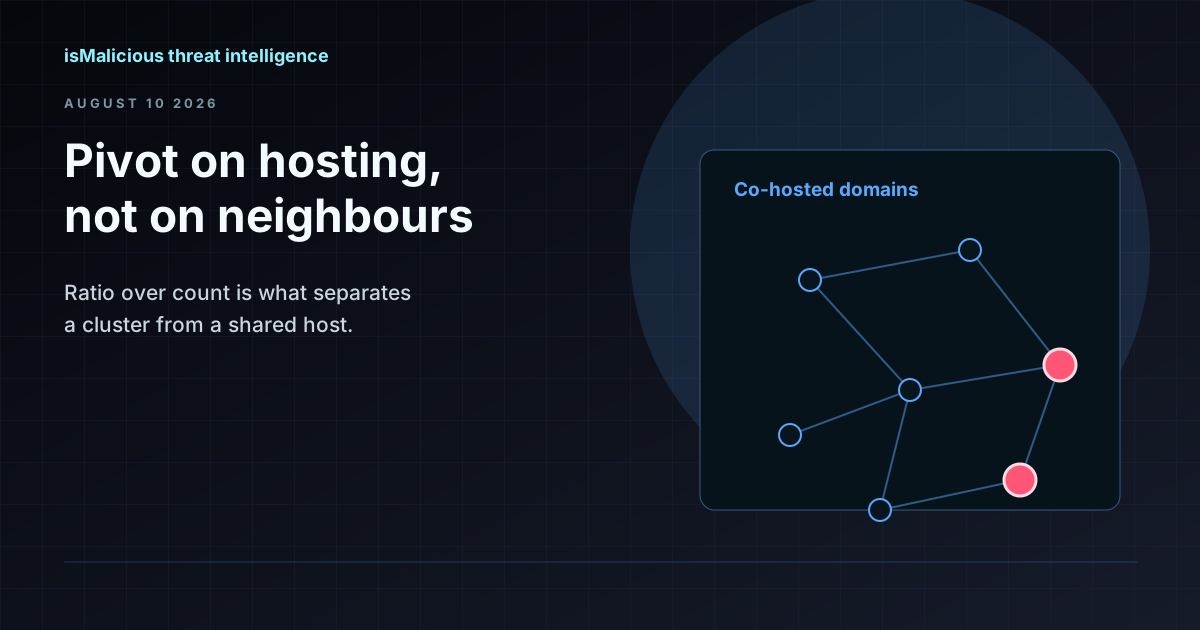
A reverse IP lookup turns one indicator into a cluster — or into a thousand innocent neighbours. Here is how to tell the difference, and how to pivot on hosting infrastructure without generating false positives.
 The Kratos Phishing Kit Takedown: 200 Servers Gone, 1,800 Copies Still Out There
German and US law enforcement dismantled Kratos, the AiTM phishing service behind roughly 15,000 Microsoft 365 campaigns a month. The infrastructure is offline, but the kit is not. Here is what to hunt for now.
Check any IP or domain
See what our indexed threat intelligence records say about it.
Try the IP / Domain Checker