Arch AUR Rootkit And Infostealer Campaign: Supply Chain Defense Starts With Hash Intelligence
The June 2026 Arch User Repository compromise shows why supply chain security needs package review, file hash reputation, developer credential protection, and fast IOC enrichment.
 IsMalicious Team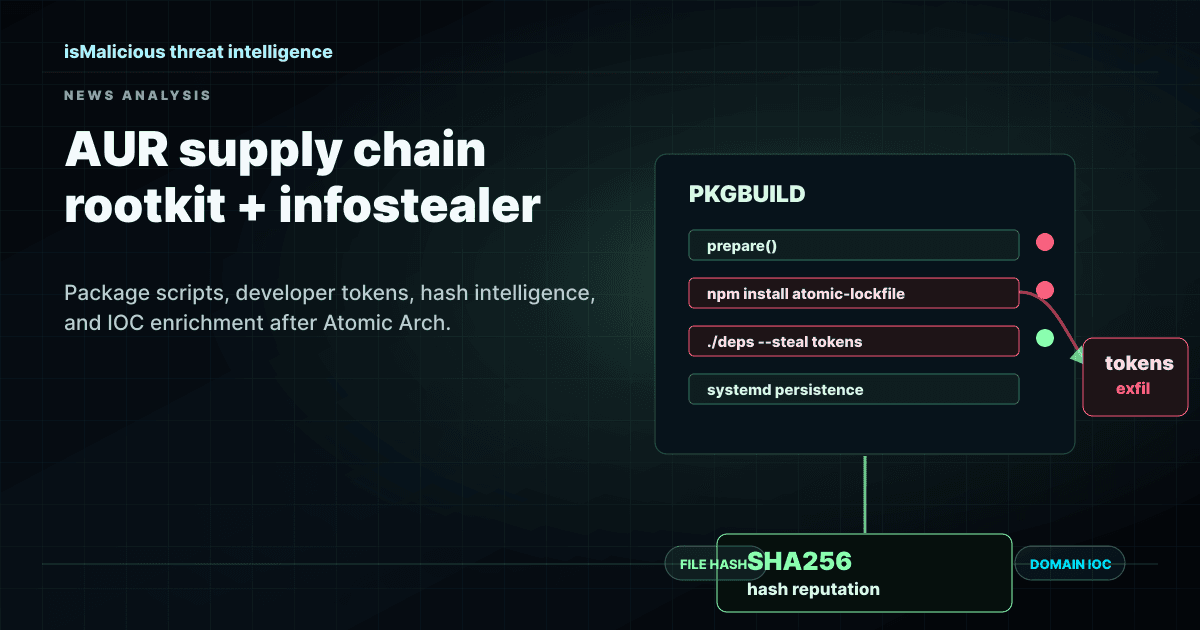
The June 2026 Arch User Repository incident is a sharp reminder that supply chain attacks do not always begin with a glamorous zero-day. Sometimes the attacker changes the recipe and waits for developers to run it. BleepingComputer reported that more than 400 AUR packages were distributing Linux rootkit and infostealer malware, while Sonatype described the Atomic Arch campaign as a takeover of orphaned AUR packages that modified build instructions to install malicious dependencies.
The distinction matters: this was reporting about the AUR, not the official Arch Linux repositories. But for defenders, the impact can still be serious. AUR packages are common on developer workstations, power-user laptops, research machines, lab systems, and sometimes CI-adjacent environments. If a package build script executes malicious logic, it can steal tokens before anyone sees a traditional exploit.
For isMalicious users, this is a case for file hash reputation, IOC enrichment, and developer credential response. Supply chain attacks create many local artifacts: payload hashes, package URLs, download domains, exfiltration endpoints, systemd units, shell histories, and stolen-token traces. The faster those observables are enriched, the faster the team can decide whether a machine is merely exposed or likely compromised.
Supply Chain Trust Is Operational, Not Philosophical
Open-source security conversations often drift into broad trust debates. The AUR incident is more concrete. Community package ecosystems rely on maintainers, review habits, signatures, package metadata, build scripts, and user vigilance. If an attacker can inherit or spoof trust around abandoned packages, the user may run attacker-controlled commands during install or update.
That means defenders should monitor the operational trust path:
- who maintains a package;
- when ownership changed;
- what the build script downloads;
- whether install hooks run network commands;
- whether dependencies were introduced suddenly;
- whether package metadata matches upstream source;
- whether local builds execute scripts with elevated privileges.
The key is not to distrust every package. The key is to make trust observable. A package update that introduces an unexpected network fetch, npm dependency, binary blob, or post-install service should be reviewed before it becomes a fleet-wide problem.
Infostealers Change The Blast Radius
Infostealers are dangerous because developer machines are dense with credentials. A compromised workstation may contain:
- GitHub tokens;
- SSH keys;
- npm tokens;
- cloud CLI sessions;
- Vault credentials;
- browser cookies;
- Slack, Discord, or Teams sessions;
- Docker and registry credentials;
- API keys in shell history or config files.
That is why an AUR package incident can become a broader cloud, source-code, or CI incident. If a stealer ran successfully, removing the package is not enough. The response must include credential rotation, token revocation, suspicious login review, repository audit logs, and endpoint investigation.
The isMalicious article on session token theft and infostealers is relevant here because many stolen sessions bypass normal password reset thinking. If browser cookies or app tokens were taken, MFA may not save the account until sessions are revoked.
File Hash Reputation Is The Fast Local Check
When responders find a suspicious binary, staged archive, script, or dependency, the first practical step is to identify it. File hash reputation helps answer:
- has this hash been reported as malicious?
- is it known clean, unknown, suspicious, or malware-linked?
- which sources agree on the verdict?
- are there related hashes or families?
- does the file connect to known campaign infrastructure?
The isMalicious file hash lookup and guide to SHA256 malware detection support this workflow. Hashes are especially useful in supply chain response because they are stable evidence. Package names and URLs may change, but a payload hash gives responders a precise object to track across machines.
Hash intelligence should be paired with infrastructure enrichment. If the payload contacted a domain, IP, or URL, check that observable too. Use domain intelligence, IP reputation, and URL scanning to understand whether the local file belongs to a broader malicious cluster.
A Practical AUR Incident Checklist
If your organization has Arch Linux users, developer workstations, or lab systems using AUR packages, use a short response checklist:
- Identify systems that installed or updated AUR packages during the relevant window.
- Compare installed package names against trusted affected-package lists.
- Review PKGBUILD and install scripts for unexpected network downloads or hooks.
- Search for known malicious dependency names and payload paths.
- Hash suspicious binaries and enrich them.
- Check outbound DNS, HTTP, and proxy logs for exfiltration endpoints.
- Rotate developer credentials that may have been present on exposed hosts.
- Revoke active sessions for high-value services.
- Rebuild or reinstall systems if rootkit-capable payloads ran with elevated privileges.
- Add confirmed indicators to blocklists and SIEM detection.
This checklist treats developer endpoints as part of the security perimeter. That is increasingly realistic. A stolen GitHub token or cloud credential can be more damaging than a single compromised server.
Do Not Stop At The Package Manager
Package managers are good at tracking files they installed. Attackers are good at creating files package managers do not own. A malicious build script can create services, copy binaries, edit shell profiles, write cron entries, change SSH material, or stage data for exfiltration.
That means cleanup should include:
- systemd service review;
- unusual process and socket checks;
- startup file review;
- browser profile and token exposure review;
- SSH key inventory;
- developer tool credential rotation;
- EDR or forensic capture;
- network egress review.
If a rootkit-like component may have run with privileges, consider rebuild over cleanup. It is often cheaper to rebuild a developer machine than to prove a privileged attacker-controlled payload left nothing behind.
API Enrichment For Supply Chain Events
Supply chain investigations quickly become bulk investigations. One package leads to many hashes. One hash leads to many hosts. One host leads to many domains, IPs, and tokens. Manual lookup is too slow.
Use the isMalicious threat intelligence API to:
- enrich file hashes found by EDR;
- check outbound domains from DNS logs;
- score IPs contacted by suspicious payloads;
- scan URLs embedded in package scripts;
- attach verdicts and source confidence to SIEM alerts;
- push confirmed infrastructure into blocklists.
The API documentation can help teams connect enrichment to existing incident response tooling. The goal is not to replace human investigation. It is to keep humans focused on decisions instead of repetitive copy-paste work.
Conclusion
The Arch AUR campaign shows how attackers abuse trust where developers are most comfortable: package install paths, community repositories, and build scripts. The defense is not one control. It is package review, developer endpoint monitoring, credential hygiene, file hash reputation, infrastructure enrichment, and automated IOC workflows. If suspicious code ran on a developer system, treat it as a credential incident until evidence says otherwise.
Frequently asked questions
- What happened to Arch AUR packages in June 2026?
- Public reporting described a large malicious campaign targeting Arch User Repository packages, with attackers abusing package build scripts to install credential-stealing malware and rootkit-like components.
- Was this the same as official Arch Linux repositories being compromised?
- No. Reporting focused on AUR community packages, which are separate from official Arch repositories. The distinction matters, but AUR compromise can still affect developer machines and build systems.
- Why is file hash intelligence important for supply chain attacks?
- Hash intelligence helps teams identify known malicious payloads, compare staged files, enrich suspicious binaries, and connect local evidence to wider campaign reporting.
- How does isMalicious help with developer supply chain incidents?
- isMalicious supports file hash lookup, IP and domain enrichment, URL scanning, and API workflows that help security teams investigate suspicious packages and credential-stealing payloads.
Related articles
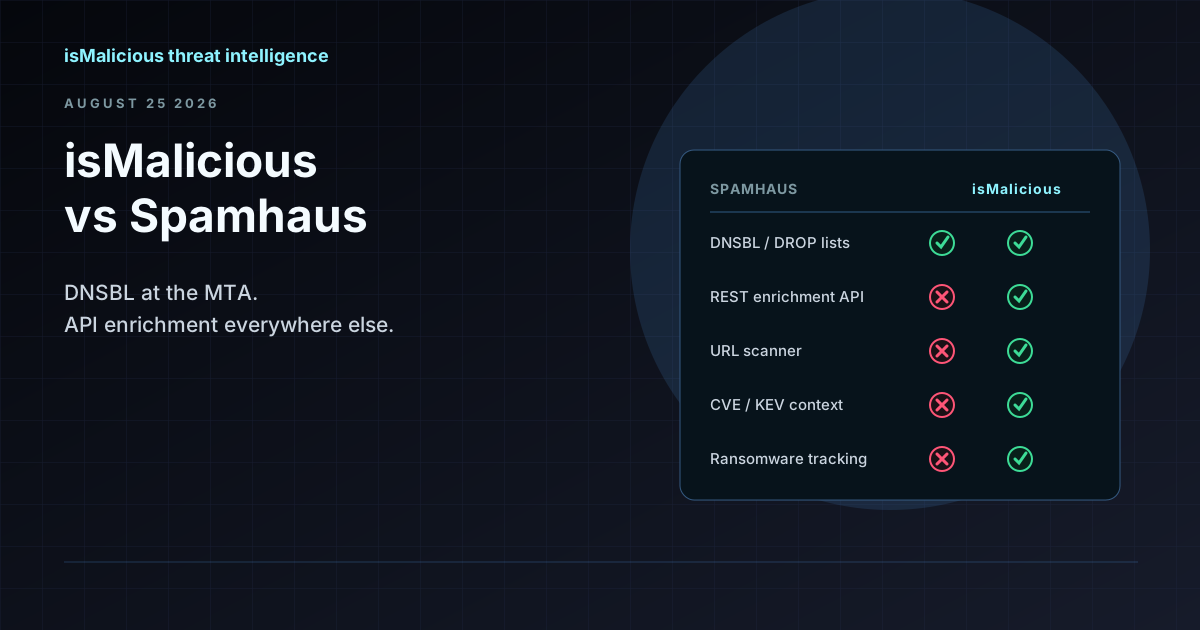 isMalicious vs Spamhaus: DNSBL Blocklists and Threat Enrichment Serve Different Layers
Spamhaus DROP and SBL are the standard for mail and network DNSBL blocking. isMalicious adds REST enrichment, URL scoring, CVE context, and STIX feeds. Most mature stacks use both at different layers.
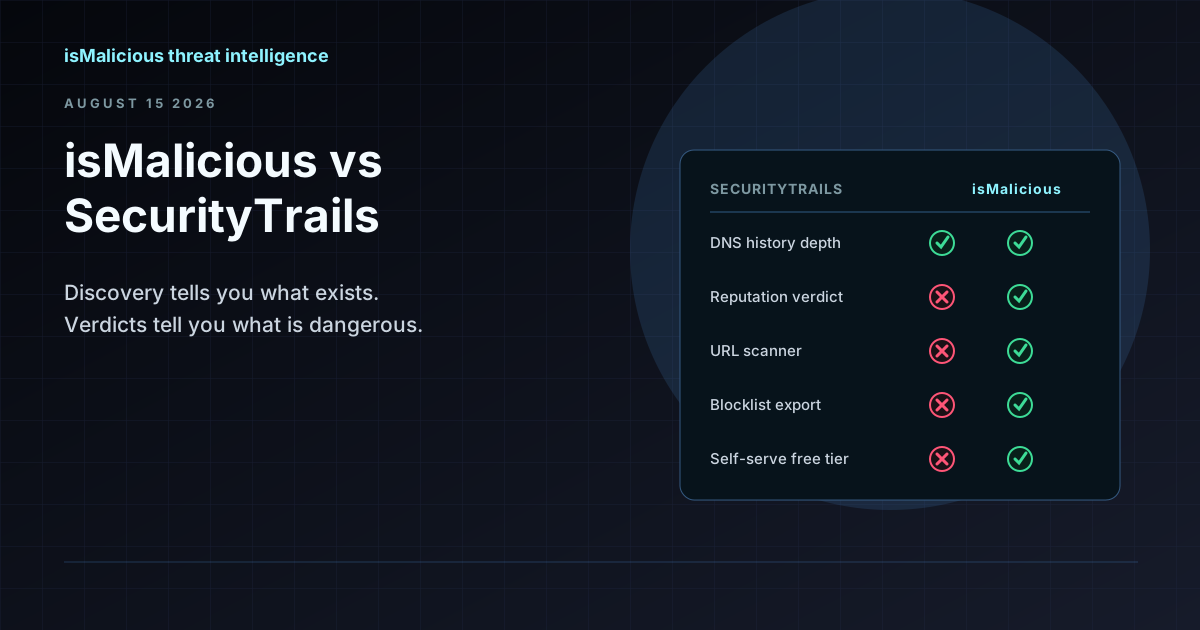 isMalicious vs SecurityTrails: Discovery Data and Reputation Verdicts Are Not the Same Product
SecurityTrails tells you what exists — every subdomain, every historical DNS record. isMalicious tells you what is dangerous. Most teams searching for a SecurityTrails alternative want the second half.
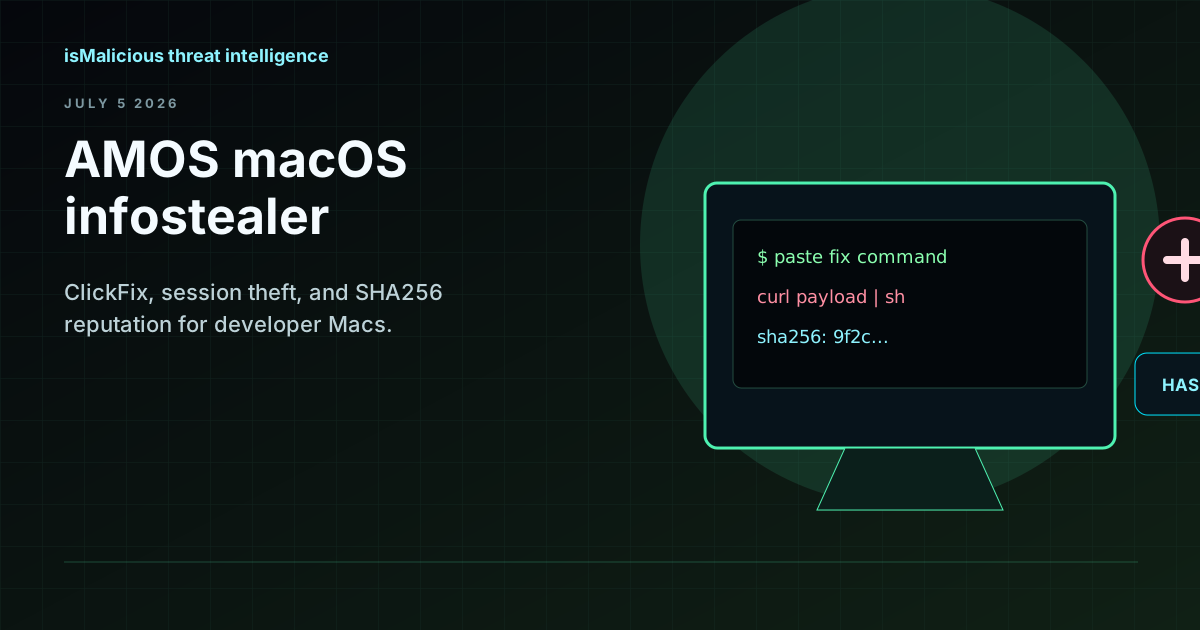 AMOS macOS Infostealer: ClickFix Shows Why Hash Reputation Must Cover Developer Macs
AMOS and related macOS infostealers are turning social engineering into credential theft. File hash reputation, URL scanning, and domain intelligence help teams respond before stolen tokens spread.
Protect Your Infrastructure
Check any IP or domain against our threat intelligence database with indexed records.
Try the IP / Domain Checker