Agentic AI Threat Mapping: MITRE ATT&CK Needs Evidence-Rich Workflows
Anthropic mapped AI-enabled cyber activity to MITRE ATT&CK and found gaps around autonomous orchestration. SOC teams need AI summaries tied to evidence, not unsupported verdicts.
 IsMalicious Team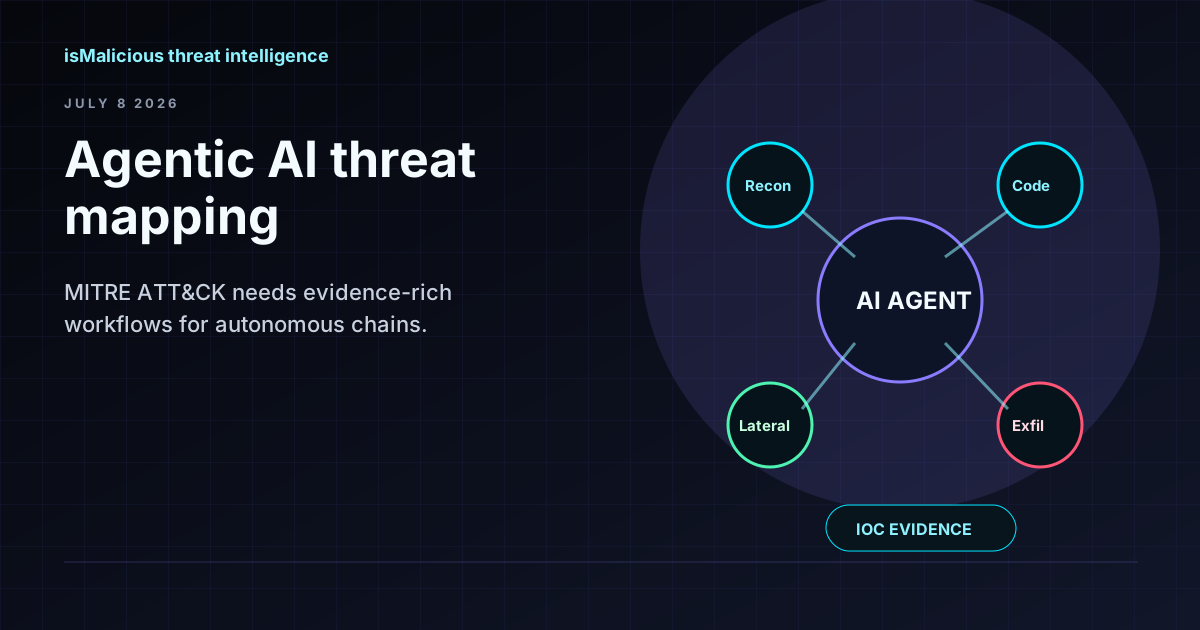
AI-enabled cyber threats are becoming specific enough to map. In June 2026, Anthropic published analysis of malicious cyber accounts mapped to MITRE ATT&CK. The important finding for defenders is not that attackers use AI for phishing. It is that AI is moving deeper into the attack lifecycle, including discovery, privilege escalation, and lateral movement support.
That matters because agentic AI changes pacing. A human attacker may wait between steps. A model-driven workflow can chain tasks, run tools, summarize results, and choose the next action. ATT&CK remains useful, but technique mapping alone may understate the risk when orchestration is the real capability.
ATT&CK Mapping Is Necessary But Incomplete
MITRE ATT&CK gives defenders a shared language. It helps map observed behavior to tactics and techniques, compare cases, and build detections. But it does not automatically answer:
- how much autonomy was involved;
- whether AI chained multiple phases;
- what observables remain after each step;
- where the defender can add friction;
- which enrichment signals support the technique mapping.
This is why AI-generated assessment needs evidence-rich workflows. A summary saying "possible lateral movement" is weak unless it links to accounts, hosts, commands, domains, IPs, hashes, and timestamps.
Infrastructure Still Creates Evidence
AI can generate code, lures, and decisions, but attacks still leave infrastructure traces. SOC teams should enrich:
- phishing domains and fake login URLs;
- IPs used for scanning or callbacks;
- payload hashes and loaders;
- DNS history for campaign clustering;
- certificate reuse across domains;
- suspicious SaaS and SSO login endpoints.
Use domain intelligence, URL scanning, IP reputation, file hash lookup, and DNS history to anchor AI-assisted analysis in evidence.
Detection Engineering Implications
Detection teams should avoid rules that only say "AI attack." That label is not observable. Build detections around behaviors that AI can accelerate:
- unusually fast reconnaissance across many services;
- scripted account discovery after a low-value foothold;
- repeated payload variations with shared infrastructure;
- command sequences that look tool-assisted;
- phishing infrastructure that creates many domain variants;
- rapid pivoting from one identity store to several SaaS apps.
Then map the behavior to ATT&CK where possible and attach the enriched observables. This gives the SOC a usable narrative: what happened, which technique it resembles, which indicators support the case, and what containment step follows.
Agentic AI may blur the line between low-skill and high-skill actors. The defensive response is not to over-index on actor labels. Focus on behavior, infrastructure, and blast radius.
Keep AI Away From Unsupported Verdicts
AI should help analysts read the case. It should not decide that an indicator is malicious without evidence. A reliable workflow looks like this:
- collect observables from alerts and logs;
- enrich observables with trusted sources;
- record source confidence and freshness;
- map behavior to ATT&CK where evidence supports it;
- ask AI to summarize and propose next steps;
- preserve the raw evidence in the case.
The earlier isMalicious guide on AI-enabled cyberattacks and MITRE ATT&CK covers the broader framework. This article focuses on the July 2026 operational angle: agentic orchestration makes evidence discipline more important, not less.
What To Put In The Case Record
Every AI-enabled investigation should preserve the raw material: the original alert, affected user, commands, URLs, domains, IPs, file hashes, enrichment response, ATT&CK mapping, and analyst decision. This record matters for detection improvement and for executive reporting. It also prevents AI summaries from becoming the only memory of the incident.
Operational CTA
Review API Docs, connect enrichment to SOC workflows, and use source-backed IOC context before asking AI to summarize an investigation. Agentic AI makes attackers faster. Evidence quality keeps defenders from becoming faster at being wrong.
Frequently asked questions
- What makes agentic AI different in cyber operations?
- Agentic AI can chain steps, make intermediate decisions, operate tools, and move across phases of an attack with less human input than a simple chat prompt.
- Does MITRE ATT&CK fully describe AI-enabled threats?
- ATT&CK remains useful for behavior mapping, but AI orchestration and autonomous chaining may not be fully represented by existing technique IDs.
- How should SOC teams use AI threat summaries?
- Use AI to summarize evidence, map likely techniques, and propose next actions, while keeping verdicts grounded in telemetry, enrichment, and documented source confidence.
- How does isMalicious help with AI-enabled threat workflows?
- isMalicious enriches IPs, domains, URLs, and hashes, supports MITRE-oriented analysis, and exposes API workflows that can feed SOC automation.
Related articles
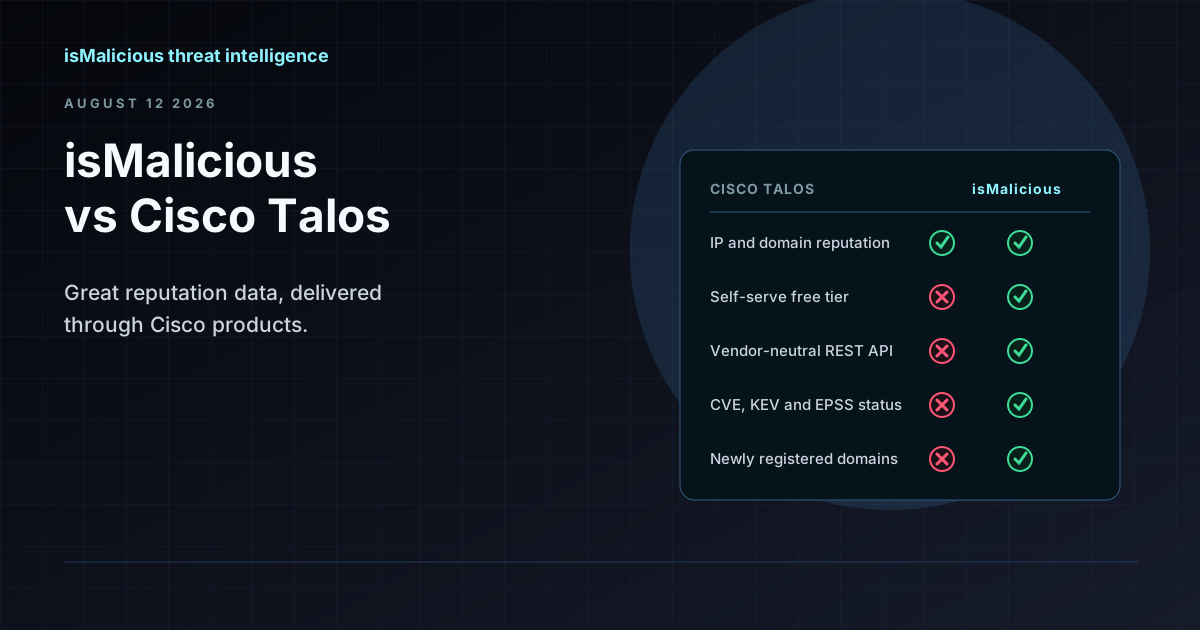 isMalicious vs Cisco Talos: Reputation Lookups Outside the Cisco Stack
Talos reputation is excellent and it lives inside Cisco products. If your stack is not Cisco, or you need an API rather than a web form, that is where the comparison starts.
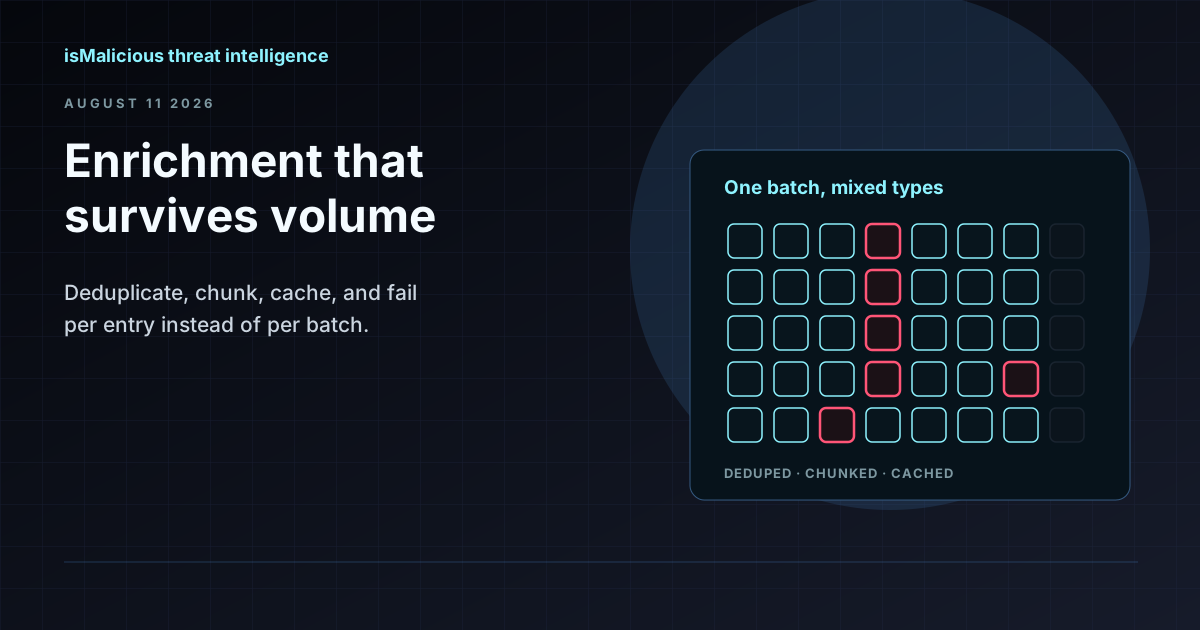 Bulk IP and Domain Lookups: Designing Indicator Enrichment That Survives Real Volume
One incident produces hundreds of indicators, and per-indicator lookups are where triage stalls. Here is how to build a batch enrichment pipeline that respects quotas, deduplicates properly, and fails gracefully.
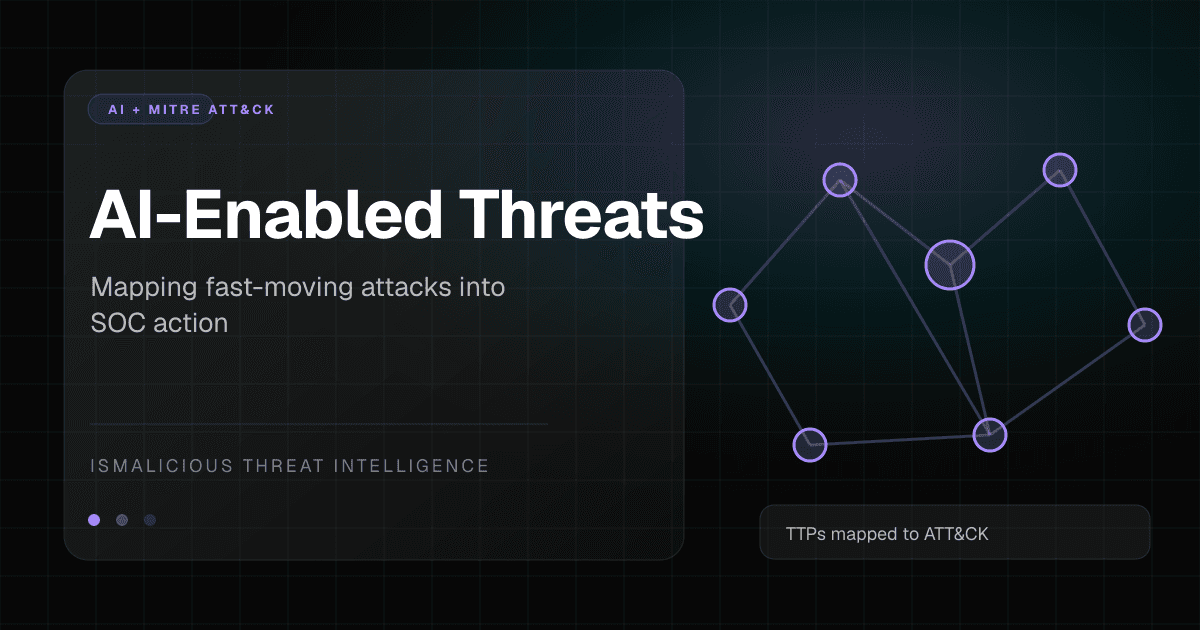 AI-Enabled Cyberattacks and MITRE ATT&CK: Turning New Threat Maps Into SOC Action
AI-enabled threats are being mapped into ATT&CK language, but mapping is only useful when it drives enrichment, detection, triage, and response workflows.
Protect Your Infrastructure
Check any IP or domain against our threat intelligence database with indexed records.
Try the IP / Domain Checker