YARA vs Sigma: Which Detection Rule Should You Use?
Compare YARA and Sigma by data source, purpose, portability, performance, false positives, testing, and threat-intelligence workflow.
 IsMalicious Team
Threat reports often end with “deploy a YARA rule” or “add a Sigma detection.” The formats are complementary, not interchangeable. YARA asks whether content matches a pattern. Sigma asks whether recorded events match a behavior.
Choosing the right rule starts with the available data and the decision you want to make.
YARA in One Sentence
YARA rules inspect strings, byte patterns, file structure, metadata and conditions. The official YARA documentation explains a syntax built around strings and a condition.
Use YARA for:
- malware sample triage;
- file and memory scanning;
- family-level code or configuration patterns;
- hunting in repositories or forensic collections;
- identifying packed or embedded content with careful rules.
YARA can find a family after hashes change, but broad strings and expensive expressions can create false positives or performance problems.
Sigma in One Sentence
Sigma rules describe suspicious events in YAML using a log source, selections and conditions. The Sigma rule documentation shows how a generic rule can be converted for different SIEM backends.
Use Sigma for:
- process, authentication and cloud audit events;
- PowerShell or command-line behavior;
- persistence and privilege changes;
- network and DNS logs;
- correlation across identity and endpoint telemetry.
Sigma portability depends on field mapping and collection. A perfect rule cannot detect an event your environment never logs.
A Practical Decision Table
Choose YARA when the primary evidence is a file, memory region or binary object. Choose Sigma when it is an event sequence, field value or behavior in logs. Use both when malware content and execution behavior reinforce one another.
Example: a malicious loader contains a stable encrypted-configuration marker. YARA finds the file. After execution, it launches a script interpreter, creates persistence and contacts a new domain. Sigma detects that behavior. File hash reputation, domain intelligence and IP context connect both detections to a campaign.
Translating Threat Intelligence Into Rules
Start with an explicit hypothesis:
- what malicious behavior or content is distinctive?
- which benign software can share it?
- what telemetry or object contains the evidence?
- how long will the signal remain useful?
For YARA, prefer several moderately stable features over one common string. For Sigma, identify the exact log source and fields before writing the selection. Attach references, author, date, status and known false positives.
Do not paste IOCs into a rule and call it behavior. Domains and hashes expire; maintain them as governed indicator lists unless the rule genuinely describes a durable pattern.
Testing and Release Gates
Test YARA against confirmed malicious samples and a large clean corpus representative of production. Record scan time and memory use. Test Sigma against saved positive events and normal logs from every target backend.
Use a lifecycle:
- experimental rule with narrow deployment;
- analyst review of matches;
- tuning and explicit exceptions;
- wider release;
- periodic validation and retirement.
Version rules in source control, require peer review and connect changes to incidents or research.
Common Failure Modes
- YARA strings copied from public samples without checking common libraries.
- Sigma rules written for fields that are absent or normalized differently.
- Critical severity assigned without precision evidence.
- No owner, expiry or test corpus.
- Rules left active after the campaign and software landscape change.
- Backend conversion accepted without inspecting the generated query.
Operating Both as One Detection Product
Link YARA matches to process execution, network connections and account activity. Link Sigma alerts back to collected files and memory. Enrich IOCs with bulk reputation checks and feed confirmed outcomes into rule tuning.
Measure precision, time to deploy from intelligence publication, coverage by data source, performance cost and incidents where one rule type confirmed the other.
Conclusion
YARA recognizes content; Sigma recognizes logged behavior. The right choice follows the evidence, not tool preference. Use both inside a reviewed detection engineering workflow, with threat intelligence providing context and incident outcomes providing quality control.
Frequently asked questions
- What is the main difference between YARA and Sigma?
- YARA primarily matches properties inside files, memory, or byte streams. Sigma describes detections over structured event logs and is converted into queries for SIEM and analytics backends.
- Can Sigma replace YARA for malware detection?
- No. Sigma can detect malware behavior recorded in logs, while YARA can identify content and code patterns. Mature programs use both at different stages.
- Which format is more portable?
- Both aim for reuse, but portability depends on data. Sigma needs mapped log fields and backend conversion; YARA needs access to comparable file or memory content and compatible modules.
Related articles
 Kubernetes Audit Logs: Threat Detection Guide
Turn Kubernetes audit logs into detections for privilege abuse, secret access, persistence, risky exec, and control-plane compromise.
 Proxy, VPN, Tor, and Datacenter IPs: A Decision Matrix for WAF, Fraud, and SIEM Rules (Without Breaking Real Users)
Not every "datacenter" IP is malicious, and not every Tor exit is a fraudster. This matrix-style guide helps you combine IP type signals with reputation and product context for safer, explainable security decisions.
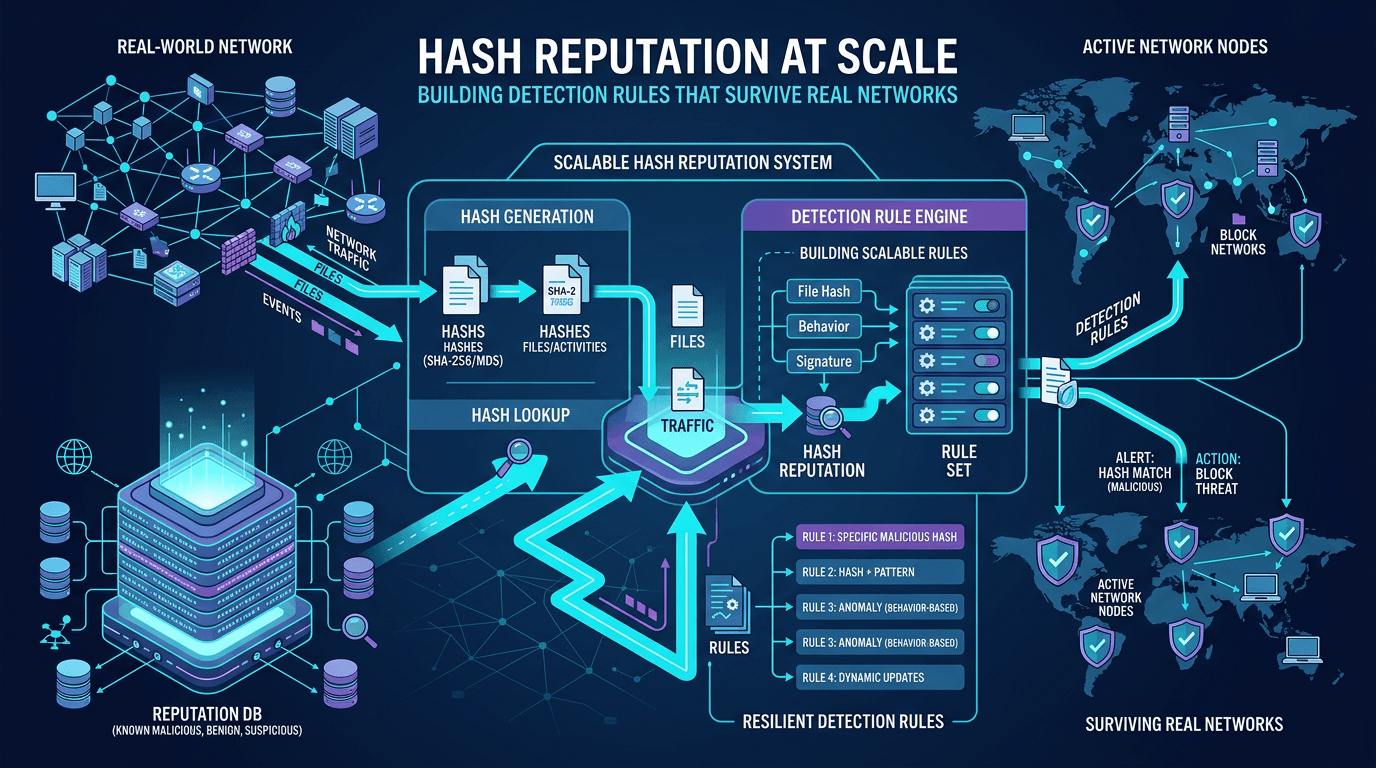 Hash Reputation at Scale: Building Detection Rules That Survive Real Networks
Move beyond one-off hash blocks: design reputation pipelines, reduce false positives, and integrate file intelligence with IP and domain context for production-ready detection engineering.
Protect Your Infrastructure
Check any IP or domain against our threat intelligence database with indexed records.
Try the IP / Domain Checker