Threat Intelligence Reports for Executives: A Practical Template
Write a CTI brief executives can use: the required decision, business impact, evidence, uncertainties, options, and follow-up, with a template and worked example.
 IsMalicious Team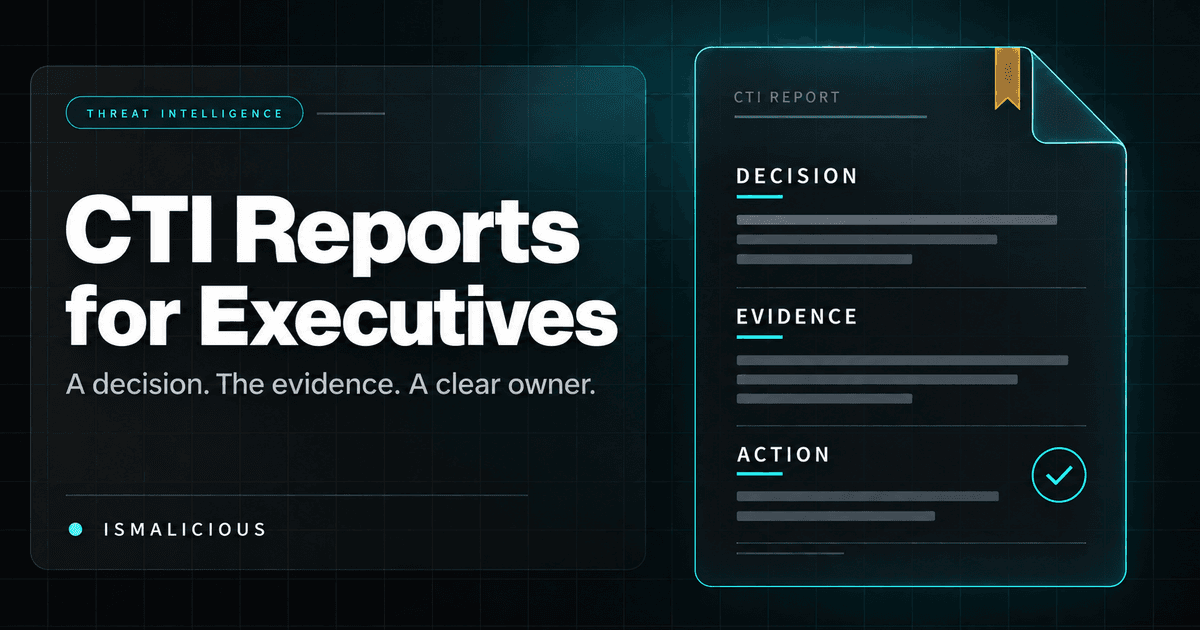
A threat intelligence report for executives should help its reader choose: reduce an exposure, accept an exception, fund a verification task, or change a priority. Put the main judgment and required decision before the catalogue of threats.
On September 10, 2026, a Reddit contributor asked whether turning KEV entries into CTI reports creates practical value. The question included the intended audience and duplication of information already available elsewhere. This individual case illustrates a useful test: what decision can the recipient make because this brief exists?
The template below concerns a brief for an executive decision-maker. It preserves the technical case file while organizing the assessment so that facts, options, and limitations remain visible when a choice is made.
Identify the reader and decision before writing
“For leadership” does not define the audience precisely enough. An operations director, finance executive, and risk committee can receive the same information while exercising different responsibilities. Name the person or body that must decide and confirm the route through which the brief should reach them.
The NCSC guidance on communicating with boards emphasizes the recipient's language and priorities. It distinguishes specialist advice from the responsibilities of those making risk decisions. A CTI brief should enable that choice without requiring its reader to become an analyst.
Complete this sentence before drafting: “This person must choose between these options by this deadline because this business activity is affected.” If you cannot finish it, clarify the request. An informational brief can still be appropriate, but its purpose and cadence should be explicitly agreed.
The PIR and collection-plan workbook can establish that decision contract before the evidence gathering begins.
Check which decisions have already been delegated. A SOC should not wait for an executive meeting to apply an authorized response measure. Escalate what exceeds the team's mandate, requires a trade-off between business functions, or changes an organizational priority.
The useful delivery time also matters. A technically accurate report received after the customer has signed a contract or frozen a change window may no longer serve its original purpose. Agree on a shorter preliminary assessment when waiting for a polished document would close the available options.
Separate the external threat from local exposure
A campaign observed elsewhere can justify a check without establishing that your organization is affected. Preserve three layers: what is known about the threat, what is known about local exposure, and what could happen to the business.
For example, a primary report describes abuse of remote access. Your inventory shows that suppliers use a comparable access mechanism. The combination creates a control question. It does not establish that those suppliers are compromised or that the reported campaign currently targets your company.
The PHIA Common Analytical Standards call for independent analysis, explicit uncertainty, and attention to the quality of its foundations. In an enterprise brief, the practical implication is to expose reasoning gaps instead of concealing them in alarming language.
The guide to CVE prioritization with EPSS, CVSS, and KEV explains technical signals. In an executive report, those signals should inform a choice with a known scope, dependencies, and owner.
Be equally careful with a reassuring result. A patch status export can establish deployment state for inventoried systems. It does not prove that every relevant system was inventoried or that no exploitation occurred before the patch. Carry those boundaries into the judgment when they affect the decision.
Build a first page that supports a choice
The following is an original editorial template. Adapt it to the reporting format your organization already uses. Each field needs case-specific information rather than a cautionary sentence repeated in every edition.
Subject: required decision and affected business activity
Recipient and decision deadline:

Main judgment:
What changed since the previous brief:
Why our business is affected:

Decisive evidence:
Unknowns that could change the judgment:
Confidence and its basis:

Recommended option and expected effect:
Other options and their consequences:
Decision requested:

Implementation owner:
Next verification and reassessment trigger:
Case and appendix references:
The title can already communicate the choice. “Restrict supplier access during maintenance” is more informative than “Week 38 CTI bulletin.” Keep the date and case identifier in the record, but do not let administrative metadata replace the actual subject.
The first page should be understandable without the appendix and challengeable through it. For each important claim, the reader or their staff should be able to retrieve the evidence, its origin, and its period. Brevity does not justify removing the uncertainty on which the whole judgment depends.
Avoid forcing every case into the same number of findings. One decisive observation can deserve more space than five peripheral indicators. The structure should make the choice easier to assess rather than make unrelated investigations look identical.
Worked example: deciding how maintenance access should operate
The following scenario is entirely fictional. A company depends on a supplier to maintain its order management system. Permanent access remained enabled after an earlier intervention. Another maintenance window is approaching, and the security team reviews the access arrangement.
A weak brief might announce: “Supplier attacks are increasing. Adversaries use advanced techniques. We recommend stronger vigilance and the adoption of best practices.” The reader does not know what changed locally or what they need to approve.
A useful version starts differently: “We recommend replacing permanent maintenance access with access limited to the scheduled window. Operations confirms that this arrangement permits the intervention. The current account remains available more broadly than the identified business need requires.”
The next paragraph defines scope: “Selected threat reports describe remote access abuse with comparable prerequisites. We have not established compromise of the supplier or our system. This review concerns an exposure and an operational option for reducing it.”
The requested decision is explicit: approve the revised maintenance arrangement, name an implementation owner, and verify that access closes afterward. The brief does not request abstract approval of “better cybersecurity.”
Each hypothetical finding should have a supporting record in the training case: the access state, the operations confirmation, and the report describing the prerequisite. A strong opening cannot compensate for evidence that is missing from the file.
Explain options without hiding their costs
Present the options that remain feasible, including those you do not recommend. In the fictional example, retaining access avoids an immediate change but preserves the exposure under review. Restricting access requires coordination with operations. Postponing maintenance could reduce one short-term concern while prolonging another operational constraint.
For each option, identify dependencies, reversibility, and the person who confirmed feasibility. A technically possible measure can be impractical during a critical business period. CTI should not invent the commercial effect of postponement. Ask the business owner and retain the answer as a validated or unresolved assumption.
Do not manufacture a loss amount to make the recommendation more persuasive. When data is unavailable, describe the activity: order processing, service availability, access to records, or maintenance capability. The appropriate owners can quantify a scenario using their established methods.
A recommendation also needs a condition under which it should be reconsidered. If maintenance fails under the proposed configuration, who decides what happens next? If the exposure disappears before the meeting, does the request remain on the agenda? These conditions stop a recommendation from surviving automatically after the situation changes.
The status quo is an option with consequences, not a neutral baseline. Describe what remains exposed and what monitoring can and cannot establish. This lets the reader compare choices without treating the absence of an immediate change as the absence of risk.
State what is missing and what challenges the conclusion
The uncertainty section should identify information that could change the reader's choice. “All intelligence is uncertain” does not help. “We have not confirmed the accounts used by the overnight subcontractor” identifies a collection need and a possible owner.
Show evidence that conflicts with your preferred option. In the example, a tested restriction that prevents an essential operation changes the recommendation. Independent evidence that the account was already disabled changes the exposure assessment. These findings should not remain hidden in the analyst's working notes.
Confidence applies to a particular judgment. You may be sure that permanent access exists while having little visibility into how the supplier uses it. One confidence label at the top of the report compresses those differences. Explain separately the uncertainties that matter to the choice.
The guide to CTI risk scoring and false positives develops this issue for technical indicators. An executive brief should preserve the distinction between a reputation score, a local observation, and an assessment of business consequences.
If the uncertainty cannot be resolved before the deadline, state the decision that remains possible with current evidence. The customer might choose a reversible precaution, a bounded exception, or further investigation. The analyst's role is to explain the basis and consequences of those options rather than remove uncertainty through stronger adjectives.
Describe what changed between versions
A recurring report should make its evolution visible. Add a sentence explaining the change: another affected system, better visibility, a completed action, withdrawn evidence, or an option that is no longer feasible. A newer date alone does not tell the recipient why the case deserves another reading.
If the judgment is stable but collection improved, say so. The recommendation might remain unchanged while operations has now confirmed the closure procedure. If no additional verification occurred, avoid implying that the situation was just reassessed.
Retain previous versions with their historical context. Report history and evidence reuse helps connect a recommendation to what was known when it was made. That chronology matters when a decision-maker later asks why an option was selected.
A correction should travel as far as the claim it replaces. If the brief was summarized in a committee record, ticket, or financial update, identify those copies. Quietly modifying the source document leaves an earlier conclusion available to guide decisions.
Make the current reference version easy to find. A reader should not have to infer which of several attachments is authoritative from its filename or the order in which messages arrived.
Prepare an appendix that supports the assessment
The appendix should enable targeted verification. Group evidence by judgment rather than discovery order. For each item, explain what it establishes, what it does not establish, its date, and its source.
A configuration excerpt can establish an access right at a point in time. A log can show use within a covered interval. An external report can document a technique. Do not require the reader to reconstruct those evidential roles from a list of twenty links.
Sensitive material may require a more restricted appendix. The first page can identify that the evidence was reviewed, who reviewed it, and how an authorized reviewer can inspect it. The guide to intelligence sharing between organizations explains why a distribution boundary should be defined.
For addresses, domains, or files in the case, file hash reputation and IOC enrichment describes useful technical context. An indicator list without roles or time periods is not a sufficient evidence appendix.
Remove material that does not support a judgment or a necessary verification. Keeping everything in the working case is different from sending everything to the executive audience. The appendix should make the assessment inspectable without becoming an uncurated evidence dump.
Review the brief as a reader encountering it for the first time
Ask someone capable of challenging the reasoning to review the draft, then involve someone who understands the affected activity. These reviews answer different questions: whether the assessment follows from the evidence and whether the options work in the real business.
The reviewer should be able to restate the required decision without your help. Ask which missing evidence matters most and what event would make them choose another option. If their interpretation differs from your intent, revise the passage before sending it.
Check words that appear precise but are not: critical, significant, targeted, immediate, and controlled. Connect each to a system, period, effect, or criterion. An isolated adjective cannot replace a measurement or an argued judgment.
The CTI-CMM evaluates the support provided to stakeholders. For this brief, use a concrete question: can the recipient make a better-informed choice with a clearer understanding of consequences and unknowns? Page count and citation count do not answer that question.
Close the loop after the decision
Record the choice, its owner, and the conditions accepted. A rejected recommendation can reveal a significant business constraint; an accepted recommendation is not yet an implemented control. Follow execution through the existing operational process and return to the decision-maker if an essential condition no longer holds.
The next edition can be short: what was done, what remains unresolved, and whether the judgment changed. When IsMalicious enrichment contributes to the case, preserve it as dated technical evidence and connect it to the local observation it helps explain. The brief's value lies in the decision it supports and the ability to explain afterward why that decision was made.
Frequently asked questions
- What belongs in a threat intelligence report for executives?
- The requested decision, main judgment, business relevance, decisive evidence, uncertainties, options, and follow-up owner. Put detailed indicators and technical evidence in an accessible appendix when they are not needed to understand the choice.
- How long should a CTI brief be?
- The first page should explain the judgment and decision without requiring the reader to open appendices. Overall length depends on evidence and context. Do not remove a material limitation merely to meet an arbitrary page limit.
- How should a report describe risk without a calculated financial loss?
- Describe dependent business activities, plausible consequences, and the conditions needed for those consequences. Ask business owners to validate assumptions. Avoid assigning a monetary amount or precise probability without appropriate data and a method.
- Should a team issue a report when nothing has changed?
- Follow the delivery agreement with the recipient. Periodic monitoring may require a brief status, but a long report should contribute a useful judgment, change, or decision. State which checks were performed and what they could not establish.
Related articles
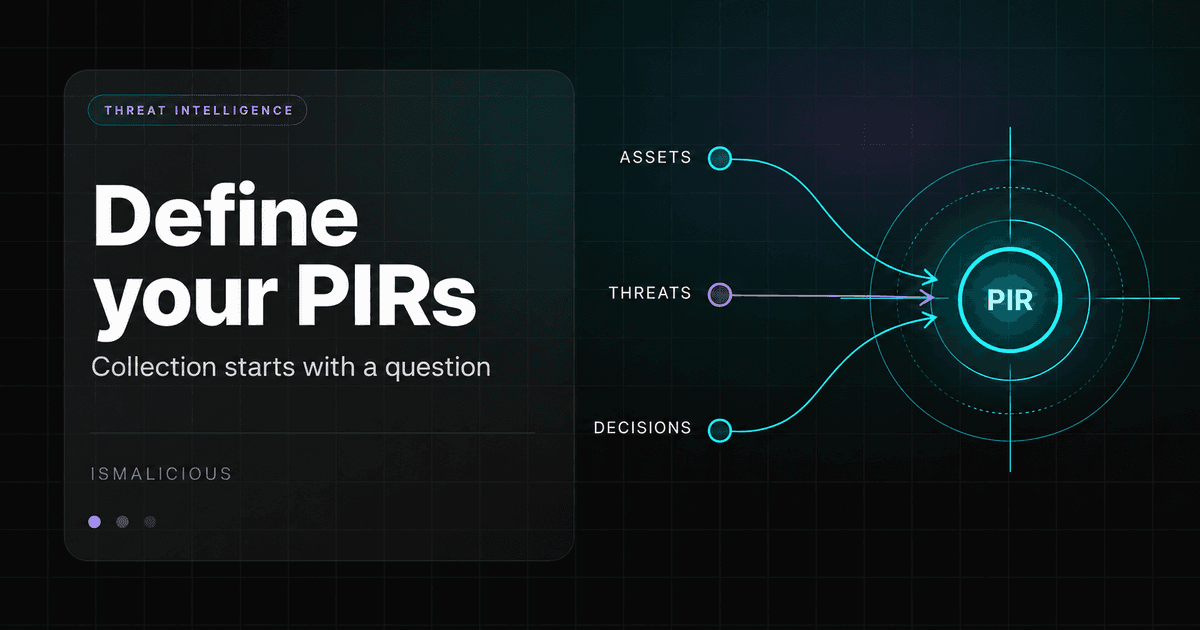 Threat Intelligence PIRs: A Workbook and Collection Plan
Turn threat intelligence requests into useful PIRs with a decision worksheet, collection plan, evidence requirements, ownership, and practical stopping rules.
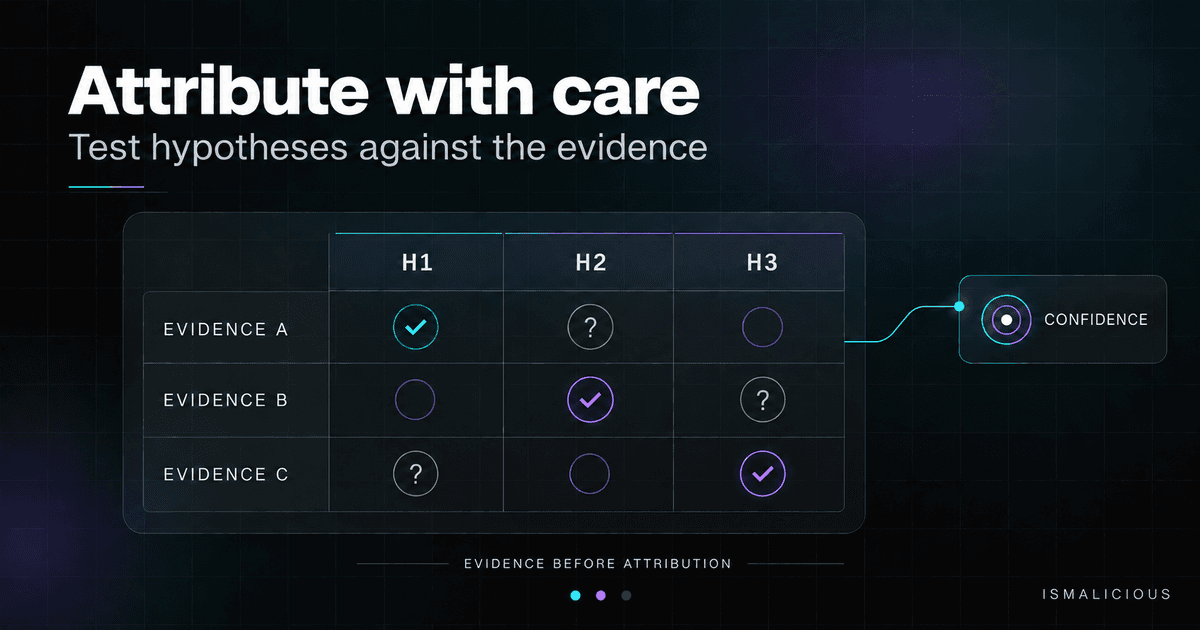 Cyber Attribution: Confidence and Competing Hypotheses
Assess cyber attribution with evidence, competing hypotheses, and explicit confidence. Use a practical judgment record without treating an IOC as an identity.
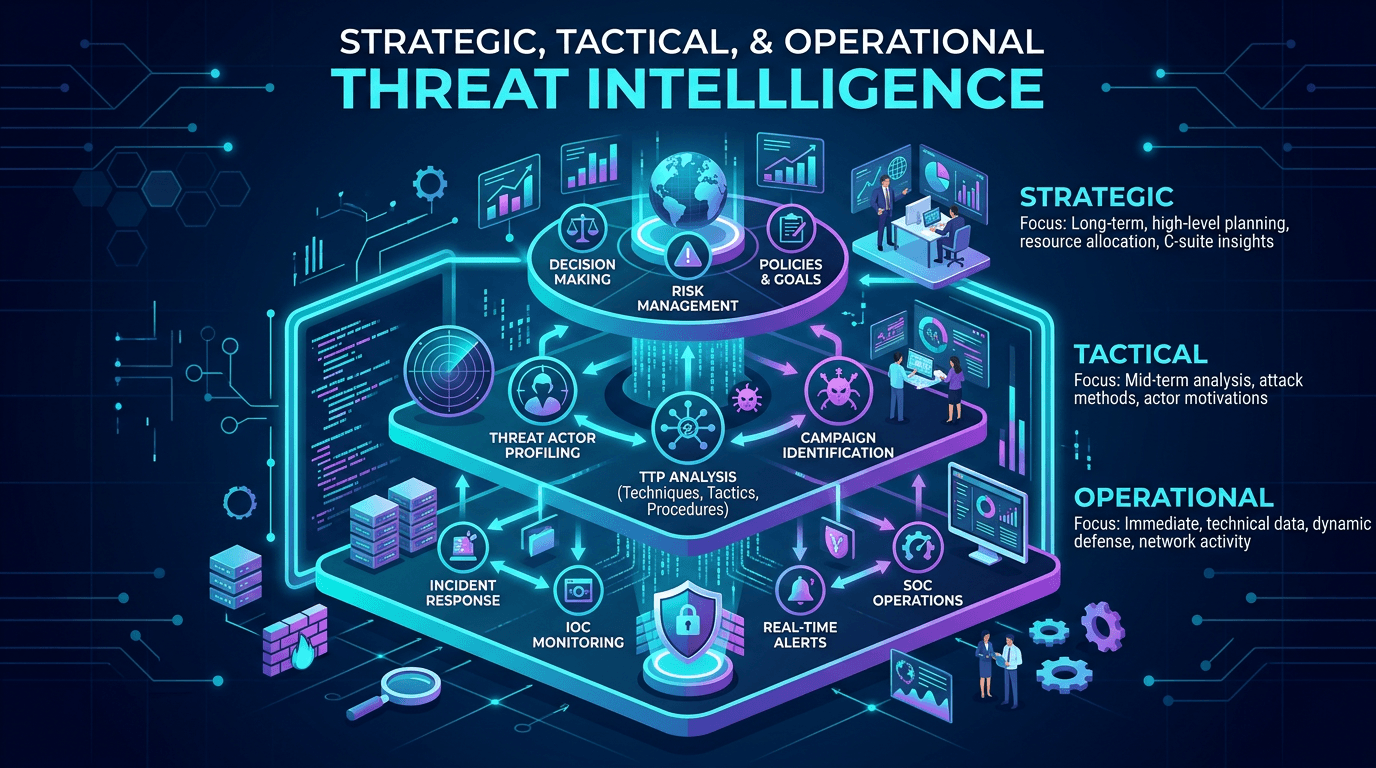 Strategic, Tactical, and Operational Threat Intelligence: Frameworks for Modern Security Programs
Align CTI outputs with audience needs: executive risk narratives, SOC-ready IOCs, and MITRE-mapped TTPs—plus governance models that keep intelligence timely and measurable.
Protect Your Infrastructure
Check any IP or domain against our threat intelligence database with indexed records.
Try the IP / Domain Checker