Threat Intelligence Sharing: How Organizations Fight Back Together
No single organization can monitor every threat alone. Learn how information sharing communities (ISACs), standard protocols like STIX/TAXII, and commercial threat feeds form a collaborative shield against adversaries.


The adversary who attacked a bank in Frankfurt yesterday will often probe a healthcare network in Chicago tomorrow. The tactics, infrastructure, and indicators of compromise are the same, but the two organizations are unaware of each other's experience. Every organization is effectively starting from scratch, reinventing the same detection rules against the same threat actor.
Threat intelligence sharing exists to break this cycle. When organizations pool their observations, blocklists, and adversary profiles, they collectively build detection capabilities that no single entity could develop alone. The defender who discovered a malicious IP address yesterday can warn thousands of others before the same attacker deploys it against new targets.
Why Intelligence Stays Siloed
Despite the obvious value of sharing, most organizations share very little of the threat intelligence they collect. Understanding why helps explain the structural interventions that effective sharing programs must address.
Legal and liability concerns top the list. Sharing information about a compromise means disclosing that you were compromised. Even anonymized indicators can reveal context that sensitive organizations prefer to control. Legal teams often advise caution, and without clear regulatory frameworks that protect good-faith sharing, organizations default to silence.
Competitive dynamics create perverse disincentives in some sectors. Financial institutions may hesitate to share indicators that reveal their fraud detection logic to competitors who are also potential recipients.
Quality and trust issues compound the problem. Low-quality, high-volume feeds containing large numbers of false positives erode trust quickly. If acting on shared intelligence causes operational disruption — blocking legitimate users or flagging clean domains — recipients stop consuming it.
Operational overhead is the practical barrier. Ingesting, normalizing, evaluating, and acting on external threat intelligence requires staff and tools that many organizations lack.
The ISAC Model
Information Sharing and Analysis Centers (ISACs) emerged in the late 1990s as sector-specific frameworks for sharing threat intelligence within critical infrastructure communities. The model was formalized by US Presidential Decision Directive 63, which recognized that critical infrastructure protection required information exchange across sector boundaries.
Today, ISACs operate across more than 25 sectors including financial services (FS-ISAC), healthcare (H-ISAC), energy (E-ISAC), automotive (Auto-ISAC), and technology (IT-ISAC). Each serves as a trusted intermediary that:
- Collects threat indicators from members who may not want to share directly with competitors
- Analyzes and contextualizes raw indicators to improve actionability
- Redistributes vetted intelligence to members who can act on it
- Facilitates real-time communication during active incidents
- Provides anonymization to protect sensitive operational details
The trust model is the ISAC's core value. Members share more freely when they trust that recipients will handle sensitive information appropriately and that attribution will be managed to protect sources.
STIX and TAXII: The Standards Layer
Technical intelligence sharing was historically hampered by format fragmentation. Every vendor, platform, and ISAC used different schemas to represent threat indicators, requiring custom integrations for every data exchange relationship. STIX and TAXII emerged to standardize the representation and transport of threat intelligence.
Structured Threat Information eXpression (STIX)
STIX is a standardized language for describing cyber threat intelligence in a machine-readable format. Rather than sharing an unstructured text email describing a threat, STIX allows organizations to express:
- Indicators of compromise: IP addresses, domains, file hashes, URLs, and behavioral patterns
- Threat actors: attribution, aliases, motivation, and sophistication level
- Attack patterns: how attacks are conducted, mapped to MITRE ATT&CK framework techniques
- Malware: behavioral characteristics, capabilities, and associated threat actors
- Courses of action: recommended defensive responses
- Relationships between all of the above
The structured format enables automated ingestion. A SIEM or SOAR platform that supports STIX can automatically import, index, and apply threat intelligence without manual intervention, enabling response at machine speed.
STIX 2.1, the current version, uses JSON-LD for serialization, making it easy to integrate with modern API-based toolchains. The specification is maintained by OASIS and has broad support across commercial security platforms.
Trusted Automated eXchange of Intelligence Information (TAXII)
STIX defines what threat intelligence looks like. TAXII defines how it moves. TAXII is an application layer protocol that defines the transport mechanism for exchanging STIX objects between systems.
TAXII operates through two primary service models:
Collections function like structured repositories. A TAXII server exposes named collections of STIX objects, and clients can query specific collections or subscribe to receive updates. Organizations sharing malware indicators might maintain a dedicated collection that partners can poll regularly.
Channels support publish-subscribe patterns. Producers push intelligence to channels and consumers receive it in near-real-time, enabling rapid sharing of time-sensitive indicators during active incidents.
Information Sharing in Practice: What Actually Gets Shared
The theoretical architecture of STIX and TAXII creates the rails. Understanding what intelligence flows through those rails is equally important.
Tactical Indicators
The most widely shared class of intelligence is tactical: specific observables that can be directly operationalized as detection rules. IP addresses operating as C2 infrastructure, malicious domains, phishing URLs, exploit hashes, and YARA rules targeting specific malware families all fall into this category.
Tactical indicators are easy to share and act on, but they have a short useful life. Attackers rotate infrastructure constantly. A C2 IP address flagged today may be abandoned within hours and replaced by clean infrastructure tomorrow. High-velocity adversaries deliberately burn indicator sets, knowing that their IOCs will appear in threat feeds and using active campaigns to map what defenders are watching.
Operational Intelligence
Operational intelligence describes how threat actors conduct campaigns: the attack patterns, tooling preferences, infrastructure management techniques, and operational security practices that characterize specific groups over time. This intelligence is slower to age because adversary behaviors evolve more slowly than their specific infrastructure.
Sharing operational intelligence — detailed incident reports, analysis of attacker TTPs, attribution context — typically happens within tighter circles of trusted partners. The information is more sensitive, requires more analytical investment to produce, and carries higher legal and reputational risk.
Strategic Intelligence
Strategic intelligence describes the broader threat landscape: industry-wide attack trends, emerging threat actor groups, geopolitical factors driving threat activity, and forecast developments. This intelligence informs resource allocation, architecture decisions, and long-term security strategy. It circulates through reports, briefings, and analyst communities rather than automated feeds.
Commercial Threat Feeds and APIs
Not every organization has the resources to participate in ISAC membership programs or build TAXII consumer infrastructure. Commercial threat intelligence services package curated, enriched intelligence into accessible APIs that integrate with existing security tooling.
The differentiation between commercial providers lies in coverage, freshness, and enrichment depth. Premium services maintain global sensor networks that observe attack traffic across thousands of organizations, producing indicators with high confidence scores and rich context. They invest in analyst teams that validate automated detections, reduce false positive rates, and produce the analytical context that transforms raw IOCs into intelligence analysts can use.
The ismalicious.com API exemplifies this model: real-time IP and domain reputation scoring backed by continuous threat intelligence collection, accessible via simple API calls without requiring dedicated threat intelligence infrastructure.
Building a Sharing Program
For organizations looking to move from passive consumers to active contributors to the threat intelligence ecosystem, a few principles guide program design:
Start with controlled sharing. Join an ISAC appropriate to your sector and begin sharing indicators through their managed program before attempting direct peer-to-peer exchange. The ISAC handles trust, anonymization, and format standardization, reducing your initial operational burden.
Define clearly what you will and will not share. Work with legal and compliance teams to establish explicit policies governing what categories of information can be shared, with what attribution, and under what terms. Clarity prevents hesitation at critical moments.
Automate ingestion. Consuming threat intelligence manually is not scalable. Invest in infrastructure — SOAR platforms, SIEM integrations, or API middleware — that automatically ingests, deduplicates, and applies external intelligence.
Measure and feedback. Track which shared indicators generate alerts, and report back to sharing partners. This feedback loop improves intelligence quality across the community and maintains the reciprocal trust that sustains sharing relationships.
Contribute quality over volume. A hundred high-confidence indicators with rich context are more valuable than thousands of unvalidated observables. Focus on sharing indicators you have validated through operational observation.
The Collective Defense Imperative
Sophisticated adversaries treat organizational boundaries as arbitrary. They research multiple potential targets simultaneously, reuse infrastructure across campaigns, and apply techniques that proved effective against one sector to others. The information asymmetry between attackers with shared knowledge and defenders operating in isolation benefits only the attacker.
Every organization that participates in threat intelligence sharing shifts this calculus incrementally. The phishing domain flagged by one financial institution that is automatically blocked at a hundred others before a single phishing email is delivered represents real adversary cost. At scale, coordinated defense changes the economics of attack.
The tools exist. STIX and TAXII provide the standard plumbing. ISACs provide the trust frameworks and sector communities. Commercial APIs make curated intelligence accessible without infrastructure investment. What remains is the organizational will to participate.
Related articles
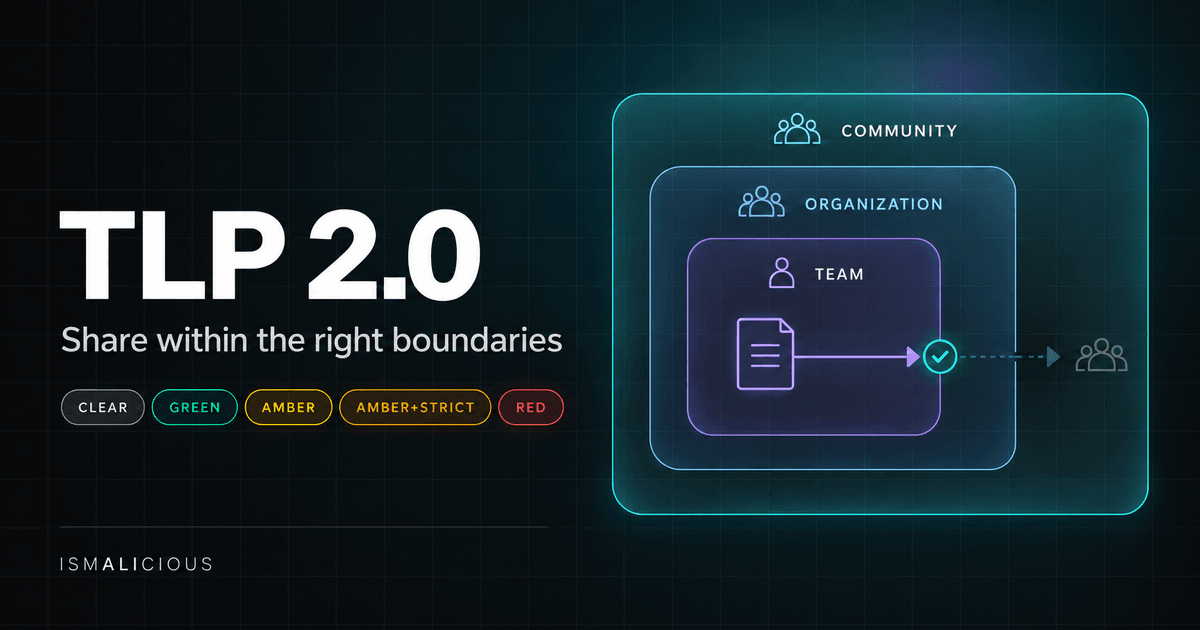 TLP 2.0: Share Threat Intelligence Without Leaking Data
Apply TLP 2.0 to CTI reports, indicators, and supplier exchanges with practical sharing boundaries, permission checks, data minimization, and export controls.
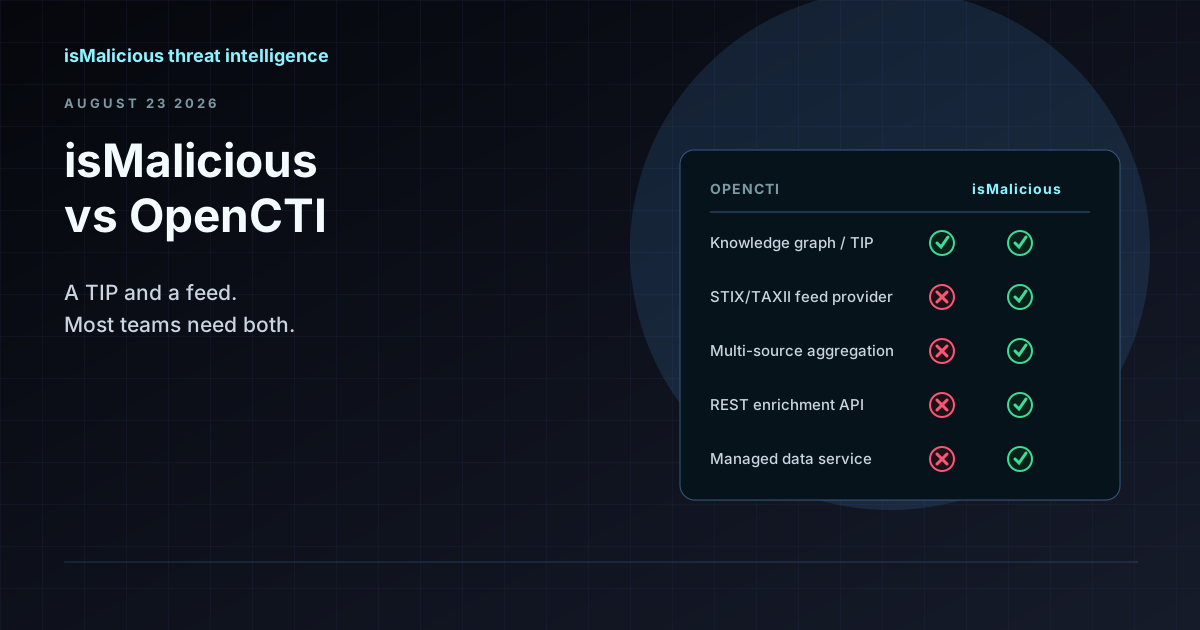 isMalicious vs OpenCTI: Why This Is the Wrong Comparison (and How They Work Together)
OpenCTI is a threat intelligence platform and knowledge graph. isMalicious is a data provider that feeds it. Teams searching for an OpenCTI alternative usually need a feed, not a replacement TIP.
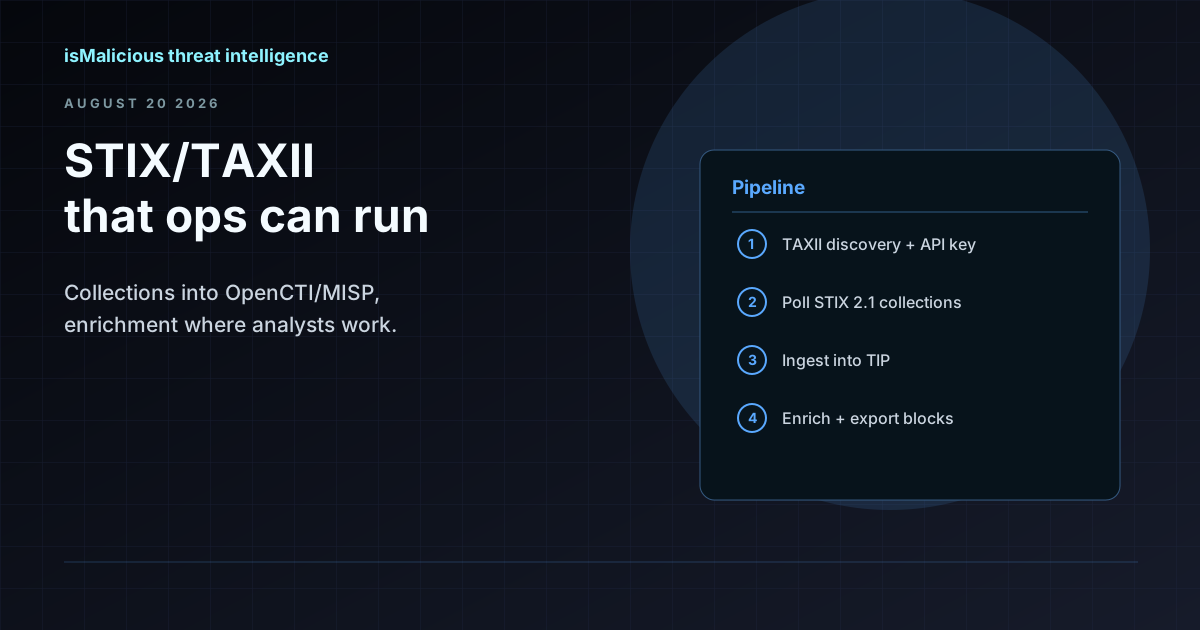 STIX/TAXII Threat Feeds: Operational Guide for OpenCTI, MISP, and SIEM Pipelines
How to wire STIX 2.1 and TAXII 2.1 collections into OpenCTI, MISP, or your SIEM — what to poll, how to handle confidence and aging indicators, and where enrichment APIs fit alongside feed ingestion.
Protect Your Infrastructure
Check any IP or domain against our threat intelligence database with indexed records.
Try the IP / Domain Checker