Ransomware Groups in October 2026: N0n, The Gentlemen, Qilin and 12 Newcomers on the Leak Sites
Our ransomware tracker, read on 15 November 2026: N0n, The Gentlemen and Qilin posted the most leak-site claims in the two 30-day windows that cover October, and 12 groups made their first claim during the month. N0n also shows why a claim count is not a victim count.
 isMalicious Team
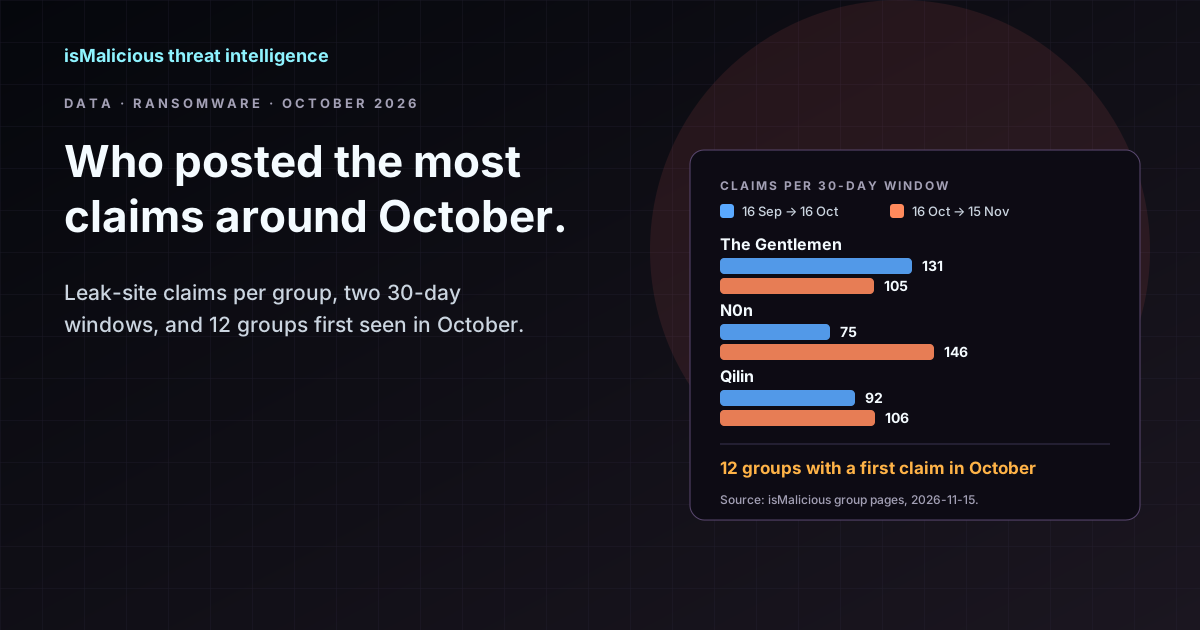
Three groups posted the most ransomware leak-site claims around October 2026: The Gentlemen, N0n and Qilin. That is what the isMalicious ransomware tracker showed when we read it on 15 November 2026, in the two 30-day windows that together cover the month. Twelve groups made their first claim in October, among them Whitearmor, Byod and Mimori, which people now search for by name. The month also produced a clear warning about these counts: N0n, the fastest-growing name on the list, claims far more victims than it appears to have.
The tracker counts claims, not incidents. A claim is a victim posted on a group's leak site, as collected by ransomware.live, counted once per group, victim and day. The tracker does not keep a figure for a closed calendar month, so this readout uses the two 30-day windows its group pages show and dates every figure.
How October reads in our data
Each group page, listed in the tracker's A–Z index of ransomware groups, shows the claims of the last 30 days and of the 30 days before. Read between 16:29 and 16:34 UTC on 15 November, the first window runs from 16 October to 15 November and the second from 16 September to 16 October. Together they cover all of October, plus the second half of September and the first half of November.
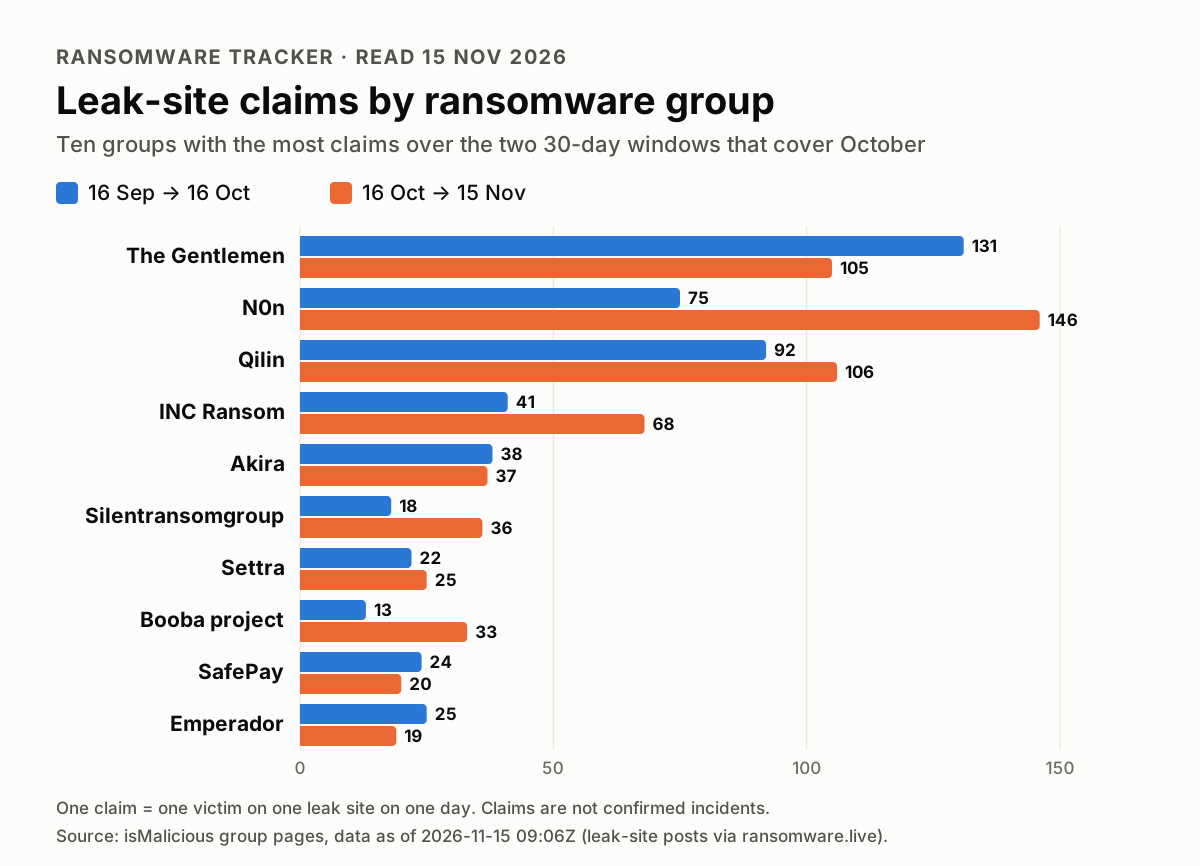
| Group | 16 Sep to 16 Oct | 16 Oct to 15 Nov | All-time claims | First claim |
|---|---|---|---|---|
| The Gentlemen | 131 | 105 | 1,103 | 2025-09-09 |
| N0n | 75 | 146 | 221 | 2026-09-18 |
| Qilin | 92 | 106 | 2,576 | 2022-10-08 |
| INC Ransom | 41 | 68 | 1,044 | 2023-08-09 |
| Akira | 38 | 37 | 1,681 | 2023-04-26 |
| Silentransomgroup | 18 | 36 | 199 | 2025-05-06 |
| Settra | 22 | 25 | 111 | 2026-06-28 |
| Booba project | 13 | 33 | 64 | 2026-07-06 |
| SafePay | 24 | 20 | 613 | 2024-11-19 |
| Emperador | 25 | 19 | 61 | 2026-08-12 |
The tracker names a group the way ransomware.live does, so The Gentlemen appears as “Thegentlemen”. Across the groups that have a page, 84 posted at least one claim in the earlier window and 78 in the later one.
For a calendar-month total, Bitdefender's Threat Debrief of November 2026 counted 1,072 claimed victims on leak sites from 1 to 31 October, and 946 once 126 of N0n's listings are set aside. Its top 10 for October includes N0n, The Gentlemen, Qilin, Akira and Booba Team; the first four are also the first five of our table, with INC Ransom.
N0n: the fastest riser, and a lesson in claim counts
N0n made its first claim on 18 September 2026 and had 221 claims on our tracker by 14 November, 75 in the earlier window and 146 in the later one. On those figures it is the most active group of the period after The Gentlemen. Its group page puts transportation and logistics first among the sectors it names, with 36 claims, and the United States first among countries, with 99. That fits the batch of 38 maritime, port and logistics organizations in 18 countries that SOCRadar saw posted on 12 October.
Bitdefender reads the group very differently. Its debrief says N0n's leak site listed more than 100 victims while the group “targeted just over 20”, and it calls the image of N0n as a significant threat “a false depiction”. It also reports that N0n spent more than $7,000 on generative AI to build scanning and reconnaissance scripts, and that researchers still debate whether it uses ransomware consistently.
SOCRadar's profile of the group (republished on Malware News) describes how it gets in: “Every documented intrusion relied on weak or compromised credentials”, through FortiGate SSL-VPN credential stuffing, RDP and WinRM password sweeps, long-lived AWS IAM keys, hijacked hosting-provider browser sessions and secrets taken from SaaS and CI/CD pipelines. It describes the locker as a lightweight AES-256-CBC file encryptor with one hardcoded key per build.
What a defender takes from this: a high claim count says a group is loud, not that it is breaching that many networks. N0n is worth watching anyway, because the access it depends on, a VPN password or a stale cloud key, is common to every network.
The Gentlemen and Qilin: steady volume
The Gentlemen made the most claims over the two windows combined, 236, though fewer in the later window than in the earlier one. Its first claim on the tracker dates from 9 September 2025, and its 1,103 claims in total put it sixth all time. Kaspersky's researchers, in a June 2026 analysis on Securelist, describe a ransomware-as-a-service operation whose activity “started ramping up” at the beginning of 2026. They report that it pushes its encryptor through the NETLOGON share, Group Policy or PsExec, disables security software by loading vulnerable drivers, and has a Linux locker for ESXi. Their article lists file hashes and a backdoor C2 address.
Qilin went from 92 to 106 claims. With 2,576 claims it is the largest group on the tracker all time, ahead of LockBit 3.0 with 2,016. The comparison matters: LockBit 3.0's latest claim on our tracker dates from 5 December 2025. An all-time ranking mixes current and dormant brands, and only a recent window says who is posting now.
INC Ransom rose from 41 to 68 claims. Earlier this year we covered the group's use of two SonicWall SMA zero-days, an example of the edge-device access these operations look for.
The groups that first claimed in October
Twelve groups with a page on the tracker made their first claim in October 2026. The date is the first claim in the history ransomware.live publishes; a leak site can go online before it posts anyone.
| Group | First claim | Latest claim | Claims to 15 Nov |
|---|---|---|---|
| Vypr | 2026-10-05 | 2026-10-05 | 7 |
| Byod | 2026-10-05 | 2026-11-10 | 19 |
| Umbra | 2026-10-06 | 2026-10-10 | 10 |
| Scarlettgroup | 2026-10-08 | 2026-11-14 | 13 |
| Hyflock | 2026-10-13 | 2026-11-10 | 15 |
| 0x00 | 2026-10-15 | 2026-10-15 | 1 |
| The seven deadly sins | 2026-10-16 | 2026-10-16 | 8 |
| Mimori | 2026-10-20 | 2026-10-20 | 2 |
| Whitearmor | 2026-10-23 | 2026-11-08 | 22 |
| Shiba | 2026-10-29 | 2026-11-06 | 6 |
| Everstake | 2026-10-29 | 2026-11-11 | 10 |
| Syntax | 2026-10-29 | 2026-10-29 | 1 |
Six of them posted nothing after October. For those six, the total is the October count: Vypr 7, Umbra 10, 0x00 1, The seven deadly sins 8, Mimori 2 and Syntax 1. Mimori draws attention out of proportion to its volume: two claims, both posted on 20 October, and nothing since. Whitearmor, with 22 claims in sixteen days, is the most active of the twelve.
Bitdefender names eight October newcomers: aoqin, everstake, shiba, whitearmor, hyflock, umbra, vypr and scarlettgroup. Seven are in our list. The eighth, Aoqin, has its first claim on our tracker on 4 November, so it is not.
More groups appeared in early November. By 15 November, Pixelleaks had posted 23 claims since 3 November, Climax inc 17 and Vortex 14 since 10 November, Curious worm 12 since 11 November and Aoqin 10. The hub lists the newest groups of the last 30 days, with a link to each one that has a page.
What a group page gives you, and what it does not
For an established group, the page lists the tools attributed to it, by stage of the attack. The Gentlemen's names rclone for exfiltration, Chisel-ng and ProxyChains for tunneling, AdFind and BloodHound for discovery. Qilin's lists a vulnerable Toshiba power-management driver among its defense-evasion tools. Some pages also carry IOCs; INC Ransom's lists two IP addresses. The page also shows the claims of the last 30 days against the 30 before, the first and latest claim, and the sectors and countries in the group's claims, with the claims that name none counted apart.
For a group that appeared last month, there is usually nothing to block yet. The pages for N0n, Whitearmor and Byod hold one Tor address each and no IOCs. That is the normal state of a new group, and it is why detection for one rests on how it gets in, not on a list of hashes.
What to do now
- Rank groups by their last 30 days, not by their all-time totals. On 15 November, the head of the all-time list included LockBit 3.0, which had posted nothing for more than eleven months.
- Treat a claim that names your organization or a supplier as a lead. Check your logs for the dates around it before you escalate or disclose. N0n shows how far a leak site can overstate its count.
- Close the access paths the newest groups rely on: MFA on every VPN and remote-access gateway, lockouts and alerts on password spraying against VPN, RDP and WinRM, and rotation of long-lived cloud keys and CI/CD secrets.
- For The Gentlemen and groups like it, alert on changes to Group Policy objects and writes to the NETLOGON share, and block known vulnerable drivers.
- Take the IOCs in vendor write-ups, such as the Securelist hashes for The Gentlemen and the IP addresses on a group page, and check them against your telemetry with the IP reputation check and the file hash lookup.
- If your sector or suppliers appear in a group's claims, as transportation and logistics do in N0n's, ask those suppliers whether they have been contacted before the data surfaces elsewhere.
Method and limits
Source: the public pages of the isMalicious ransomware tracker. On 15 November 2026, between 16:29 and 16:34 UTC, we read the hub and the 105 group pages whose latest claim falls on or after 16 September, which the ransomware sitemap lists with that date. The pages stated “Data as of 2026-11-15 09:06Z”. Every figure above is the one a page printed at that time.
What a claim is: one victim on one group's leak site on one day, as ransomware.live publishes the posts. A victim posted twice the same day counts once; posted again later, it counts again, and the same organization claimed by two groups counts twice.
What we could not read: our tracker shows a count for the current month only, so it no longer displays October's total. An archived copy of the hub, captured on 29 October at 15:04 UTC, showed 1,004 under “Attacks this month”; at the time that tile did not say when it had been counted, so it covers 1 October to some point before that capture. The windows above are rolling: re-read today, the same pages give different numbers. Groups without a page on the tracker are not in the counts. Leak sites post late, sometimes weeks after the intrusion, so the last days of each window will still grow.
What a claim is not: proof of a breach. We name no victim here. A claim can be false, inflated or recycled, and Bitdefender's correction of N0n's count shows the size of the error a single group can introduce.
FAQ
Frequently asked questions
Which ransomware groups were most active in October 2026?
On the isMalicious ransomware tracker, read on 15 November 2026, three groups led both 30-day windows that cover October: The Gentlemen with 131 leak-site claims from 16 September to 16 October and 105 from 16 October to 15 November, N0n with 75 and 146, and Qilin with 92 and 106. INC Ransom followed with 41 and 68, then Akira with 38 and 37. Bitdefender, counting the calendar month, names N0n, The Gentlemen, Qilin, Akira and Booba Team among its October top 10.
How many ransomware victims were claimed on leak sites in October 2026?
Bitdefender counted 1,072 claimed victims on ransomware leak sites from 1 to 31 October 2026, and 946 after removing 126 of N0n's listings that it does not consider real victims. The isMalicious tracker shows a count for the current month only, so it no longer displays October's total; an archived copy of its hub from 29 October showed 1,004 under “Attacks this month”.
Which new ransomware groups appeared in October 2026?
Twelve groups with a page on the isMalicious tracker made their first leak-site claim in October 2026: Vypr and Byod on 5 October, Umbra on 6 October, Scarlettgroup on 8 October, Hyflock on 13 October, 0x00 on 15 October, The seven deadly sins on 16 October, Mimori on 20 October, Whitearmor on 23 October, and Shiba, Everstake and Syntax on 29 October. The first claim is the first one in the history ransomware.live publishes, which can come after a leak site went online.
Is the N0n ransomware group as large as its leak site suggests?
Probably not. N0n has 221 claims on the isMalicious tracker, all posted since 18 September 2026, but Bitdefender reports that the group targeted just over 20 victims even though its leak site listed more than 100, and removed 126 of its listings from its October total. SOCRadar describes intrusions that relied on weak or stolen credentials, such as FortiGate SSL-VPN credential stuffing and RDP and WinRM password sweeps.
Does a ransomware leak-site claim prove that an organization was breached?
No. A claim is what a group posts on its own site. It can be false, inflated, recycled from an older breach or posted weeks after the intrusion, and the same victim can appear on several sites. Treat a claim that names you or a supplier as a lead to verify with your own logs, not as a confirmed incident.
Related articles
 INC Ransomware Chains Two SonicWall SMA Zero-Days (CVE-2026-15409, CVE-2026-15410)
INC affiliates are weaponizing an SSRF and a post-authentication code injection in SonicWall SMA 1000 to reach internal networks. Exploitation started weeks before the July 14 patch — here is how to hunt and triage.
 Cl0p Is Exploiting PTC Windchill (CVE-2026-12569) to Steal Engineering Data
A Cl0p affiliate is chaining a FlexPLM information disclosure with an unauthenticated RCE in PTC Windchill to plant JSP web shells and run double-extortion data theft. Here are the detection signals and the triage workflow.
 Cyber Extortion Now Includes Physical Threats: What Incident Response Teams Must Change
Cyber incidents are no longer always contained to systems and data. As extortion crews add physical threats, responders need ransomware intelligence, safety escalation, IOC enrichment, and executive-ready evidence.
Check any IP or domain
See what our indexed threat intelligence records say about it.
Try the IP / Domain Checker