Operation Endgame Takes Down Gootloader, CastleRAT and StealC: What Defenders Should Hunt Now
Between 9 and 11 November 2026, Operation Endgame took down the servers and domains behind Gootloader, CastleRAT and StealC and secured about 6.4 million stolen credentials. No arrest was announced. The infrastructure is gone; the infected hosts, the stolen passwords and the access already sold are not.
 IsMalicious Team
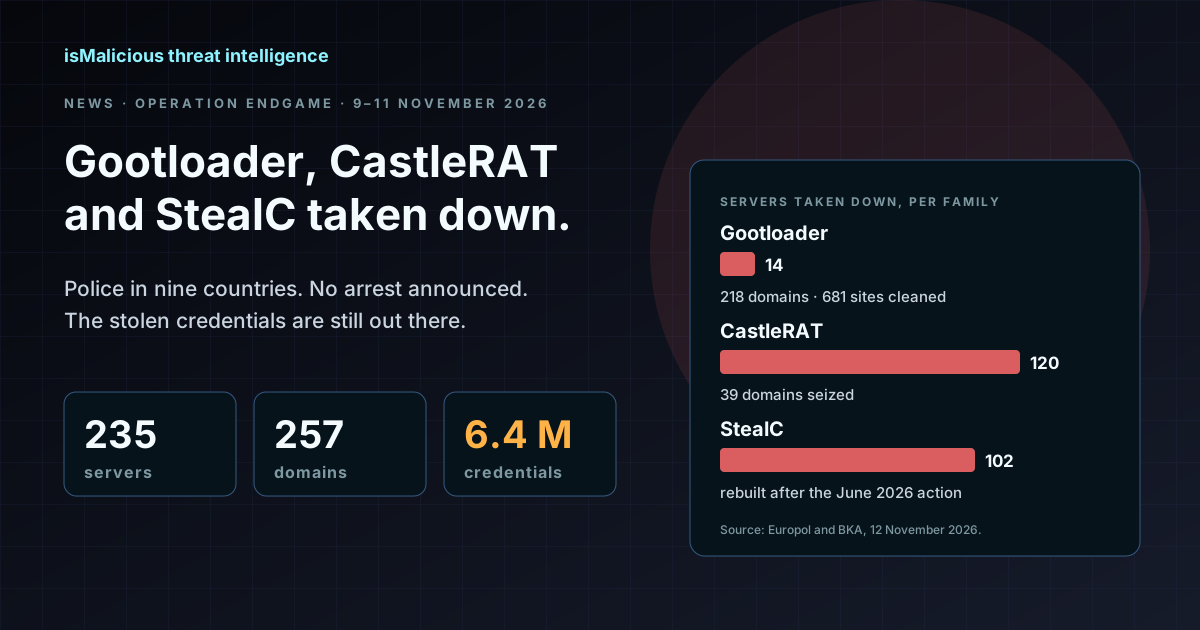
Between 9 and 11 November 2026, police in nine countries took down the infrastructure behind three malware families as part of Operation Endgame: the Gootloader loader, the CastleRAT remote access trojan and the StealC infostealer. Europol counts 235 servers and 257 domains actioned together with private partners, 681 compromised websites cleaned, and about 6.4 million stolen credentials found on the seized systems. No arrest was announced. For a defender, the operation removes the attackers' servers; it does not remove an infection already on a workstation, a password already stolen, or network access already sold.
What was announced
Europol and the German Federal Criminal Police Office (BKA) published on 12 November, as did the Dutch police and the US Department of Justice. The BKA gives the action dates, 9 to 11 November. The participating agencies came from Bulgaria, Canada, Denmark, Germany, Moldova, the Netherlands, Poland, the United Kingdom and the United States, with support from Europol's European Cybercrime Centre and from Eurojust.
| Family | What it is | Europol figures |
|---|---|---|
| Gootloader | Loader spread through hacked sites | 14 servers and 218 domains taken down, 681 sites cleaned |
| CastleRAT | Remote access trojan, known since 2025 | 120 servers and 39 domains seized |
| StealC | Infostealer with a loader function | 102 servers dismantled, after a first action in June |
The per-family server counts add up to 236, one more than Europol's total of 235; the domain counts do add up to 257. The other releases add details of their own:
- The BKA puts more than 40 of the servers in Germany and describes the 6.4 million credentials as belonging to more than 40,000 victims. It also says part of the StealC infrastructure ran at Virtualine/Omegatech, a bulletproof hoster that Frankfurt police and the Dutch High Tech Crime Unit had already shut down at the end of October 2026.
- The Dutch police took down 80 of the 102 StealC servers themselves, count 6 of the 120 CastleRAT servers in the Netherlands, and say further investigative action was carried out against the main Gootloader suspect.
- The Justice Department removed Gootloader from more than 100 servers, compromised WordPress sites included, and seized US domains that showed a seizure banner afterward. It counts at least 25,000 computers infected worldwide since 2018 and ransomware attacks on at least 44 US victims, with about $28.8 million in losses. It names no defendant. Its server count includes hacked websites, so it is not comparable to Europol's 14.
Europol's headline says 6.4 million victim datasets while its body says "over 6 million victim credentials"; the BKA and the Dutch police both write 6.4 million.
What a takedown changes, and what it does not
Seizing command servers and delivery domains stops the current campaigns: an infected host can no longer receive orders from a server that is offline, and a seized domain no longer serves the next download. The seized data also feeds victim notification, which is the part most organizations will notice first.
Three things stay as they were.
First, the operators. With no arrest, the people who built and ran these services keep their skills, their code and, in most cases, their customers. StealC is the precedent: it was a target of the June 2026 Endgame action, and according to the BKA its operators adapted their infrastructure and brought it back online. The Dutch police say they had been tracking new StealC versions since June. The November action went after that rebuilt infrastructure.
Second, the infected hosts. A takedown does not reach into a victim's workstation. Gootloader's persistence, a CastleRAT implant or the files StealC dropped stay where they are until someone removes them. Without a server to talk to they go quiet, which makes them easier to miss, not safer.
Third, what was already taken. StealC exists to collect passwords, stored access data and digital identities for resale, and Europol says the suspects sold the credentials they stole for later attacks, ransomware included. The Justice Department says Gootloader's operators sold access to infected computers to ransomware actors. Anything exfiltrated or sold before 9 November is outside the reach of the operation.
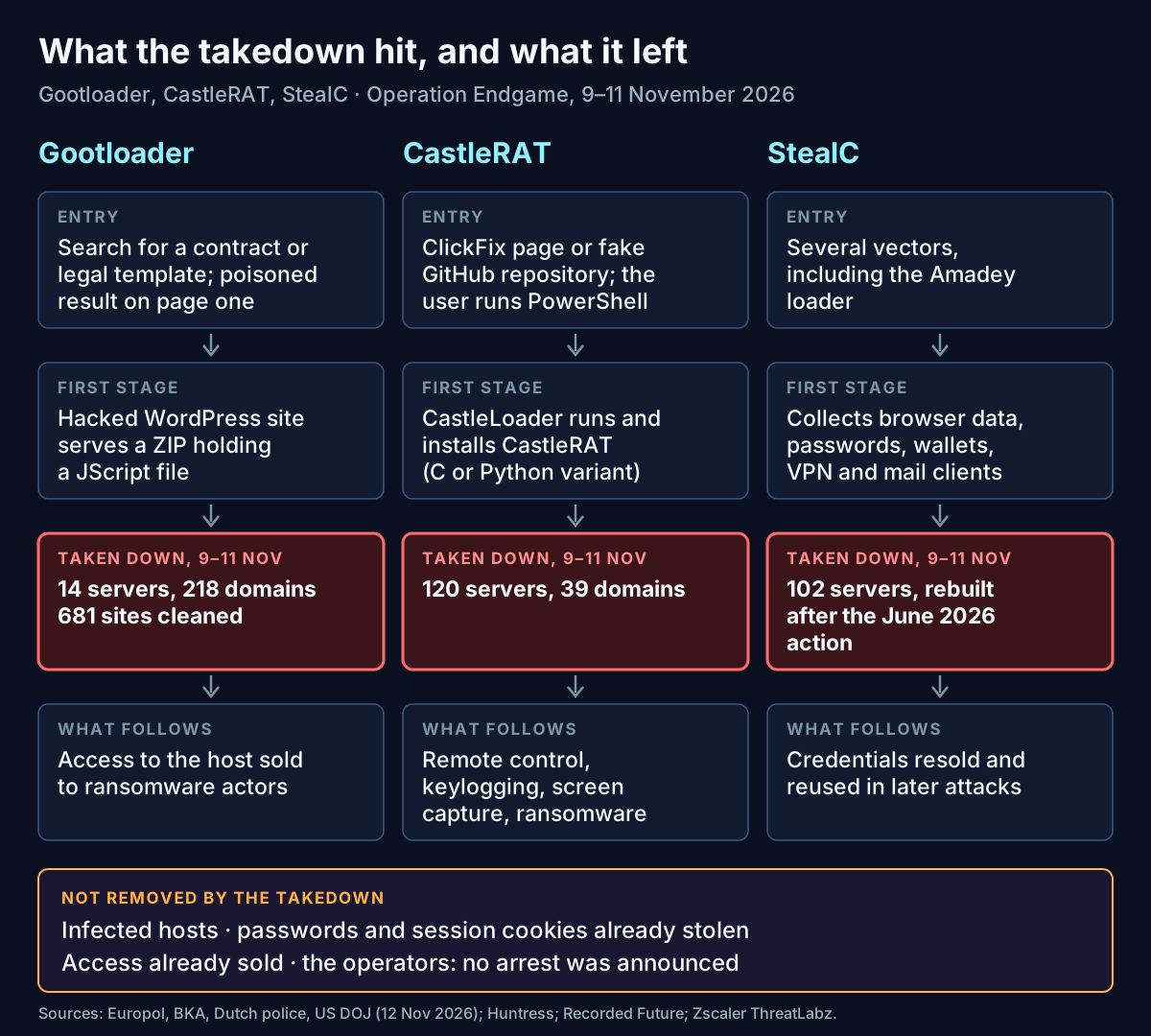
How each family gets in
Gootloader: a search for a contract template
Gootloader reaches its victims through search engines. Its operators plant pages on compromised WordPress sites and push them up the results for searches about contracts, agreements and other legal templates; Europol describes the lure as fake legal documents. In a case Huntress documented in November 2025, the victim searched Bing for "missouri cover utility easement roadway" and clicked the first result.
The download is a ZIP holding a JScript file. Huntress noted that the archive is built so that 7-Zip shows a harmless text file while the Windows built-in extractor drops the script ready to run. Double-clicked, it runs under wscript.exe or cscript.exe and launches PowerShell; persistence came from shortcuts in the Startup folder pointing to .js and .lnk files under %AppData%, where earlier versions used scheduled tasks. In one Huntress case, reconnaissance started about 20 minutes after execution and a domain controller was compromised about 17 hours later. Huntress links the access to Storm-0494, which hands environments to Vanilla Tempest (both are Microsoft's names), a ransomware actor that has deployed Rhysida among others.
CastleRAT: a command the user pastes
CastleRAT is the remote access trojan of an actor Recorded Future first tracked as TAG-150 and now calls GrayBravo. Its research describes infections that start with Cloudflare-themed ClickFix pages, which convince the user to paste a PowerShell command, or with fake GitHub repositories posing as legitimate applications. CastleLoader runs first and installs CastleRAT.
CastleRAT exists in C and Python. Both variants run commands, download further payloads and query the ip-api geolocation service when they start. The C variant adds keylogging, screen capture and, in Recorded Future's December 2025 report, browser credential theft. Some samples look up their command server on Steam Community pages. Europol says CastleRAT intrusions ended in encrypted data, crippled IT systems and ransom payments.
StealC: an infostealer sold as a service
StealC has been sold since January 2023, and its version 2 appeared in March 2025, according to Zscaler ThreatLabz. It collects data from browsers, crypto wallets, messaging and email clients, VPN software and gaming applications, and it can also download and run an EXE, an MSI package or a PowerShell script. ThreatLabz observed it being deployed through the Amadey loader. Europol simply says it spread "through multiple attack vectors", which is the nature of a stealer rented to many customers.
What to hunt now
The useful window is the period before 9 November, read retrospectively.
For Gootloader, look for wscript.exe or cscript.exe running a .js file from a Downloads folder, a temporary folder or an extracted ZIP, especially with PowerShell as its child process. Look for new shortcuts in user Startup folders that point to .js files under %AppData%, and for scheduled tasks that launch wscript.exe. In proxy logs, a download of a small ZIP from a site that is not yours, right after a search for a legal document, is the pattern. Associating .js, .jse and .wsf files with Notepad through Group Policy means a double-click opens the script instead of running it.
For CastleRAT, look at PowerShell launched from the Run dialog (the RunMRU registry key records what users typed), at non-browser processes calling ip-api or requesting Steam Community pages, and at software installed from GitHub that does not come from the vendor's own repository.
For StealC, and for any host where one of the three ran, treat everything the browser stored as stolen:
- Reset every password saved in the browser, starting with the identity provider, VPN, email and administrator accounts.
- Revoke sessions and refresh tokens, not only passwords: a stolen session cookie survives a password change. Our post on session token theft by infostealers covers how to detect a replayed session.
- Rotate the API keys, SSH keys and cloud credentials that sat on the machine, and move any crypto wallet funds to a new wallet.
Check exposure on the notification services. Have I Been Pwned loaded the CastleRAT data on 13 November: about 180,000 email addresses, and 893,000 unique passwords seen more than 3 million times, now in Pwned Passwords. A domain owner can search its own domain there, and a password policy that checks new passwords against Pwned Passwords now refuses these. The Dutch police's Check your hack page emails you if an address appears in a dataset they seized; they say more data will be added in the coming weeks, so the StealC and Gootloader material may still arrive. Network owners receive infection reports from Shadowserver, which the Justice Department credits with identifying infected systems and notifying victims. In Germany, the BSI helps notify victims by warning the internet providers of infected systems.
If you run WordPress, Europol asks site owners to change credentials, enable multi-factor authentication and patch. A site that was among the 681 cleaned was compromised once already, so look for administrator accounts you did not create.
Indicators: what was published and how to check them
As of 15 November, none of the four official releases lists the seized domains, IP addresses or file hashes. The public indicator sets are the vendor reports above: Huntress for Gootloader, Recorded Future's appendices for CastleLoader and CastleRAT, Zscaler for StealC. Those reports predate the operation, so their indicators are for searching past logs and EDR telemetry; they are not a blocklist for next week's campaign.
To check what your hunt turns up:
- A hash from an EDR alert or a vendor appendix goes into the file hash reputation check, which takes MD5, SHA-1 or SHA-256 without uploading the file.
- A domain your proxy recorded goes into the domain reputation check, which shows its registration, DNS and hosting alongside any listing.
- A download link goes into the URL scanner, which follows the redirect chain to where it lands.
- The family pages for Gootloader, CastleRAT and StealC list the hashes, IP addresses, URLs and domains attributed to each family in our feeds, with downloads.
A result of "not listed" means no source has reported the value yet, not that it is clean. A CastleRAT server stood up last week, or a domain seized on 10 November, may not appear in any feed.
What to do now
- Search endpoint and proxy telemetry from before 9 November for the Gootloader, CastleRAT and StealC behaviors above.
- For every host where one of them ran, reset the stored passwords, revoke sessions and refresh tokens, and rotate keys.
- Check your domain on Have I Been Pwned, and keep checking the Dutch police service as they add data.
- Compare the hashes and domains your hunt finds against the vendor indicator sets and the family pages.
- Expect StealC and CastleRAT to come back on new infrastructure, as StealC did after June, and keep detections based on behavior rather than on this week's servers.
Sources: Europol, 12 November 2026; BKA, 12 November 2026 (German); Netherlands Police, 12 November 2026; US Department of Justice, 12 November 2026; Europol on the June 2026 action; Have I Been Pwned, CastleRAT; Huntress on Gootloader; Recorded Future on CastleLoader and CastleRAT and GrayBravo's clusters; Zscaler ThreatLabz on StealC.
FAQ
Frequently asked questions
What did Operation Endgame take down in November 2026?
Between 9 and 11 November 2026, police from Bulgaria, Canada, Denmark, Germany, Moldova, the Netherlands, Poland, the United Kingdom and the United States, coordinated by Europol and Eurojust, acted against three malware families. Europol reports 14 servers and 218 domains taken down for the Gootloader loader, with 681 compromised websites cleaned; 120 servers and 39 domains seized for the CastleRAT remote access trojan; and 102 servers dismantled for the StealC infostealer. Its total is 235 servers and 257 domains.
Were there any arrests in the Gootloader, CastleRAT and StealC takedown?
None was announced. Europol, the German BKA, the Dutch police and the US Department of Justice describe server takedowns, domain seizures and victim notification, and the Justice Department names no defendant. The Dutch police add that further investigative action was taken against the main Gootloader suspect, without details.
How do I check whether my credentials were in the seized data?
Have I Been Pwned added a CastleRAT breach on 13 November 2026 with about 180,000 email addresses, and its Pwned Passwords service now holds 893,000 unique passwords from the same data. The Dutch police run a Check your hack page that emails you if your address is in a seized dataset. Europol also names DIVD, CheckjeHack, NoMoreLeaks, Sekoia, Shadowserver and NL-NCSC as recipients of victim data, and the Dutch police say more data will be added in the coming weeks.
Does the takedown remove the malware from infected computers?
No. Taking servers and domains offline cuts the operators off from their command infrastructure, and the US Justice Department removed Gootloader from more than 100 servers, compromised WordPress sites included. A workstation that ran Gootloader, CastleRAT or StealC still has to be found and cleaned by its owner, and any password or session cookie stolen from it before the takedown remains usable until it is changed or revoked.
Did the authorities publish indicators of compromise?
Not as of 15 November 2026. The Europol, BKA, Dutch police and Justice Department releases publish no list of seized domains, IP addresses or file hashes. For hunting, the public indicator sets remain the vendor reports on each family, such as Huntress on Gootloader, Recorded Future on CastleLoader and CastleRAT, and Zscaler on StealC.
Related articles
 The Kratos Phishing Kit Takedown: 200 Servers Gone, 1,800 Copies Still Out There
German and US law enforcement dismantled Kratos, the AiTM phishing service behind roughly 15,000 Microsoft 365 campaigns a month. The infrastructure is offline, but the kit is not. Here is what to hunt for now.
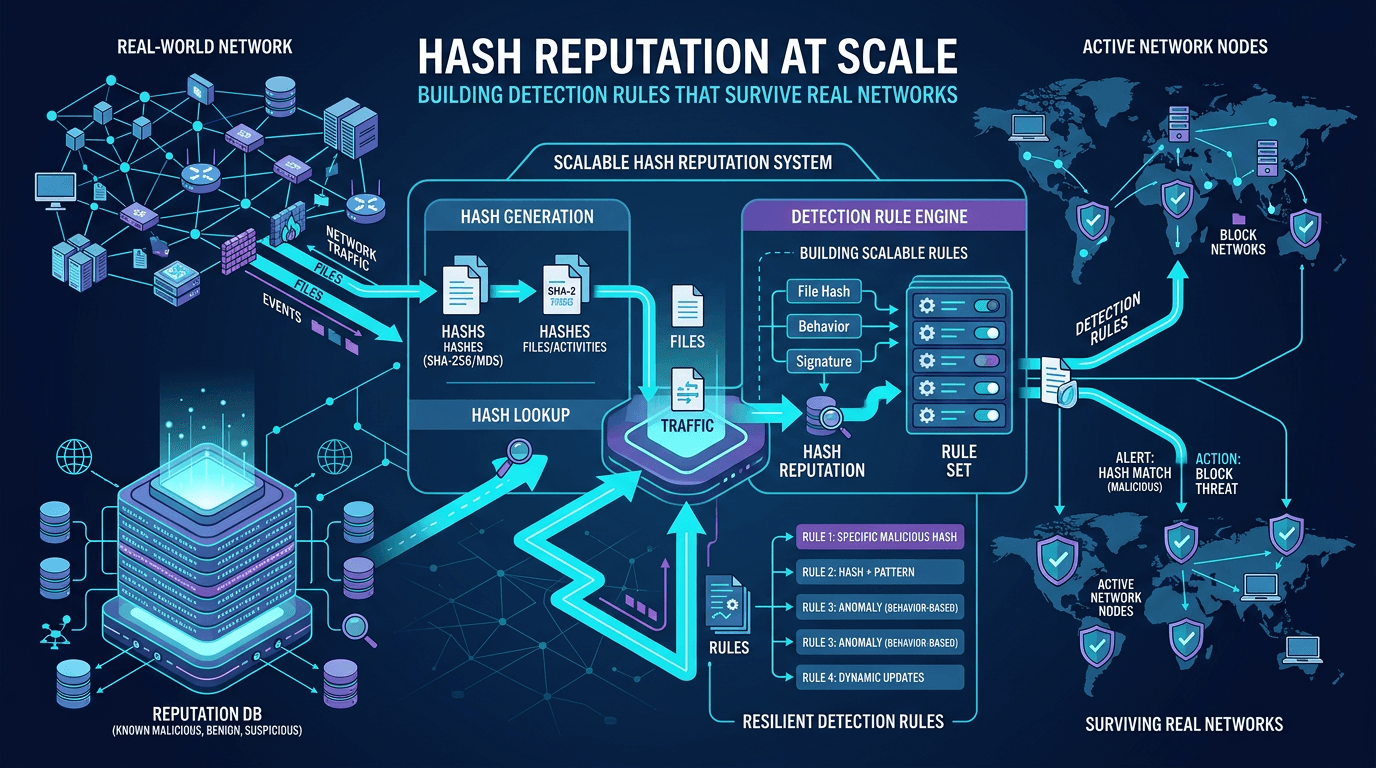 Hash Reputation at Scale: Building Detection Rules That Survive Real Networks
Move beyond one-off hash blocks: design reputation pipelines, reduce false positives, and integrate file intelligence with IP and domain context for production-ready detection engineering.
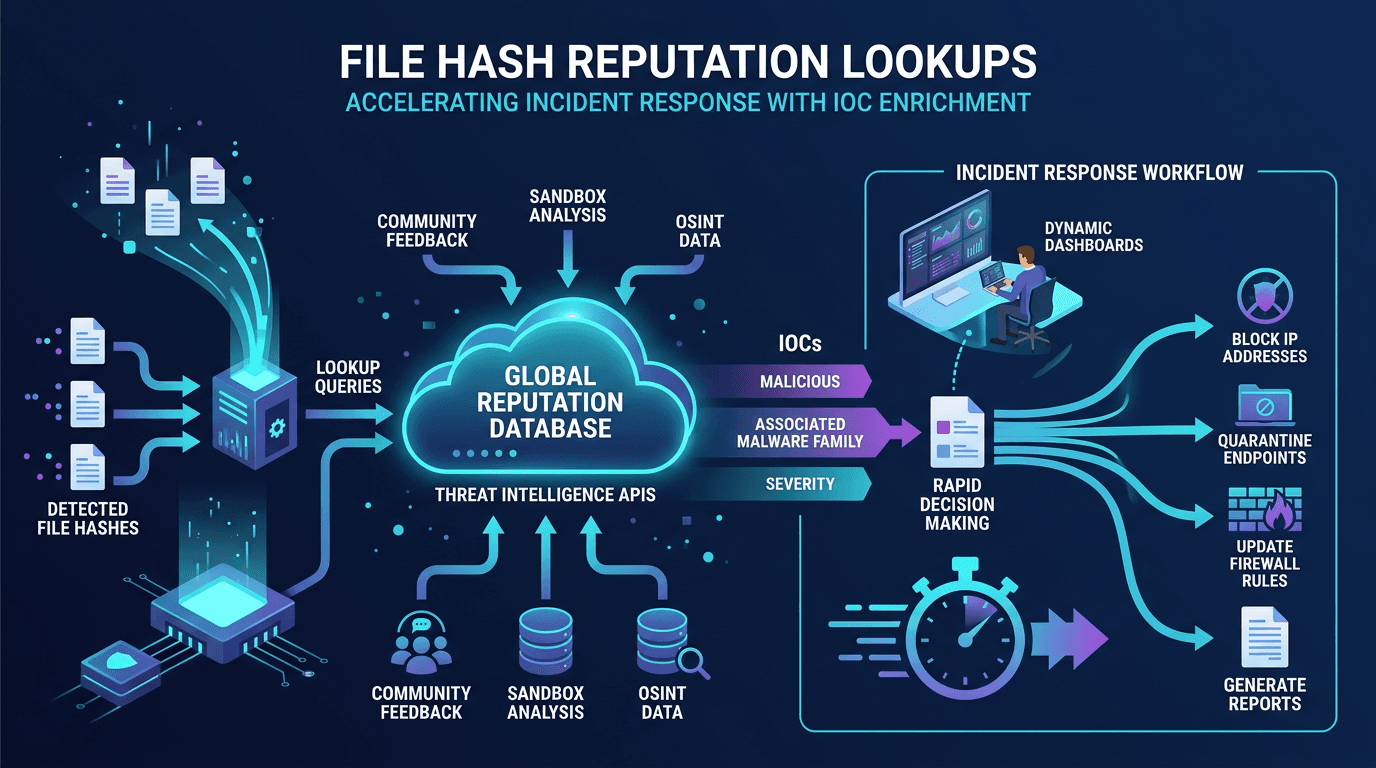 File Hash Reputation Lookups: Accelerating Incident Response With IOC Enrichment
A practitioner's guide to file hash reputation lookups—how they work, which data sources power them, how to build automated IOC enrichment pipelines, and how to integrate hash intelligence into SOC, SOAR, and incident response workflows.
Check any IP or domain
See what our indexed threat intelligence records say about it.
Try the IP / Domain Checker