isMalicious vs GreyNoise: IP Noise Scoring and Threat Intelligence API Compared
GreyNoise tags internet background noise; isMalicious adds verdicts, WHOIS, DNS history, and ransomware context. A SOC-focused comparison for triage teams.
 IsMalicious Team
Every SOC alert queue fills up with the same low-value noise: mass internet scanners, research crawlers, and opportunistic bots hammering every exposed port on the internet. GreyNoise built its name solving exactly that problem. But once the noise is filtered, analysts still face the harder question — is what's left actually dangerous, and what does it connect to? That's where the comparison with isMalicious gets interesting.
What GreyNoise Solves Well
GreyNoise's core value is separating "someone is scanning the entire internet" from "someone is scanning you specifically." Its strengths:
- Internet background noise classification — tagging IPs that are part of mass, non-targeted scanning activity so analysts stop chasing every SSH brute-force attempt from a research bot
- RIOT allowlisting — identifying IPs belonging to known business services (CDNs, cloud health checks, SaaS crawlers) so they don't trigger false-positive alerts
- Scanner intent tagging — distinguishing benign research scanners from IPs actively probing for exploitable services
- Noise reduction at scale — dramatically cutting the volume of low-value alerts a SIEM has to surface
If your problem is "our detection rules fire on every internet scanner," GreyNoise is squarely built for that.
Where GreyNoise Stops Short
Noise classification answers "is this internet-wide scanning," not "is this indicator malicious and why." GreyNoise's model is not designed to:
- Produce a deep-context verdict on a domain, URL, or file hash — its focus is IP-centric scan behavior
- Correlate an indicator against WHOIS registration history, historical DNS resolutions, or infrastructure reuse patterns
- Tie an IP or domain to ransomware operator infrastructure or active CVE/KEV exploitation
- Run AI-driven analysis that synthesizes multiple signals into one verdict: block, allow, or escalate
Once an IP clears the "not just noise" bar, an analyst still has to pivot to other tools to figure out what it actually is. That gap is where a full-context IP reputation lookup earns its keep — a noise score tells you an IP is worth a second look, but it doesn't tell you whether that second look ends in a block, a monitor, or a shrug.
That distinction matters more as attacker infrastructure gets reused across campaigns. An IP that scans broadly today might resolve a phishing domain next week, or sit in the same /24 as a ransomware affiliate's staging server last quarter. Noise classification is a snapshot; understanding infrastructure reuse requires history — which is exactly what a scan-behavior model isn't built to store.
Feature Comparison: Noise Scoring vs. Full-Context Enrichment
| Capability | GreyNoise | isMalicious |
|---|---|---|
| Mass-scanner noise classification | Yes — core strength | Not a primary focus |
| RIOT / known-service allowlisting | Yes | Not applicable |
| Verdict synthesis (malicious / clean) | Limited, scan-behavior only | Yes, across IP/domain/URL/hash |
| WHOIS & registration history | No | Yes |
| Historical DNS resolution context | No | Yes |
| Ransomware infrastructure correlation | No | Yes |
| CVE / KEV exploitation correlation | Partial (scan-target inference) | Yes, dedicated CVE Watch |
| AI-assisted analysis | No | Yes |
| Entity types covered | Primarily IPs | IP, domain, URL, hash |
| Bulk / streaming API | Yes | Yes |
For the full feature-by-feature breakdown, see the head-to-head comparison page.
Why They're Complementary, Not Competing
In practice, the two tools sit at different stages of the same pipeline. GreyNoise's job is to shrink the haystack — strip out the internet-wide scanning traffic that every exposed asset receives constantly, so the SIEM isn't drowning an analyst in noise. isMalicious's job starts after that: take whatever survives the noise filter and answer the question that actually drives a response — is this thing malicious, what is it connected to, and has it shown up in a ransomware campaign or an actively exploited CVE.
A SOC that only runs GreyNoise still has to manually chase WHOIS records, pivot through DNS history, and cross-reference CVE feeds by hand for anything that isn't obviously "just noise." A SOC that only runs isMalicious risks spending enrichment budget — API calls, analyst time — on IPs that were never worth investigating in the first place. Running both closes that gap from each direction.
A Concrete Workflow: From Noise Filter to Deep Triage
- Ingest — Your SIEM or EDR surfaces a batch of external IPs hitting exposed services.
- Filter — GreyNoise flags which IPs are known mass-scanners or RIOT-allowlisted business services; discard those.
- Bulk enrich — Send the remaining IPs through bulk IP/domain lookup to get reputation verdicts, WHOIS, and DNS history in one pass instead of one-by-one manual pivots.
- Correlate — Check whether any surviving IPs or their associated domains match known ransomware infrastructure or actively exploited CVEs.
- Triage with AI context — Use the AI-synthesized analysis to prioritize which of the remaining handful actually warrants an analyst ticket.
This turns a queue of hundreds of raw scan hits into a short list of enriched, prioritized cases — without paying for deep enrichment on traffic that was never going to change a blocking decision.
The same pattern applies outside the SIEM, too. Fraud teams filtering signup traffic, abuse teams triaging support tickets, and threat hunters building an infrastructure map all hit the same wall: noise classification narrows the pool, but someone still has to answer "what is this, who owns it, and has it done anything before." Wiring the two tools together — automatically, not as a manual afterthought — is what keeps that second step from becoming the bottleneck.
Integration and API Ergonomics
Both platforms expose bulk and streaming APIs suited to automated pipelines, but the shape of the response differs with the job each tool does. GreyNoise responses are structured around scan classification and RIOT tags. isMalicious responses are structured around verdicts and context: reputation score, WHOIS, DNS history, associated threat categories, and correlated CVE/ransomware signals, in one call across IP, domain, URL, and hash types. The full API reference documents request/response shapes for teams wiring this into a SOAR playbook or custom detection pipeline.
Operational Next Step
If your team is searching for a GreyNoise alternative, the honest answer is usually not "replace it" but "pair it with something that picks up where noise classification ends." Keep GreyNoise (or an equivalent) trimming mass-scanner traffic at the edge, and route what survives through isMalicious's reputation API for the WHOIS, DNS history, ransomware correlation, and AI-assisted verdict that turns a filtered IP list into a decision your team can act on. For SOC teams building this into a standing pipeline rather than a one-off lookup, the SOC-focused workflows page covers how bulk enrichment fits into existing detection and response tooling.
FAQ
Frequently asked questions
Is isMalicious a replacement for GreyNoise?
Not exactly. GreyNoise specializes in classifying internet-wide scanning noise and allowlisting known-benign scanners. isMalicious focuses on verdict-grade reputation and deep context — WHOIS, DNS history, ransomware and CVE correlation, and an AI-generated assessment — across IPs, domains, URLs, and hashes. Most SOC teams get more value running them together than swapping one for the other.
Why would a SOC team search for a GreyNoise alternative?
Usually because noise classification alone does not answer "should I act on this indicator." Teams that need a single verdict, historical DNS context, or ransomware/CVE correlation on top of scanner tagging look for a tool like isMalicious that covers the enrichment step GreyNoise does not.
Can I feed GreyNoise output into isMalicious?
Yes. A common pipeline uses GreyNoise to strip out mass-scanner noise first, then sends the remaining IPs to isMalicious in bulk for reputation verdicts, WHOIS, DNS history, and AI-assisted triage before an analyst spends time on the case.
Does isMalicious classify internet background noise like GreyNoise does?
isMalicious is not built as an internet-wide scan sensor network the way GreyNoise is. Its strength is entity-level enrichment and verdict synthesis once an indicator is in front of an analyst — whether it arrived from a SIEM alert, a GreyNoise feed, or a manual lookup.
Related articles
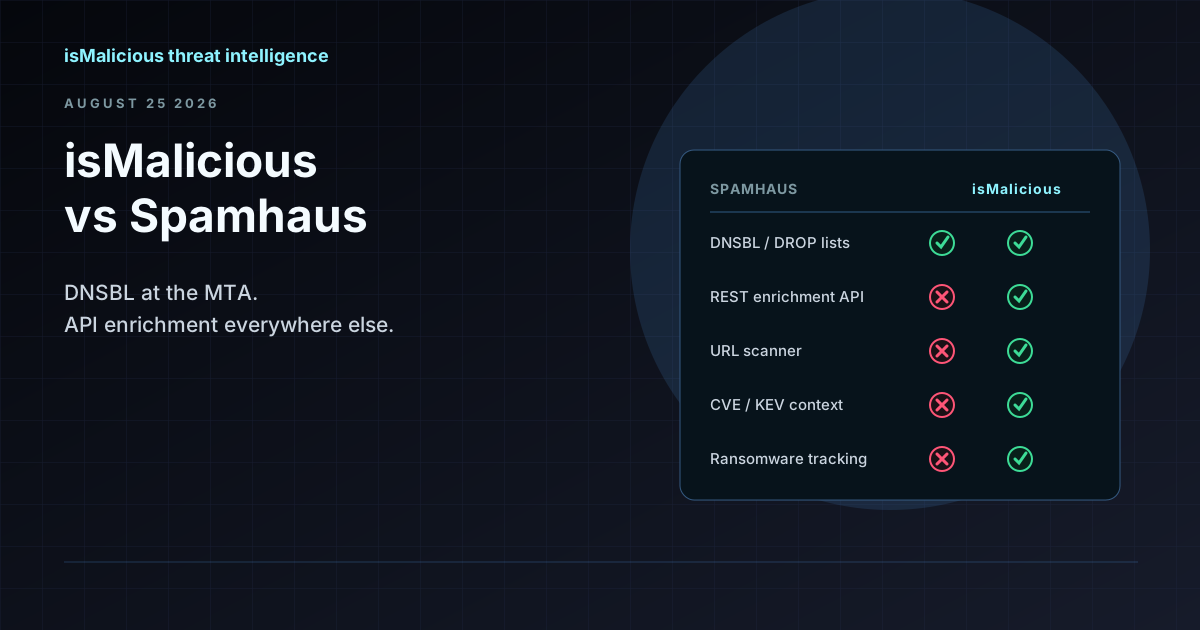 isMalicious vs Spamhaus: DNSBL Blocklists and Threat Enrichment Serve Different Layers
Spamhaus DROP and SBL are the standard for mail and network DNSBL blocking. isMalicious adds REST enrichment, URL scoring, CVE context, and STIX feeds. Most mature stacks use both at different layers.
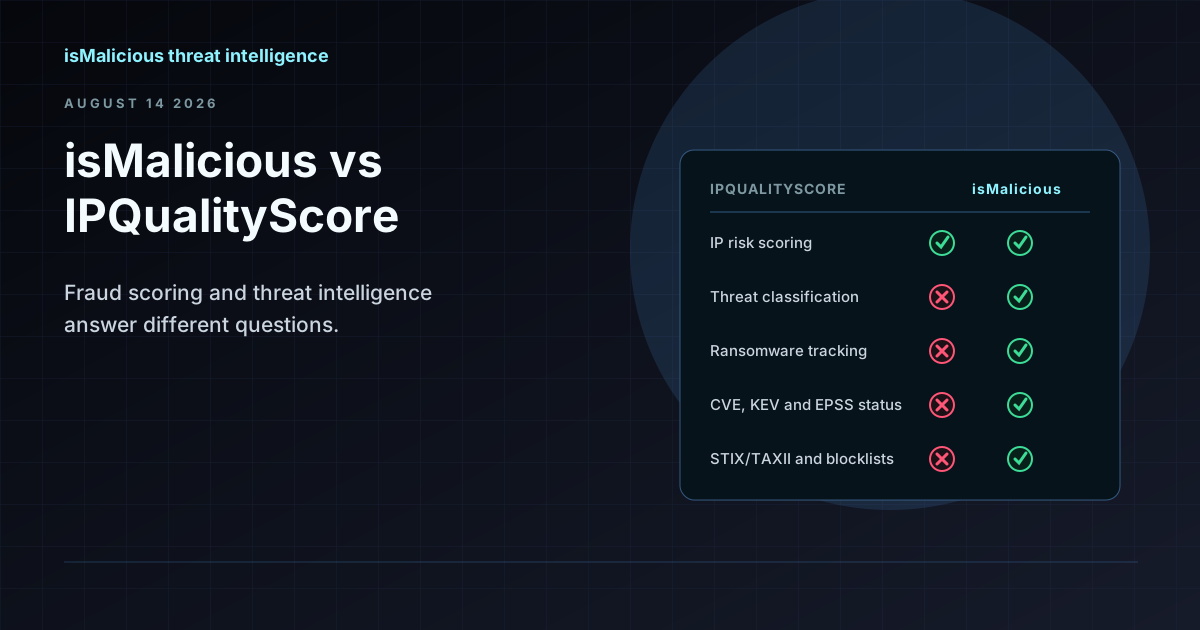 isMalicious vs IPQualityScore: Fraud Scoring and Threat Intelligence Are Different Jobs
IPQS scores whether a signup is fraudulent. isMalicious scores whether infrastructure is malicious. The two get compared constantly because both return a number about an IP address — and they answer different questions.
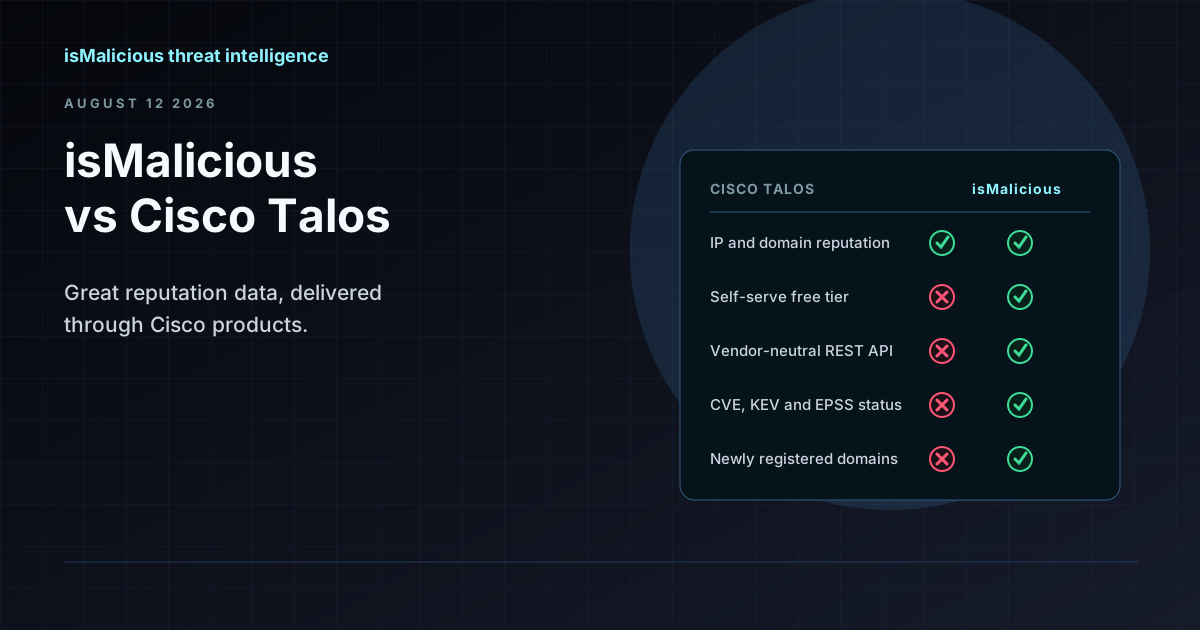 isMalicious vs Cisco Talos: Reputation Lookups Outside the Cisco Stack
Talos reputation is excellent and it lives inside Cisco products. If your stack is not Cisco, or you need an API rather than a web form, that is where the comparison starts.
Check any IP or domain
See what our indexed threat intelligence records say about it.
Try the IP / Domain Checker