JA4 TLS Fingerprinting for Threat Hunting
Use JA4 TLS fingerprints for threat hunting, malware clustering, allowlisting, and anomaly detection without treating a fingerprint as identity.
 IsMalicious Team
IP addresses and domains rotate. A TLS client still has to negotiate a connection. JA4 fingerprinting summarizes properties of that handshake so defenders can cluster similar clients, find unusual software and carry a detection across changing infrastructure.
That power has a limit: a fingerprint is not an identity. Shared libraries, browser updates, proxies and deliberate attacker changes can create collisions or drift. JA4 is most useful as a correlation key inside a broader threat-hunting workflow.
What JA4 Captures
The JA4 project derives a structured value from TLS client behavior, including protocol and handshake characteristics. Related JA4+ methods cover other parts of network communication, but their meanings and licenses differ; teams should review the upstream documentation before product integration.
Compared with an opaque hash, the structured form helps analysts:
- group connections by client implementation;
- compare a suspect across IP and domain changes;
- baseline expected applications;
- attach reputation and campaign context;
- express detection logic that is easier to review.
Encrypted payloads remain encrypted. The fingerprint comes from observable negotiation metadata.
High-Value Hunting Questions
Which clients are rare?
Count fingerprints by organization, business unit and device class. A fingerprint seen on one endpoint may deserve review, especially when the destination is also uncommon.
Which destinations share one client?
Pivot from a suspicious fingerprint to domains, IPs, ASNs and certificates. Malware that rotates C2 infrastructure may keep the same networking library.
Which fingerprints violate application policy?
An approved updater or service should have a known process, signer and destination set. A new fingerprint under the same executable may indicate an update, injection or tampering.
Which known-bad fingerprints appear internally?
Threat reports can provide a candidate fingerprint, but treat it as a lead. Confirm with process, destination and endpoint evidence before containment.
Build the Data Model
Store timestamp, fingerprint, source and destination, server name when available, certificate fingerprint, network sensor, device, process and flow outcome. Version the implementation so a parser change does not look like attacker drift.
Enrich destination IPs with IP reputation, domains with domain reputation and certificates with their historical relationships. Keep first-seen and prevalence values for the fingerprint itself.
Detection Patterns
Effective analytics combine rarity and risk:
- rare JA4 plus new domain plus unsigned process;
- known malware-associated JA4 contacting a low-reputation IP;
- common browser fingerprint emitted by a non-browser process;
- one fingerprint moving through fast-flux infrastructure;
- fingerprint change immediately before suspicious data transfer.
Avoid global “known bad” blocking without local validation. Popular runtimes can produce the same handshake across benign and malicious applications.
Evasion, Drift and False Positives
Attackers can change TLS libraries or imitate common clients. Middleboxes may terminate TLS and replace the client view. Browser updates can shift the baseline overnight. Record sensor placement and compare like with like.
Use allowlists that bind fingerprint to process, signer, destination class and owner. A fingerprint alone is too broad; a documented application profile is much safer.
Incident Response
When a JA4 alert is confirmed, search historical flows for the fingerprint and related JA4 values. Identify the earliest endpoint, all destinations and any certificate reuse. Acquire the responsible process and compare its network library with the observed handshake.
Feed confirmed relationships into malicious infrastructure clustering. This can reveal campaign activity that an IP-only search misses.
Metrics
Track fingerprint coverage, unknown-rate by device class, alerts confirmed by endpoint evidence, detection persistence across infrastructure rotation and false positives after software updates. Measure how often a JA4 pivot discovers additional endpoints or destinations.
Conclusion
JA4 helps defenders recognize a client after the network around it changes. Use it to connect flows, not to declare guilt. The strongest detections combine TLS fingerprint, process identity, certificate context and current threat intelligence in a hunt that analysts can explain and reproduce.
Frequently asked questions
- What is a JA4 fingerprint?
- JA4 is a structured fingerprint derived from attributes of a TLS client handshake. It helps group similar client implementations while remaining readable enough for analysis and filtering.
- Does one JA4 fingerprint identify one malware family?
- No. Different software can share a TLS stack and fingerprint, while malware can modify its handshake. JA4 must be correlated with destination, process, certificate, timing, and reputation.
- Can JA4 replace IP and domain reputation?
- No. JA4 describes connection behavior, while reputation adds infrastructure history and context. Together they survive more attacker changes than either signal alone.
Related articles
 DGA Detection: Find Algorithmically Generated Domains
Detect domain generation algorithms with lexical, DNS, endpoint, and reputation signals while controlling false positives in production.
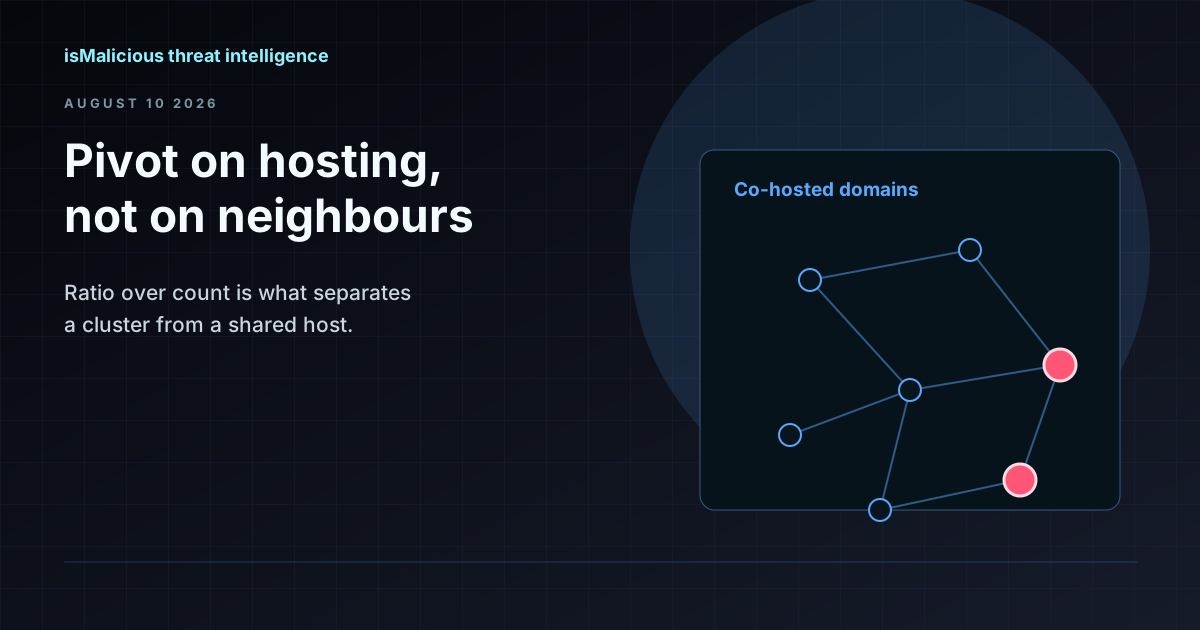 Reverse IP Lookup: Pivoting on Infrastructure Without Drowning in Shared Hosting
A reverse IP lookup turns one indicator into a cluster — or into a thousand innocent neighbours. Here is how to tell the difference, and how to pivot on hosting infrastructure without generating false positives.
- OSINT for SOC Analysts: Turning Open Source Intelligence Into Threat intelligence analysts can use
A complete guide to open source intelligence (OSINT) for security operations—tools, techniques, workflows, and legal considerations for collecting, analyzing, and operationalizing open threat data in a modern SOC.
Protect Your Infrastructure
Check any IP or domain against our threat intelligence database with indexed records.
Try the IP / Domain Checker