Threat Intelligence Feed ROI: Build a Reliable Benchmark
Evaluate threat intelligence feeds with an independent sample, complete operating costs, and a measure of incremental value before buying or renewing a contract.
 IsMalicious Team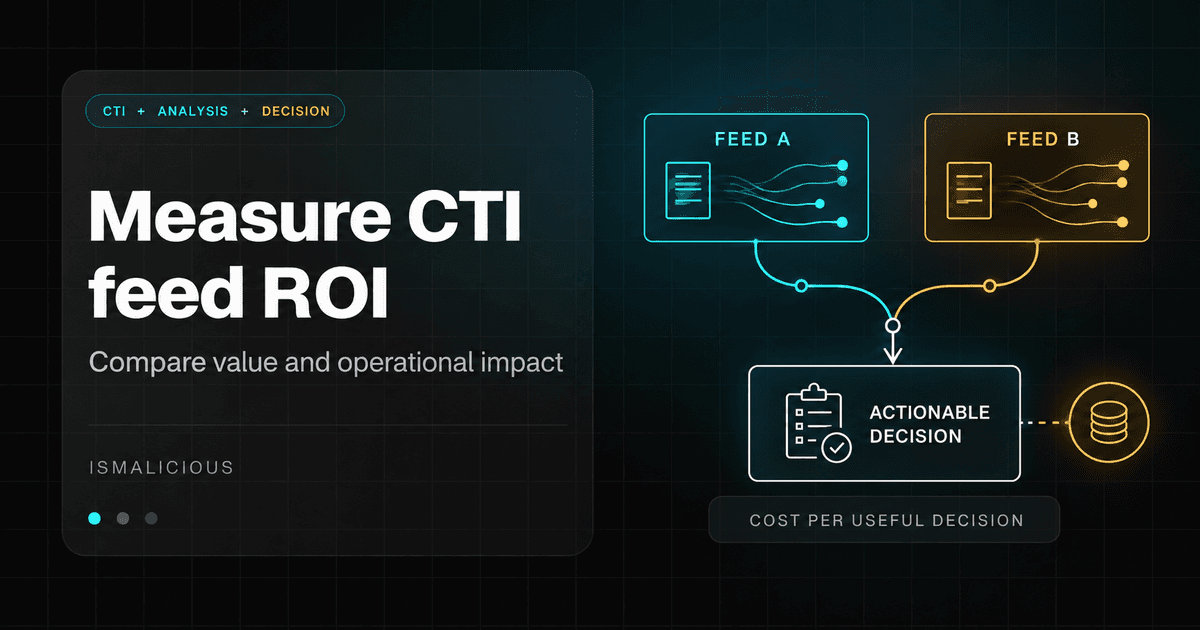
Threat intelligence feed ROI depends on the decisions a feed improves and the work it saves after its full cost is counted. The number of indicators received or SIEM matches generated cannot answer that question. A million additional indicators can leave decisions unchanged while increasing storage, processing, and investigation costs.
A discussion posted on August 31, 2026, in r/Information_Security asks whether paid feeds are worthwhile when they do not translate into detections. It is a useful editorial prompt, not a survey or evidence of market consensus. A purchasing decision needs a controlled comparison within the environment that will consume the intelligence.
The following protocol is a proposed evaluation method. Its numerical example is fictional and does not describe customers or measured IsMalicious performance.
Define the decision the feed should improve
Start with a statement you can test: “This feed should reduce the time needed to assess employee-reported domains without increasing unjustified escalations.” That identifies an object, a population, and an observable outcome. “Improve our threat intelligence” does not establish a success criterion.
If the intended decision remains unclear, complete the PIR workbook and collection plan with the stakeholder before selecting benchmark cases.
NIST SP 800-150 recommends identifying information-sharing goals and appropriate sources. For a supplier evaluation, that supports defining the intended use before reviewing the catalog.
Separate requirements with different consumers: phishing triage, infrastructure research, incident enrichment, and strategic reporting. A domain feed can perform well in the first category and contribute little to the last. Assign an owner who can judge the outcome for each use case.
Specify exclusions as well. If DNS telemetry covers headquarters endpoints only, do not describe the result as a company-wide protection measurement. Establishing the scope early prevents a narrow technical success from becoming an unsupported procurement claim. Our guide to evaluating threat intelligence sources and evidence helps frame provenance before the trial begins.
Freeze a realistic baseline
The baseline is what the team actually uses: existing commercial sources, public feeds, procedures, and analyst effort. Record that configuration at the start. Include connector versions, refresh intervals, expiration rules, and the fields visible in case records. Our guide to threat intelligence platform architecture helps identify the components involved.
If the team simultaneously improves its connector, case template, and training, a reduction in investigation time cannot confidently be attributed to the new feed. Keep a change log. Where a change materially affects the workflow, begin a new comparison period after the configuration stabilizes.
Before measuring value, check that the candidate has received a fair technical trial. Verify complete retrieval, pagination, encoding, timestamps, and update handling. An integration that silently drops half the feed measures a problem with the evaluation rather than a lack of intelligence at the supplier.
The MISP feed system supports comparisons between feeds and their overlap. That describes relationships between datasets. Operational value requires a further step: determining whether the overlapping or additional information changes decisions in local cases.
Sample cases without selecting the winners
Avoid a test set made entirely of famous incidents or indicators supplied by the salesperson. The candidate may already be particularly well informed about those cases. Instead, select cases from your own workload using a rule established before inspecting the candidate’s answers.
A defensible sample might separate employee phishing reports, network alerts, and individual research requests. Randomly select cases within each category over a predefined period. Retain difficult cases, missing results, and unresolved outcomes. Removing them improves the apparent benchmark by removing the work the team actually needs help with.
Reserve a portion for independent final validation, often called a holdout set. Use the remaining cases to configure field mappings and thresholds. Once you inspect the final validation results, do not silently retune the configuration and report its performance on those same cases as independent evidence.
Keep related campaign material together when splitting the sample. Fifty URLs from one phishing-kit" class="text-ds-accent hover:text-ds-accent-2 font-medium no-underline">phishing kit are not fifty independent situations. If closely related examples appear in both development and validation sets, knowledge from the first set can leak into the second.
Record the sampling frame as well as the selected cases. A set drawn from escalated incidents answers a different question from a set drawn from all incoming alerts. The denominator matters as much as the outcome.
Compare with and without the candidate safely
Use copied cases or observation mode for the evaluation while existing protections continue operating. The condition without the candidate is the established baseline. It does not require removing security controls from production.
One approach is to assign comparable cases to analysts who see either the baseline evidence or the baseline plus candidate enrichment. Balance difficulty and rotate analysts between conditions. Differences in experience should not become differences attributed to the supplier.
Having the same analyst immediately review both versions of a case creates a memory effect. The second investigation is faster partly because the first has already resolved it. Avoid treating that sequence as a clean comparison. If the team is too small for balanced assignments, document the limitation and use the exercise mainly to identify weaknesses, rather than presenting the timing as a causal estimate.
Measure active work time separately from elapsed time to disposition. A case waiting two hours for a shift handover does not represent two hours an enrichment API can save. Also record interruptions when they are substantial enough to distort the comparison.
Define incremental contribution at the case level
A match becomes useful when it supplies evidence that changes a documented choice. That may mean a justified escalation, a better-supported closure, a productive investigative pivot, or confirmation that avoids additional manual research.
Capture the contribution in a short record:
Case: pseudonymized internal identifier
Baseline disposition: additional investigation required
New information: dated observation with a verifiable source
Disposition with candidate: justified escalation
Independent evidence supporting classification: case reference
Active work time, baseline / enriched: minutes
Remaining uncertainty: brief explanation
Exclusive contribution and incremental contribution are different. A domain may exist in two feeds, with one delivering it six hours earlier. An exclusive indicator that has no relationship to observed assets has not yet demonstrated value for that scope.
When measuring timeliness, preserve the moment your system could actually use the information. An old observation timestamp delivered after an incident does not prove the feed would have enabled an earlier response. Our article on operational IOC pipelines covers the ingestion and lifecycle considerations behind that distinction.
Treat “more context” as a hypothesis until the record shows what the context did. A longer report can improve an investigation, but it can also add reading time without changing the outcome.
Qualify outcomes without inventing ground truth
Confirm classifications using case evidence, rather than the majority vote of the feeds under comparison. Multiple suppliers can repeat the same upstream source. Agreement can therefore amplify a shared mistake instead of independently confirming a claim.
Keep confirmed positives, confirmed false positives, and unresolved results separate. Publish the unresolved count alongside the others. If precision is calculated only for adjudicated cases, label it accordingly; it does not automatically describe every candidate result.
Do not equate a missing match with a true negative. There may be insufficient evidence to classify the event. Similarly, teams usually do not know every attack that occurred in their environment. Claiming a global recall rate would require a ground truth they do not possess.
Use a second reviewer for cases that materially affect the purchase decision. Where practical, hide the supplier name during review. Keep disagreements and their resolution. Three disputed cases can matter more to the final decision than thousands of matches that changed nothing.
If one reviewer calls a case actionable and another calls it inconclusive, establish which evidence would resolve the disagreement. Do not settle it by averaging confidence scores from incompatible sources.
Calculate full cost with a transparent example
The following fictional monthly calculation illustrates the method. The organization handles 600 eligible cases, assumes six minutes of active work saved per case, and values analyst capacity at €60 per hour.
Capacity released: 600 × 6 / 60 = 60 hours
Value of that capacity: 60 × €60 = €3,600

Monthly subscription: €900
Additional indexing and storage: €240
Added maintenance and triage: 18 hours × €60 = €1,080
Recurring cost: €2,220

Initial integration: 60 hours × €60 = €3,600
Chosen six-month amortization: €600 per month
Monthly balance during that period: €780
Released capacity is not necessarily a cash saving. It becomes a practical benefit when the team can process more cases, reduce a backlog, or replace work previously purchased elsewhere. Do not describe it as reduced payroll unless payroll actually changes.
Test a less favorable assumption. At three minutes saved, the capacity value falls to €1,800 and the monthly balance becomes negative €1,020 after amortization. This is a sensitivity scenario. It is neither a statistical confidence interval nor a forecast of commercial returns.
Add costs relevant to the actual deployment: quota overages, historical retention, procedure changes, training, support, and contract exit. Our guide to IOC enrichment APIs for security operations helps identify tasks that enrichment can realistically shorten.
Check for double counting. If the maintenance estimate already includes reviewing candidate-generated alerts, do not deduct the same analyst minutes again under a separate false-positive cost. Conversely, leaving that work out of every category hides a real operating expense.
Keep rare-threat coverage separate from measured savings
Some feeds address rare but important threats. Thirty days without a relevant incident cannot establish that the capability is unnecessary. Evaluate documentation quality, relevance to your assets, the ability to initiate a meaningful hunt, and the results of clearly labeled validation scenarios.
Keep two lines in the decision: measured operational benefit, and desired coverage that the trial did not demonstrate. This allows an organization to pay for strategic capability without assigning it an invented financial return.
A team may rationally accept a net cost for specialized sector intelligence that is difficult to replace. It should still name the decisions the capability supports, the people who will consume it, and the date of reassessment. “It might be useful” without an owner or a review date is not a durable operating requirement.
Check that the intended use is permitted
A successful benchmark loses relevance if the planned use is outside the agreement: distribution to customers, retention after termination, automated processing, or embedding results in a product. Include these constraints in the evaluation record and retain the supplier’s written answers.
Before distributing benchmark examples, record the intended recipients and verify the restrictions attached to the material. Our TLP sharing guide explains how to preserve those instructions through review and export. Keep the approved distribution scope with the evaluation record.
Check the exit path too. Can you identify candidate-derived material, remove its enrichment where required, and preserve investigation evidence under the applicable rules? Recording provenance from the beginning makes that task substantially easier than reconstructing it at renewal time.
Set the renewal rule before the final presentation
Write the decision conditions before the supplier demonstration. For example: a time benefit reproduced on independent validation cases, false-positive work compatible with team capacity, coverage of a named requirement, and an acceptable cost under the conservative scenario.
Those thresholds belong to the organization. A team handling occasional investigations may value a different commercial model from a busy SOC. No universal percentage can replace workload, staffing, and procurement constraints.
The outcome can be a purchase, a smaller scope, a precisely bounded additional trial, or rejection. If the sample is insufficient, identify the missing case categories and set an extension deadline. An evaluation that continues indefinitely becomes a subscription without an explicit decision.
For a shareable indicator, an IsMalicious reputation lookup can supply additional context for your test cases. Record it as one source of evidence and apply the same standard used for every supplier: what information changed which decision, at what cost, and with what remaining uncertainty?
Frequently asked questions
- How do you measure the ROI of a threat intelligence feed?
- Compare representative cases with and without the candidate feed, then account for work actually saved and every additional operating cost. Report coverage benefits separately when you cannot credibly assign them a monetary value.
- Does high overlap make a threat intelligence feed unnecessary?
- No. A source may provide the same information earlier, explain its provenance, or provide continuity during another source’s outage. Measure the decisions it changes as well as the indicators it contributes exclusively.
- How long should a CTI feed evaluation last?
- Define a fixed period, a minimum number of cases for each use case, and a limit on extensions. The required duration depends on activity and coverage. A quiet month cannot establish effectiveness against rare threats.
- Can a feed benchmark calculate the number of attacks prevented?
- An indicator match does not establish that an attack would have succeeded without the feed. Report confirmed cases, work saved, and additional coverage. Estimating avoided losses requires a separate, explicit risk model.
Related articles
 Threat Intelligence Sources: Evaluate Evidence Before You Act
Use isMalicious Sources and Threat Patterns to examine freshness, contribution, agreement, coverage, and corpus-wide patterns before turning a detection into action.
 SOC Alert Fatigue: How Threat Intelligence Reduces False Positives Without Hiding Real Attacks
Alert fatigue is not a staffing problem alone. SOC teams need better evidence, source quality, confidence bands, and enrichment workflows that turn noisy alerts into defensible decisions.
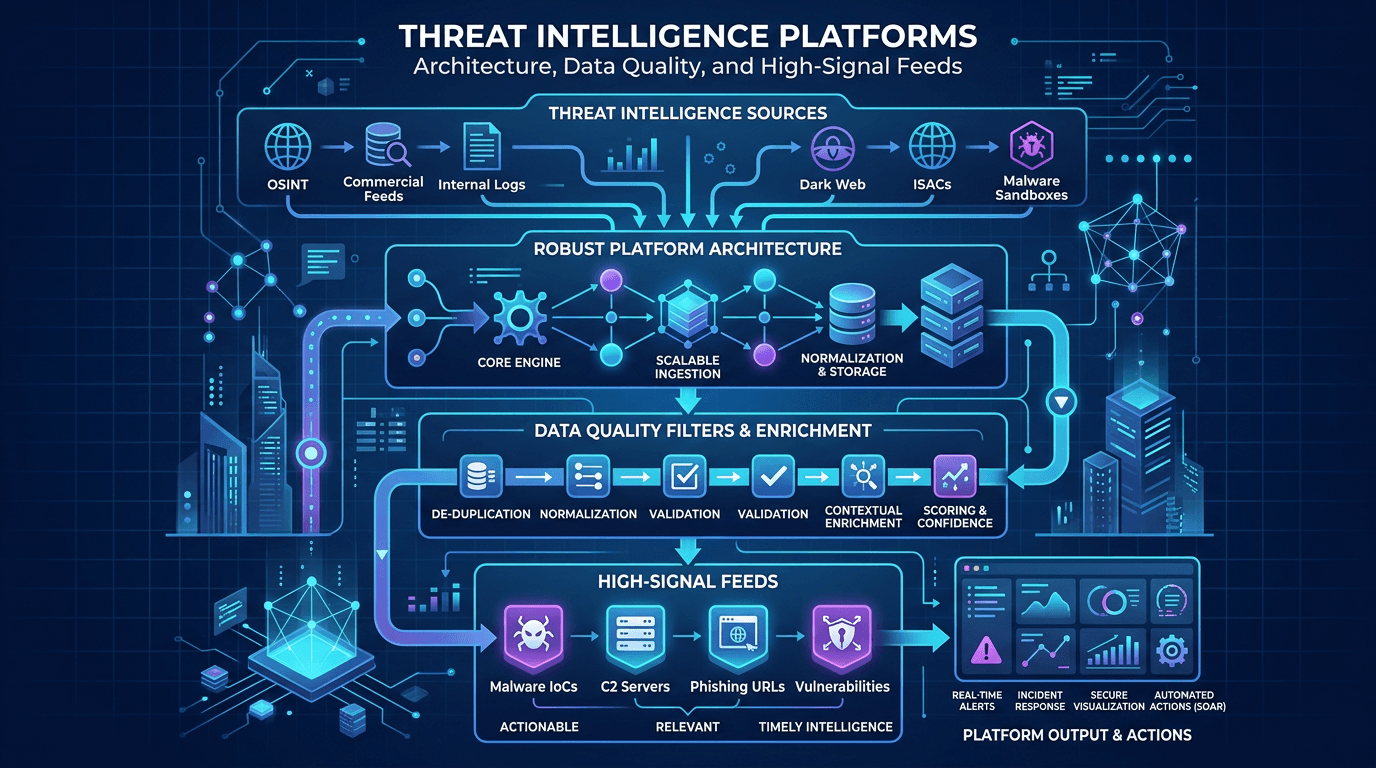 Threat Intelligence Platforms: Architecture, Data Quality, and High-Signal Feeds
Design TIPs and intel pipelines that scale: normalization, confidence scoring, deduplication, API-first delivery, and how to pair platform investments with analyst workflows.
Protect Your Infrastructure
Check any IP or domain against our threat intelligence database with indexed records.
Try the IP / Domain Checker