Shadow AI Governance: How Security Teams Can Detect Risk Without Blocking Innovation
Shadow AI is the new shadow IT: fast adoption, weak visibility, and serious data leakage risk. Security teams need discovery, domain intelligence, policy, training, and monitoring.
 IsMalicious Team
Shadow AI is what happens when employees adopt AI tools faster than the organization can govern them. It looks familiar because it is a new version of shadow IT: a team finds a useful service, signs up with a work email, uploads data, connects a browser extension, or grants an OAuth permission. The tool solves a real productivity problem. Security sees it later, often through logs, expense reports, or a data-loss incident.
The difference is the sensitivity of what people paste into AI systems. Prompts can contain customer records, source code, credentials, strategy documents, incident reports, legal drafts, proprietary datasets, and regulated personal information. Microsoft Learn's guidance on data leakage through shadow AI captures the concern clearly: unauthorized AI usage can create leakage and governance gaps before a company even knows which tools are in use.
Security teams should not respond by trying to ban curiosity. That rarely works. The better answer is visibility, policy, approved alternatives, training, and monitoring.
Shadow AI Is Not Only Chatbots
Many programs begin by listing popular chat interfaces, but shadow AI is broader than that. It can include:
- consumer chatbots used with work data;
- browser extensions that summarize pages or email;
- meeting transcription and note-taking tools;
- AI coding assistants outside approved plans;
- document automation services;
- model APIs used by developers with personal keys;
- plugins connected to SaaS accounts;
- autonomous agents granted access to files, email, or repositories;
- embedded AI features inside existing products.
Some of these tools may be safe enough with the right contract, configuration, and data controls. Others may be unacceptable for regulated data. The security challenge is not "AI bad." It is "which tool, which data, which identity, which retention policy, which integration, and which business process?"
That is an inventory problem before it is a training problem.
Discovery Starts With Network And Identity Signals
You cannot govern tools you cannot see. Start with the telemetry the organization already has:
- DNS logs;
- secure web gateway logs;
- proxy and firewall logs;
- CASB discoveries;
- identity provider app grants;
- OAuth consent records;
- endpoint browser extensions;
- expense and procurement data;
- developer secrets and API key usage;
- SaaS audit logs.
Domain and URL intelligence helps make sense of this data. If employees are visiting a new AI service, security needs to know whether the domain is legitimate, newly registered, parked, impersonating a known vendor, or associated with risky infrastructure. Use domain reputation checks, URL scanning, and DNS history to validate services before turning raw logs into policy decisions.
This is also useful for phishing. Attackers will exploit AI hype with fake login pages, malicious extensions, cloned tools, and OAuth consent lures. Shadow AI governance and phishing defense now overlap.
Training Is Necessary But Not Sufficient
Security awareness training remains unsolved because it is often asked to compensate for missing controls. Employees are told "do not paste sensitive data into AI tools," but they are not given a clear approved workflow, a safe tool, or examples that match their job.
Better training should be specific:
- what data may be used with approved AI tools;
- what data must never be entered;
- how to spot fake AI tools and malicious extensions;
- how to request review for a new AI service;
- what to do if sensitive data was submitted accidentally;
- how developers should handle AI API keys and generated code;
- why customer and regulated data require special handling.
But training will not catch everything. People make mistakes. Tools change. New services appear every week. That is why training must be paired with monitoring, approvals, and technical controls.
For the broader shadow IT foundation, see shadow IT risk management.
Build A Tiered AI Tool Policy
A flat allow-or-block policy will fail. Use tiers.
Tier 1: approved enterprise AI tools. These have legal review, data-processing terms, identity integration, logging, retention controls, and user guidance.
Tier 2: approved low-risk public tools. These may be allowed for non-sensitive content, research, or public information with clear restrictions.
Tier 3: review-required tools. These include services that process documents, code, customer data, meeting recordings, or integrations with SaaS systems.
Tier 4: blocked or prohibited tools. These include impersonation domains, malware-linked services, unsafe browser extensions, tools with unacceptable data policies, and known malicious infrastructure.
Threat intelligence supports the tiering process. It will not decide legal approval, but it can identify malicious domains, suspicious hosting, newly registered lookalikes, risky URLs, and infrastructure associated with abuse. Use the isMalicious API to automate those checks inside review workflows.
Monitor For Risk Patterns, Not Just Tool Names
Blocking a list of AI domains is not enough. New services appear constantly, and legitimate vendors add AI features under existing domains. Monitor risk patterns:
- unknown AI service accessed by many employees;
- uploads to unapproved tools;
- OAuth grants to AI plugins;
- browser extensions with broad permissions;
- new domains imitating approved vendors;
- API keys committed to repositories;
- AI tools accessed from privileged admin workstations;
- suspicious redirects from AI-themed phishing pages;
- repeated access to newly registered domains.
Monitor domains, URLs, and certificates tied to approved vendors and high-risk lookalikes. If a vendor's domain changes DNS, certificate, or reputation status, alert the right team before users are affected.
For high-volume review, connect enrichment to your SIEM. A SOC should be able to query AI-tool activity alongside domain reputation, URL scan results, identity events, and DLP signals.
Shadow AI And Data Leakage Response
When sensitive data may have been submitted to an AI tool, treat it like a contained data exposure investigation. The response should document:
- what data type was submitted;
- which tool or domain received it;
- which user and identity were involved;
- whether the tool is approved;
- whether contractual protections exist;
- whether retention or deletion is available;
- whether any credentials, secrets, or regulated records were included;
- what notifications or legal review are required.
Technical enrichment helps verify the service and surrounding infrastructure. If the domain is suspicious, newly created, or linked to known malicious activity, escalate as a security incident. If the service is legitimate but unapproved, route to privacy, legal, and governance workflows.
The point is to separate malicious exposure from unmanaged but legitimate usage. Both matter, but the response differs.
Help Employees Choose The Safe Path
Governance works better when the safe path is faster than the unsafe path. Provide approved tools, clear examples, and a lightweight request process. If review takes three months, employees will route around it. If approved tools cannot handle common workflows, shadow AI will return under a different name.
Security teams should publish a short decision guide:
- Use approved enterprise AI for internal drafts and approved data classes.
- Use public tools only for public or non-sensitive content.
- Never paste credentials, secrets, customer records, legal data, source code, or incident data into unapproved tools.
- Request review before connecting AI tools to SaaS, repositories, email, or storage.
- Report accidental submissions quickly.
That guidance should be reinforced by detection, not replaced by it.
A 30-Day Shadow AI Governance Sprint
Shadow AI can feel too broad to start. A short sprint keeps the work concrete.
In week one, build the initial inventory. Pull DNS, proxy, CASB, identity, and expense data for known AI service categories. Do not try to classify everything perfectly. The goal is to identify the most-used services, unknown services, suspicious lookalikes, and tools that touch sensitive workflows.
In week two, enrich and tier the services. Use domain reputation, DNS history, URL scanning, ownership context, and legal review status. Separate approved tools from unapproved but legitimate tools and suspicious infrastructure. This distinction keeps the program credible with business teams.
In week three, publish policy and safe alternatives. Give employees a short list of approved tools, allowed data classes, prohibited data classes, and the intake path for new tools. Make the policy practical enough that a product manager, analyst, developer, and sales team can all understand it.
In week four, connect monitoring to response. Create SIEM alerts for risky usage patterns, OAuth grants, suspicious domains, and uploads to unapproved services. Define who receives the alert and what they should do. A shadow AI alert should not become a generic security ticket with no owner.
This sprint will not solve every governance issue, but it gives the organization visibility, language, and a repeatable operating rhythm.
Repeat the sprint quarterly. AI service usage changes quickly, and yesterday's exception can become tomorrow's unmanaged business process.
Bottom Line
Shadow AI is not a reason to block every AI tool. It is a reason to build visibility and governance before data leakage becomes routine. Security teams need discovery, domain intelligence, identity review, training, approved alternatives, monitoring, and incident workflows.
Use isMalicious to validate AI-related domains and URLs, connect enrichment to your SIEM/SOAR, and monitor suspicious infrastructure around the tools your organization actually uses. Innovation is easier to support when risk is visible.
FAQ
Frequently asked questions
What is shadow AI?
Shadow AI is the use of AI tools, agents, plugins, or model services without security, legal, privacy, or IT approval.
Why is shadow AI a security risk?
It can expose sensitive prompts, customer data, source code, credentials, regulated information, and internal documents to services the organization has not reviewed.
Can training solve shadow AI by itself?
No. Training helps employees make better choices, but security teams also need discovery, approved alternatives, monitoring, access controls, and clear data-handling rules.
How can isMalicious help with shadow AI governance?
isMalicious can enrich domains, URLs, IPs, and related infrastructure, monitor watched assets, and feed SIEM/SOAR workflows with context for AI-tool usage investigations.
Related articles
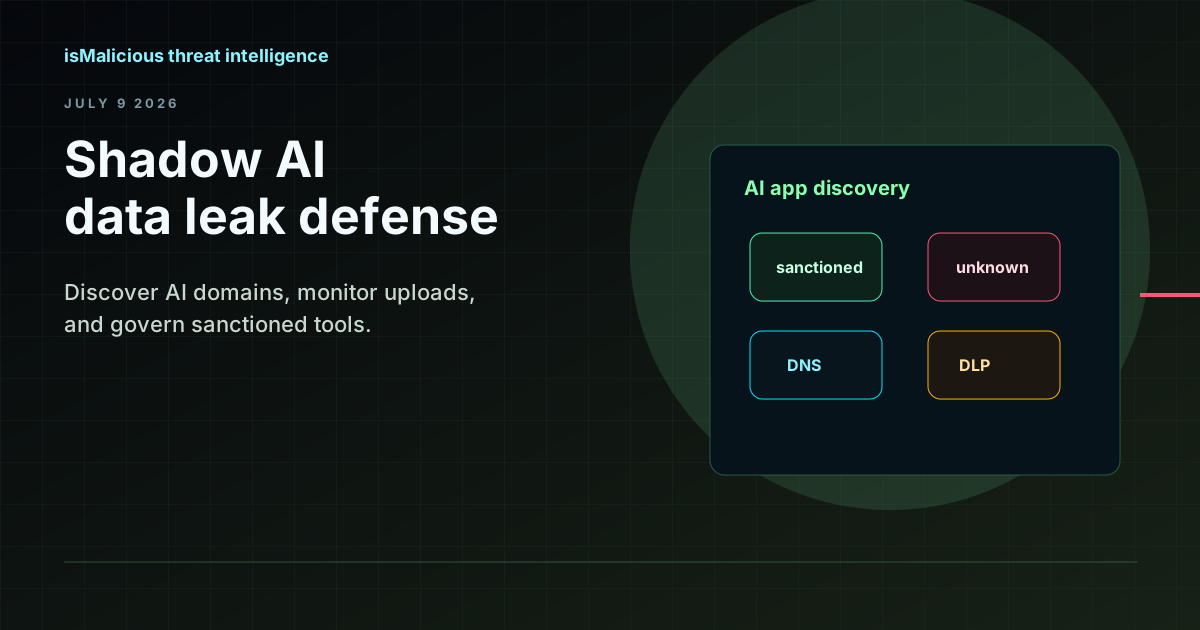 Shadow AI Data Leak Defense: Monitor Domains, URLs, And Unsanctioned AI Apps
Shadow AI has become a governance and data leakage issue. Security teams need discovery, DNS visibility, sanctioned app controls, and domain monitoring around AI tool usage.
 YellowKey and BitLocker Bypass: How Security Teams Should Re-Baseline Stolen-Device Risk
YellowKey made a quiet assumption loud again: encrypted endpoints still need vulnerability intelligence, asset context, and incident workflows. Here is how to respond when a last-resort control becomes a live risk.
 Security LLM and Agent Workflows: When (and How) to Check Malicious Domains, IPs, and URLs Before Acting
AI assistants in SOAR, IDEs, and browser extensions can exfiltrate data or run malicious code if they fetch the wrong link. This guide gives guardrails: schema for tool calls, policy tiers, and where threat intelligence checks belong in the loop.
Check any IP or domain
See what our indexed threat intelligence records say about it.
Try the IP / Domain Checker