GitHub Actions and CI/CD Pipeline Compromise: A Growing Supply Chain Attack Vector
CI/CD pipeline compromises keep recurring across GitHub Actions ecosystems. Learn the detection signals, hardening steps, and enrichment workflow security teams need.
 IsMalicious Team
Since 2025, the security community has documented a recurring pattern: popular GitHub Actions and other CI/CD components get compromised — through maintainer account takeover, malicious version tags, or poisoned upstream dependencies of the action itself — and start exfiltrating secrets or injecting code during builds that ran cleanly the day before. The pattern has not gone away in 2026. It has become a category of incident that security teams now plan for rather than treat as a one-off.
What makes this different from a typical dependency-confusion or malicious-package story is the layer being attacked. A compromised npm package waits for a developer to npm install it. A compromised GitHub Action runs automatically, inside an environment that already holds the credentials the attacker wants, every single time a workflow triggers. There is no install step to catch, no lockfile diff to review before the damage is done — the malicious code executes as part of the pipeline you already trusted.
Why CI/CD Pipelines Are Such an Attractive Target
Build systems accumulate exactly the kind of access an attacker wants, and they get far less scrutiny than the production systems they feed.
- Broad secret access by design. Pipelines routinely hold cloud provider credentials, container registry publish tokens, code-signing keys, and API keys for a dozen internal services — often scoped more generously than any individual engineer's own access.
- Implicit trust in third-party actions. Referencing a community action by a mutable tag (
@v4) rather than a pinned commit SHA means the code that runs today can silently change tomorrow, with no review gate in between. - Low visibility compared to production. Most organizations instrument production workloads with EDR, network monitoring, and log aggregation, but treat build runners as disposable, ephemeral, and therefore unmonitored.
- Blast radius through reuse. A single popular action can be a dependency of thousands of repositories; compromising it once can compromise all of them simultaneously, which is precisely why this attack class keeps recurring.
- Self-hosted runner exposure. Organizations running their own runners for cost or performance reasons often place them on internal networks with fewer egress restrictions than a managed cloud runner would have.
Detection Signals to Watch For
Pipeline compromise tends to leave traces in places teams do not normally look, which is exactly why it persists.
- Unexpected outbound connections from build runners — a build step that previously only talked to your package registry and cloud provider suddenly reaching out to an unfamiliar host.
- Unfamiliar domains or IPs appearing in pipeline logs, particularly ones resolving to newly registered infrastructure or hosting providers with no relationship to your toolchain.
- Secrets-scanning or DLP alerts firing mid-build, rather than at commit time, suggesting a secret was read and transmitted during execution rather than merely present in the repository.
- Unreviewed changes to workflow files —
.github/workflows/*.ymledits that bypass the usual pull request scrutiny applied to application code. - Anomalous build duration or resource usage, which can indicate an extra process (a reverse shell, an exfiltration script, a crypto-miner) running alongside the legitimate build.
- Action version drift — a workflow referencing a floating tag whose underlying commit has changed since the last time anyone audited it.
Hardening the Pipeline
Most of the effective mitigations are configuration changes, not new tooling.
- Pin actions to commit SHAs, not tags.
uses: org/action@<40-char-sha>cannot be silently repointed the wayuses: org/action@v4can. - Apply least-privilege tokens. Scope
GITHUB_TOKENand any service credentials to the minimum permissions a given workflow actually needs, and set them explicitly rather than relying on defaults. - Separate secrets by environment and job. A build job that compiles code should not have access to the deployment credentials a separate release job needs.
- Require review for workflow file changes. Treat
.github/workflows/with the same change-control rigor as production infrastructure code, including CODEOWNERS gating. - Monitor runner network egress. Establish an allowlist of expected destinations for build traffic and alert on anything outside it — this single control catches most exfiltration attempts regardless of how the attacker got in.
- Rotate credentials on a schedule, and immediately after any action or dependency update, so a delayed detection does not translate into indefinite standing access.
Enriching Build-Time Network Indicators
When a build runner reaches out somewhere it shouldn't, the question is rarely "is this normal" in isolation — it's how fast a responder can tell the difference between benign infrastructure and something worth escalating. That triage step is where enrichment earns its keep.
- Pull the unfamiliar IPs and domains surfacing in build logs through IP reputation lookups and domain intelligence to check registration age, hosting reputation, and prior malicious associations before assuming the worst — or dismissing it.
- Push that enrichment into existing SIEM workflows via the isMalicious API so build-pipeline telemetry gets the same automated context as any other log source, instead of living in a separate, manually-checked silo.
- Correlate exfiltration destinations across builds and repositories — a single indicator touching multiple pipelines is a strong signal of a shared compromised action rather than an isolated misconfiguration.
- Feed confirmed-malicious infrastructure back into egress allowlists and blocklists so the same indicator cannot quietly succeed on the next build.
When You Suspect a Pipeline Is Already Compromised
Treat a suspected pipeline compromise the same way you would treat a confirmed one until proven otherwise: revoke and rotate every credential the affected workflow could reach, pull the suspicious action pin or workflow change out of production immediately, and preserve build logs before they age out of retention.
For incident response teams working a live case, the fastest wins usually come from enriching the outbound indicators first — confirming whether a domain or IP seen in the logs is known-malicious infrastructure changes how urgently the rest of the response needs to move, and how wide the blast-radius assessment needs to go. isMalicious exists to make that first triage step fast enough to keep up with how quickly these pipelines run.
FAQ
Frequently asked questions
What makes CI/CD pipeline compromise different from a typical dependency supply chain attack?
Dependency attacks poison a package that developers pull into their own code. Pipeline compromise instead targets the build system itself — a GitHub Action, a self-hosted runner, or a workflow file — so the attacker gets direct access to the secrets, tokens, and build output flowing through CI/CD, without needing anyone to install anything.
Why are GitHub Actions and similar CI/CD tools such an attractive target?
Build pipelines routinely hold broad, implicitly trusted access: cloud credentials, signing keys, registry publish tokens, and source write access. That access is rarely monitored with the same scrutiny as production systems, and a single compromised action can run inside thousands of downstream repositories the moment it is referenced by a tag rather than a fixed commit.
What should a security team look for to detect a compromised build pipeline?
Watch for unexpected outbound connections from build runners, unfamiliar domains or IPs appearing in workflow logs, secrets-scanning alerts triggered mid-build, new or modified workflow files outside normal change review, and build durations or network patterns that deviate from an established baseline.
How does isMalicious help teams investigate a suspected pipeline compromise?
isMalicious provides IP and domain reputation, WHOIS, and DNS history lookups that let responders quickly triage unfamiliar endpoints surfacing in build logs, plus an API for pushing that enrichment straight into SIEM and incident response tooling instead of pivoting between manual lookup tabs.
Related articles
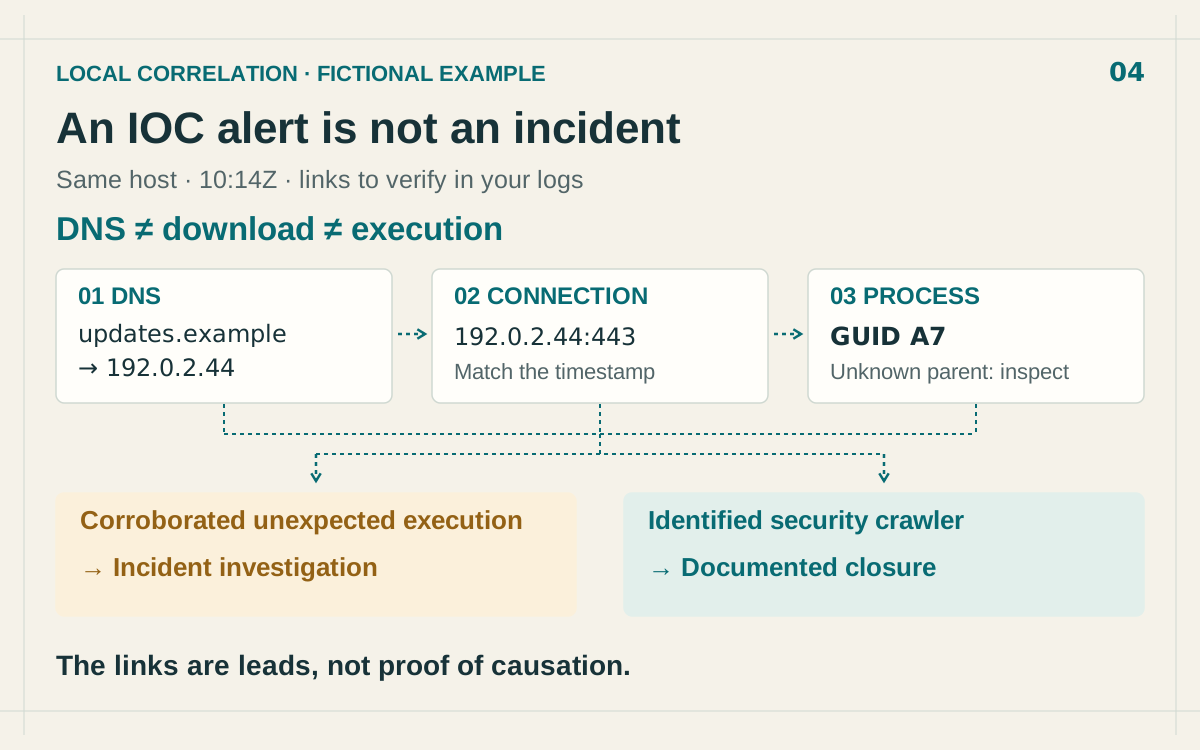 Investigate an IOC Alert: Link IP, DNS and Process Logs
An IOC match is an investigation lead. Correlate DNS, network connections and process records to establish what happened on the endpoint.
 GitHub Actions OIDC: Secure Cloud Deployments
Replace long-lived cloud secrets with GitHub Actions OIDC while constraining claims, permissions, environments, reusable workflows, and incident response.
 Malicious npm Packages: Detecting Open-Source Supply Chain Compromise
Malicious npm packages use typosquatting, dependency confusion, install scripts, and maintainer compromise to steal secrets and backdoor builds. Learn practical detection and response.
Check any IP or domain
See what our indexed threat intelligence records say about it.
Try the IP / Domain Checker