Certificate Transparency for Phishing Detection
Use Certificate Transparency logs to find rogue certificates, phishing subdomains, brand impersonation, and exposed assets before they become incidents.
 IsMalicious Team
Phishing infrastructure often becomes visible before the first email is sent. An operator registers a lookalike domain, creates a subdomain and requests a TLS certificate. Certificate Transparency (CT) turns that issuance into a public signal that defenders can monitor.
CT is not a malicious-domain feed. It is a high-volume source of names and certificates. Its value comes from matching those observations to brands, owned assets and infrastructure patterns, then enriching the candidates quickly enough to act.
What Certificate Transparency Provides
RFC 9162 defines Certificate Transparency version 2.0. Participating certificate authorities submit certificates or precertificates to append-only logs. Defenders can search or stream entries and inspect:
- subject alternative names;
- issuer and validity dates;
- certificate fingerprints;
- log timestamps;
- parent domains and newly visible subdomains.
CT exposes public certificate issuance, not every private certificate and not every hostname on the internet. Treat it as one sensor in an attack-surface and threat-intelligence program.
High-Value Monitoring Use Cases
Rogue issuance for owned domains
Alert when a certificate appears for an approved domain but the issuer, account, key process or hostname is unexpected. This can reveal account compromise, shadow IT or an error in automated issuance.
Brand impersonation
Generate normalized variants of the brand and important products. Search new certificates for typos, inserted words, homoglyphs and deceptive subdomains. A certificate for secure-brand-login.example deserves enrichment, even though the legitimate brand does not own it.
Unexpected subdomains
Compare names against the asset inventory. New environments, forgotten previews and acquired-company zones often appear in CT before security knows they exist.
Infrastructure clustering
Certificate fingerprints, issuers, timing and shared names can connect apparently separate phishing domains. Combine them with DNS and hosting evidence before claiming one operator.
Build a Triage Pipeline
Normalize internationalized names to punycode, split registrable domains correctly and deduplicate wildcard entries. Classify each observation as owned, lookalike or unrelated. Then enrich:
- resolve A, AAAA, MX, NS and CNAME records;
- check domain age and registrar context;
- inspect current and historical IP reputation;
- render the page safely and follow redirects;
- compare certificate and page fingerprints with prior campaigns.
Use the subdomain finder for owned zones, DNS history for infrastructure changes and the URL scanner when a candidate serves content.
Prioritize Alerts Without Drowning
Large organizations generate many legitimate certificates. Reduce noise with an inventory of approved issuers, ACME accounts, wildcard policies, environments and owners. Require every exception to have an expiry and an accountable team.
For lookalikes, rank candidates by:
- visual or lexical similarity;
- age and first-seen time;
- login, payment or download keywords;
- MX configuration and email capability;
- hosting and IP reputation;
- redirection toward credential collection;
- targeting evidence from email or proxy telemetry.
A close brand match with no DNS is a watch item. The same domain serving a cloned login page is an incident.
Respond to Suspicious Issuance
For an owned domain, confirm authorization with the certificate-management owner. If issuance is unauthorized, revoke the certificate, secure DNS and CA accounts, rotate affected credentials and review audit logs.
For an impersonating domain, preserve evidence, block the domain and URL, notify mail and browser controls, and begin registrar, host and certificate-abuse reporting. Continue monitoring because operators often replace the name after takedown.
Metrics for CT Monitoring
Track time from log entry to detection, validated assets discovered, true phishing domains found before delivery, false positives per monitored brand and time to takedown. Measure how many alerts lacked a known owner; that is an asset-governance gap.
Conclusion
Certificate Transparency provides an early, public view of infrastructure creation. Its signal becomes something to act on when paired with inventory, domain reputation, passive DNS and safe page analysis. Use CT to ask “why was this certificate issued?” before an attacker forces the question during an incident.
Frequently asked questions
- What are Certificate Transparency logs?
- Certificate Transparency logs are publicly auditable, append-only records of publicly trusted TLS certificates and precertificates. They make certificate issuance visible to domain owners and defenders.
- Does a certificate in a CT log prove a site is malicious?
- No. It proves that issuance was logged. Defenders must validate domain ownership, DNS, hosting, page behavior, certificate fields, and organizational context before assigning a verdict.
- Can CT monitoring find phishing before a campaign launches?
- Sometimes. Operators often obtain a certificate before sending lures, creating a useful early-warning window. Other campaigns use compromised sites or issue certificates immediately before launch.
Related articles
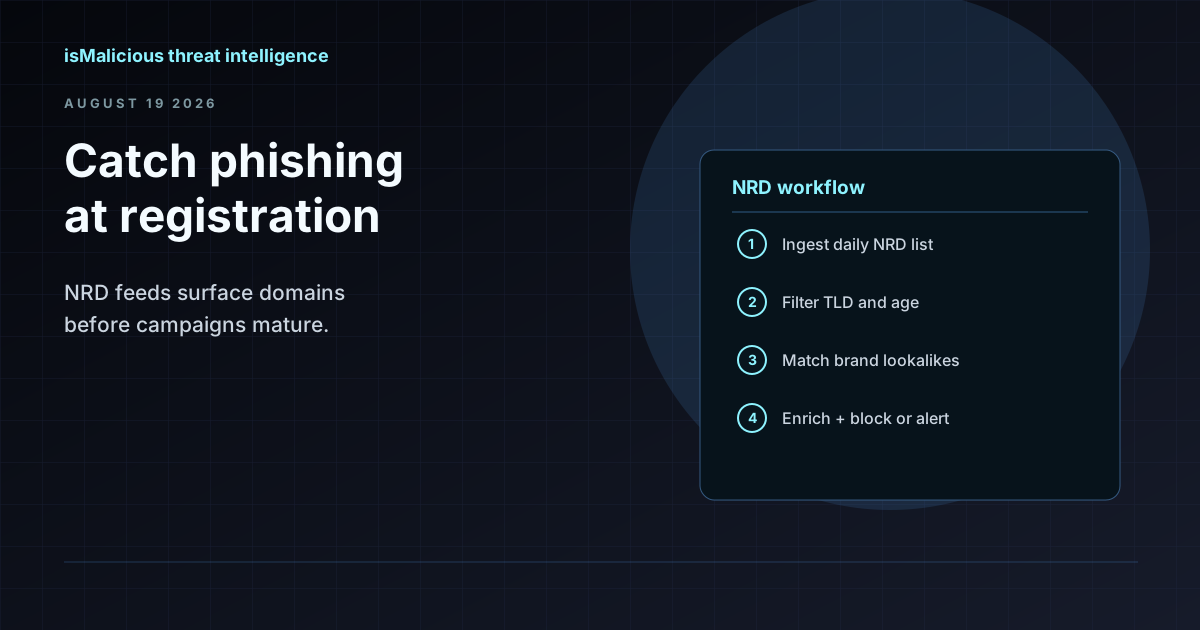 How to Use an NRD Feed to Catch Phishing Before It Lands in the Inbox
Newly registered domains are where most phishing campaigns start. This guide walks through NRD feed workflows for brand monitoring, mail gateway hygiene, and SOC triage — without treating domain age as a blunt block rule.
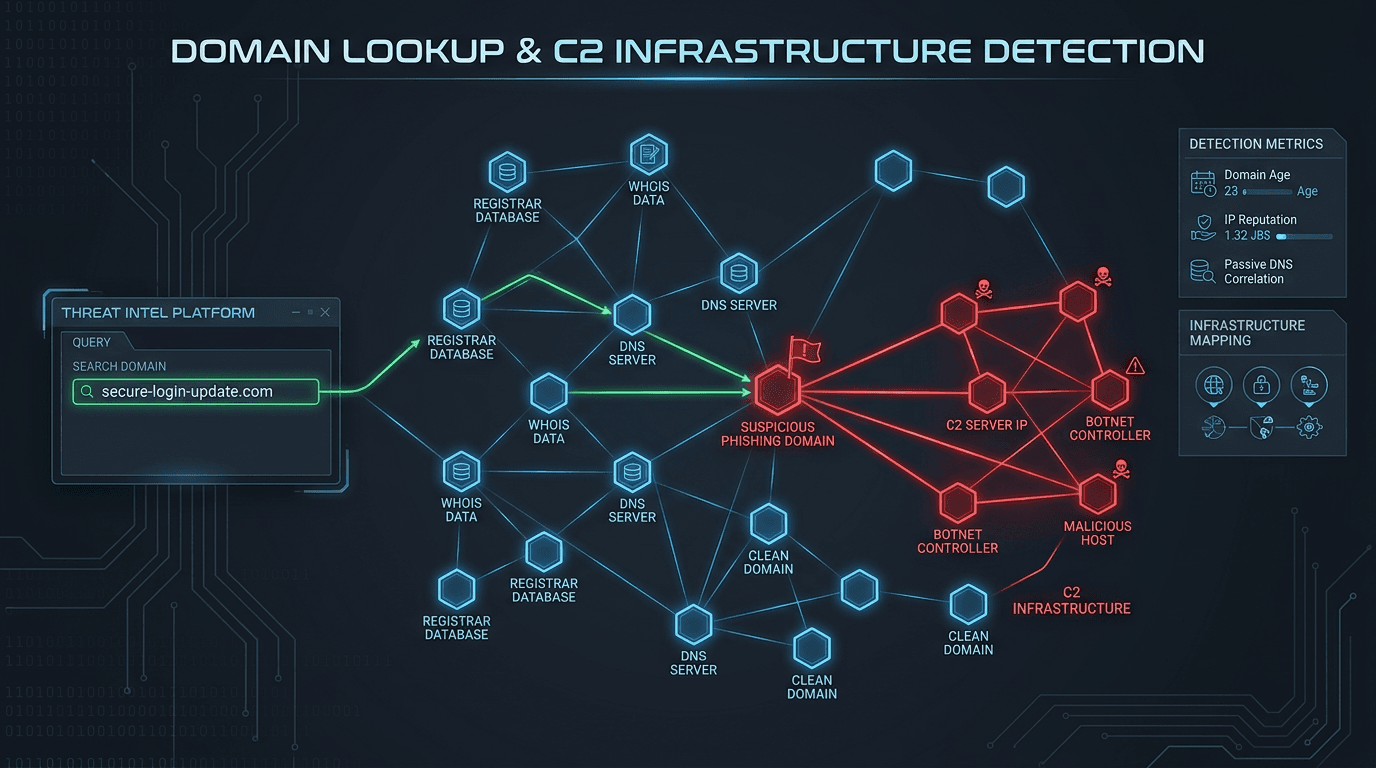 Malicious Infrastructure Clustering: How Passive DNS, TLS Certificates, and ASNs Reveal Shared Campaigns
A single C2 IP is a clue; shared signing patterns and DNS co-occurrence are a map. This guide explains how defenders cluster infrastructure without chasing ghosts—and how to document findings for IR, threat intel, and law enforcement handoffs.
 Brand Impersonation and Lookalike Domains: A Practical Monitoring Playbook for Security, Legal, and Fraud Teams
Typosquats and homoglyphs are cheap to register and expensive to ignore. Learn how to discover, prioritize, and remove lookalike infrastructure before it harvests credentials or poisons your customers’ trust in search and email.
Protect Your Infrastructure
Check any IP or domain against our threat intelligence database with indexed records.
Try the IP / Domain Checker