News · Vulnerabilities
Outlook CVE-2026-124194: The Only Exploited Flaw of November Patch Tuesday Is Rated Moderate
Of the 1,093 CVEs Microsoft published on 10 November 2026, one was exploited: an Outlook flaw that sends the user's NTLMv2 hash to an attacker's server when a crafted message file is opened. It is the release's only Moderate. Here is what the hash is worth to an attacker, which builds fix it, and what to block and hunt beyond the patch.
 isMalicious Team
On this page08
Microsoft's November 2026 Patch Tuesday fixed one vulnerability that was already being exploited: CVE-2026-124194, a flaw in Outlook that makes it send the user's NTLMv2 hash to a server the attacker controls when the user opens a crafted message file. Microsoft rates it Moderate, with a CVSS base score of 6.5, and CISA added it to its Known Exploited Vulnerabilities catalog the same day, 10 November, with a due date of 24 November. Install the November Office build first. Then close the paths the hash travels: outbound SMB, outgoing NTLM, and the internal services that accept a relayed NTLM login.
What Microsoft says about the flaw
Microsoft's update guide entry titles it "Microsoft Outlook Spoofing Vulnerability" and files it under CWE-356, a user interface that does not warn of an unsafe action. Its FAQ describes the attack in three steps:
- an unauthenticated attacker sends a specially crafted message file and convinces the user to open it in an affected version of Outlook;
- opening it can make Outlook connect to an attacker-controlled network location without displaying the usual external-content warning;
- that connection discloses the user's NTLMv2 hash, "which the attacker could use to authenticate as the user".
The Preview Pane is not an attack vector: the user has to open the file. The vector is CVSS:3.1/AV:N/AC:L/PR:N/UI:R/S:U/C:H/I:N/A:N. Microsoft's temporal score adds E:H, the highest exploit code maturity, and the entry reads "Exploited: Yes", "Publicly Disclosed: No", "Exploitation Detected".
Microsoft lists six affected products: Microsoft 365 Apps for Enterprise and Office LTSC 2021 and 2024, each in 32-bit and 64-bit. It names no other Outlook client. It publishes no mitigation or workaround for this CVE, does not name the file format, and says nothing about the attackers, their targets or when exploitation began. Its acknowledgments read "Benoit Sevens using Claude with Anthropic" and "nono".
Why the release's only Moderate matters most
We read Microsoft's own release data for November (the CVRF document behind the update guide) on 15 November. It holds 1,093 CVEs that Microsoft assigned and first published on 10 November, which is close to the "about 1,090" the Zero Day Initiative review counts. The same document carries 1,644 entries in all, because it also lists Chromium and other third-party CVEs; secondary reports quote totals from 1,094 to over 1,200, and we could not reconcile the larger ones with Microsoft's data.
Inside those 1,093:
| Measure, Microsoft CVEs published 10 November 2026 | Count |
|---|---|
| Rated Critical | 63 |
| Rated Critical and marked exploited | 0 |
| Rated Moderate | 1 |
| Rated Moderate and marked exploited | 1 |
| CVSS base score above 6.5 | 860 |
| In CISA KEV on 15 November | 1 |
Sorted by severity or by CVSS, CVE-2026-124194 comes after 860 other CVEs of the same release and ties with 59 more. It is the only Moderate among them and the only one anyone has been seen exploiting.
EPSS does not separate it either. FIRST published no score for it on 10 November, the day of listing; from 11 November it scored 1.62%, in the 76th percentile. In our CVE catalog on 15 November, six of the 1,093 scored higher, the highest at 1.94%, and none of those six is exploited according to Microsoft or CISA. The median of the release was 0.45%. That is the pattern our September–October KEV readout measured: on the day a CVE is listed, EPSS has not yet seen the exploitation that got it listed.
The Moderate rating is not a mistake. It describes the preconditions: someone has to open a file. CVE-2023-23397, the Outlook hash leak of March 2023, was scored 9.8 with no user interaction in its vector: a crafted email triggered it when Outlook retrieved and processed the message, before anyone viewed it in the Preview Pane. The consequence is the same in both cases, an NTLMv2 hash on an attacker's server. Exploitation shows that someone is getting users to open the file, so the lower score no longer says the risk is lower. That is the case for sorting on KEV before CVSS and EPSS, which our guide to CVSS, EPSS and KEV prioritization develops.
What the attacker gets from an NTLMv2 hash
What leaves the workstation is not the password. It is the NTLMv2 response Windows computes from the user's password and a challenge sent by the server, along with the user and domain names. The attacker has two uses for it.
Relay
The attacker forwards the authentication, as it happens, to another service that accepts NTLM, and is logged in there as the user. This needs a target the attacker can reach and that does not bind the login to the connection. Microsoft's guidance on NTLM relay against AD CS states the rule: services that allow NTLM must use Extended Protection for Authentication (EPA) or signing such as SMB signing. A service that accepts NTLM over the internet is a target from the start; an internal one becomes a target once the attacker has a foothold inside.
Offline cracking
The attacker tries candidate passwords until one produces the captured response. A long, unique password makes this impractical; a short or reused one does not, and a recovered password works wherever that account signs in with a password alone.
Microsoft's March 2023 guidance on CVE-2023-23397 described the relay use and said a Russia-based actor had used that flaw against a limited number of government, transportation, energy and military organizations in Europe. For CVE-2026-124194 it has published nothing of the kind.
The fixed builds
Microsoft 365 Apps updates itself through Click-to-Run, but a device that stays offline, has updates paused or sits on a slower channel keeps running the vulnerable build until it updates. Compare the installed version with Microsoft's security release notes for November 10, 2026, which list CVE-2026-124194 under Outlook:
| Channel or edition | Fixed version and build |
|---|---|
| Current Channel | Version 2610, build 20527.20196 |
| Monthly Enterprise Channel | 2610 build 20527.20194, 2609 build 20430.20264, 2608 build 20326.20320 |
| Semi-Annual Enterprise Channel (receives Monthly Enterprise Channel builds) | 2610 build 20527.20192, 2609 build 20430.20262, 2608 build 20326.20318 |
| Office LTSC 2024 Volume Licensed | Version 2408, build 17932.21140 |
| Office LTSC 2021 Volume Licensed | Version 2108, build 14334.21048 |
The fix ships with Office, not with the Windows cumulative update, so a patch report that only tracks Windows updates can show these machines as compliant.
Mitigations beyond the patch
The patch closes this Outlook path. The controls below also cover the other ways of making a Windows client authenticate to a server it should not trust, a class Outlook has been through before with CVE-2023-23397.
Block outbound SMB
Microsoft's mitigation for CVE-2023-23397 was to block TCP 445/SMB outbound "by using a perimeter firewall, a local firewall, and via your VPN settings", so that NTLM authentication messages cannot reach remote file shares. Check the VPN part: a split-tunnel laptop at home sends SMB straight to the internet unless its own firewall refuses it.
Restrict outgoing NTLM
The policy "Network security: Restrict NTLM: Outgoing NTLM traffic to remote servers" has three values. Start with Audit all, read which servers receive NTLM, add the legitimate ones to the exception list, then set Deny all. On Windows 11 24H2 and Windows Server 2025, the SMB client can also block NTLM for outbound connections on its own, through the "Block NTLM (LM, NTLM, NTLMv2)" policy under Lanman Workstation or Set-SmbClientConfiguration -BlockNTLM $true, with its own exception list.
Protected Users for privileged accounts
Microsoft's 2023 advice was to add users to the Protected Users group, "which prevents the use of NTLM as an authentication mechanism", starting with high-value accounts such as Domain Admins. Applications that require NTLM will break for those members, so test first; removing a user from the group reverts the settings.
Remove the relay targets
Require SMB signing: Windows 11 24H2 Enterprise, Pro and Education require it inbound and outbound by default, Windows Server 2025 outbound only, and older systems and third-party file servers need checking. On AD CS web enrollment and the certificate enrollment web service, set EPA to Required and enable Require SSL, as KB5005413 describes. Any internal HTTP service that accepts NTLM deserves the same review.
Watch outbound NTLM to external hosts
Microsoft's 2023 investigation guidance points to firewall logs for outbound SMB connections and to the ServerName field of SMBClient events 30800, 30803, 30804, 30806 and 31001 for servers that are not trusted; those events show a connection attempt, not that a hash left. With outgoing NTLM set to Audit all, the NTLM operational log (Applications and Services Logs\Microsoft\Windows\NTLM) records each request on the client, and event 8001 names the target server. A workstation authenticating to a public IP address is worth an alert on its own.
Checking the hosts you find
When the logs give you an external IP address or hostname that received SMB or NTLM traffic, look it up with the IP reputation check, which returns a score, the ASN, the geolocation and the other domains hosted on the address, and for a hostname with the domain reputation check, which adds registration age, DNS changes and hosting. A listed address confirms the case and gives you neighbours to search for in the same logs. A result that says "Not listed" does not clear the host: a server stood up for one campaign may not be on any list yet, and a workstation sending NTLM to an unknown internet host stays an incident to investigate.
What to do now
- Deploy the November Office build to every Microsoft 365 Apps and Office LTSC 2021 or 2024 installation, and check the build per device rather than per update policy. CISA's due date is 24 November.
- Block outbound TCP 445 at the perimeter, on host firewalls and on VPN clients.
- Set outgoing NTLM to Audit all, then Deny all with exceptions; on Windows 11 24H2 and Server 2025, enable SMB client NTLM blocking.
- Put administrators and other high-value accounts in Protected Users after testing.
- Require SMB signing everywhere it is not yet required, and EPA with SSL on AD CS web enrollment and other NTLM web services.
- Search back through your firewall, SMBClient and NTLM logs as far as retention allows for workstations authenticating to external hosts, and check each destination.
- Rank this one ahead of the Criticals in the same release: it is the one in CISA KEV.
Sources: the Microsoft update guide entry and its CVRF data (api.msrc.microsoft.com/cvrf/v3.0/cvrf/2026-Nov, read on 15 November 2026), the CISA KEV catalog (version 2026.11.13), FIRST's EPSS API, the Zero Day Initiative's November review, and the Microsoft pages linked above. CVSS ranks come from Microsoft's own base scores; EPSS ranks come from the isMalicious CVE catalog, which holds all 1,093 CVEs and was read on 15 November 2026.
Frequently asked questions
What is CVE-2026-124194?
CVE-2026-124194 is a Microsoft Outlook spoofing vulnerability fixed on 10 November 2026. According to Microsoft, an unauthenticated attacker sends a specially crafted message file and convinces the user to open it in Outlook; Outlook then connects to an attacker-controlled network location without its usual external-content warning and discloses the user's NTLMv2 hash. Microsoft rates it Moderate, CVSS 3.1 base score 6.5, and marks it as exploited.
Is CVE-2026-124194 exploited and is it in CISA KEV?
Yes. Microsoft's update guide marks it "Exploitation Detected", the only CVE of the November 2026 release with that flag. CISA added it to the Known Exploited Vulnerabilities catalog on 10 November 2026 with a due date of 24 November 2026. Microsoft has not said who exploited it or against whom.
Which Outlook versions are affected and which builds fix it?
Microsoft lists Microsoft 365 Apps for Enterprise and Office LTSC 2021 and 2024, 32-bit and 64-bit. The fixed builds are 16.0.14334.21048 for Office LTSC 2021, 16.0.17932.21140 for Office LTSC 2024, and for Microsoft 365 Apps the November builds of each channel, such as Version 2610 build 20527.20196 on Current Channel.
Can the Preview Pane trigger CVE-2026-124194?
No. Microsoft states that the Preview Pane is not an attack vector. The user has to open the crafted file, which is why the CVSS vector says user interaction is required. CVE-2023-23397, an older Outlook hash leak that triggered when Outlook processed the message, was scored 9.8.
What can an attacker do with a leaked NTLMv2 hash?
Two things. Relay it on the fly to another service that accepts NTLM without signing or Extended Protection for Authentication, and act there as the user; or try passwords offline until one reproduces the captured response, which works against short or reused passwords. Blocking outbound SMB, restricting outgoing NTLM, Protected Users for privileged accounts and SMB signing plus EPA on relay targets reduce both.
Related articles
- Exploited in September and October 2026: 79 KEV Additions and Their EPSS on Listing Day
Two months of CISA KEV additions read against our CVE catalog: 43 in September, the most in thirteen months, and 36 in October. 28 of the 79 are network and security appliances, 11 score below CVSS 7.0, and on the day CISA listed them, 17 had no EPSS score yet and 40 of the other 62 scored under 1%.
- Exploited in August 2026: 31 KEV Additions, 7 Above 10% EPSS When Listed
A month of CISA KEV additions read against EPSS on the day CISA listed them: 3 of 31 had no score, 12 scored under 1%, and only 7 reached the common 10% threshold. CVSS, due dates and delays, the method, and a correction to the first version of this article.
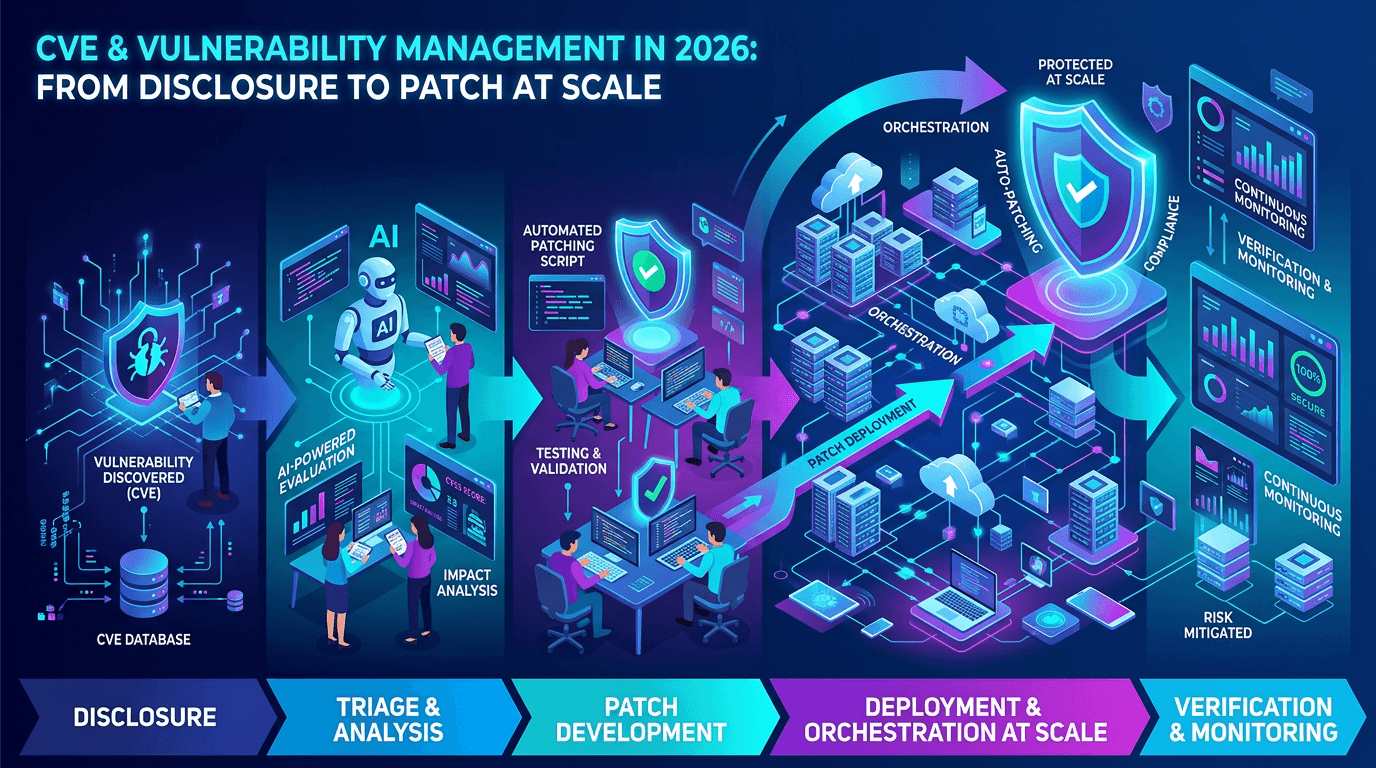 CVE & Vulnerability Management in 2026: From Disclosure to Patch at Scale
A practical guide to the CVE ecosystem, CVSS scoring, exploitability signals, and how security teams prioritize vulnerabilities without drowning in scanner noise.
Check any IP or domain
See what our indexed threat intelligence records say about it.
Try the IP / Domain Checker