IOC Retrohunting: Investigating Historical Logs Reliably
Run reliable IOC retrohunts by separating event time, intelligence availability, and validity, then document historical evidence and the limits of negative results.
 IsMalicious Team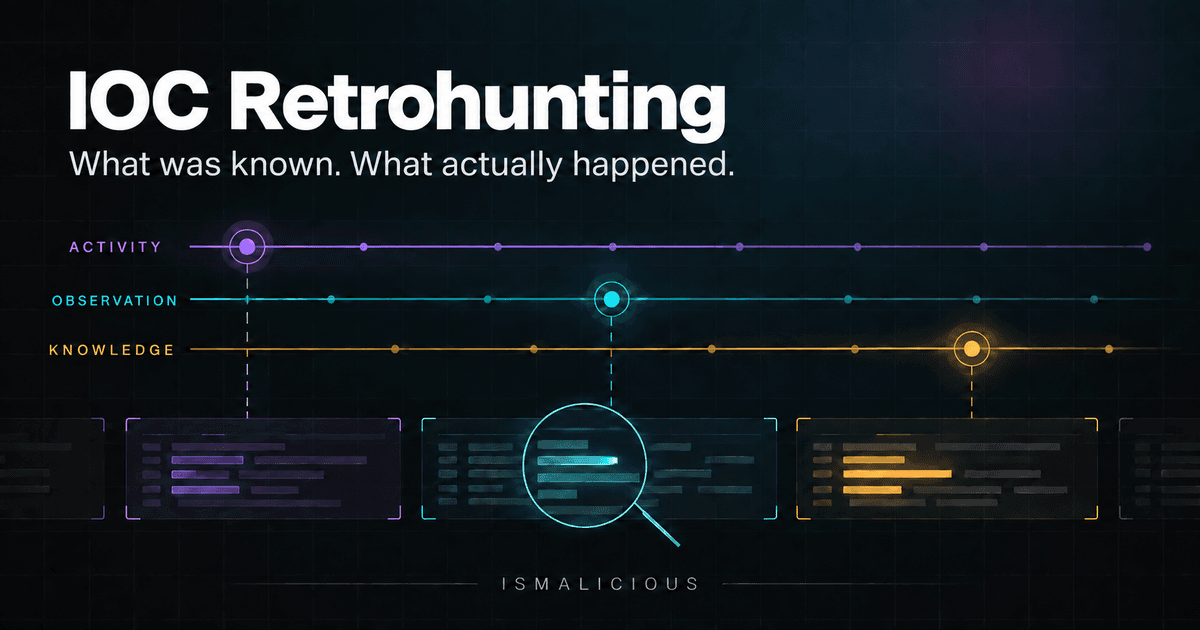
IOC retrohunting searches historical logs for an indicator discovered later. A newly attributed domain, IP address, or file hash can reopen an investigation that had little useful context when the event occurred. The central challenge is temporal: what is known today does not necessarily describe what was true, visible, or available at the time.
A September 10, 2026 discussion in r/Splunk about converting intelligence into tested detections raises telemetry readiness and the reassessment of existing coverage. Retrohunting is an operational extension of that question, developed here as an investigation method. The discussion supplies a problem statement, not a benchmark or evidence of product effectiveness.
A useful retrohunt must distinguish two questions: can current knowledge reveal historical activity worth investigating, and could the organization have detected it using information actually available then? Mixing them produces misleading historical alerts and unfair assessments of the SOC.
Begin with a bounded hypothesis
Write the question before importing an indicator list. For example: “Did managed endpoints contact domains attributed to this campaign during its documented activity period?” Specify the relevant log sources, environments, dates, and observable types.
For a recurring hunt requirement, the PIR workbook helps identify the decision owner, required evidence, and conditions for stopping or reopening collection.
A contact search is not automatically a compromise search. A DNS lookup may come from a security tool. A blocked connection has different implications from a successful download. The type of event determines which claims the evidence can support.
Choose a stopping point as well. A campaign may contain thousands of indicators, while the first hypothesis concerns only domains related to an access method present in your environment. A narrower initial hunt is easier to explain and can be expanded in response to evidence.
Our guide to operational IOC pipelines covers normalization and provenance at ingestion. The concern here is preserving the meaning of those inputs across time, including after their classification changes.
Preserve multiple clocks in the case record
Event time describes when an action occurred according to the event source. Ingestion time describes when a collector or SIEM received the record. Forwarding delays, archive restoration, and timezone errors can separate those times substantially.
Splunk’s time modifiers distinguish event-time and index-time filtering. Its documentation also requires an appropriate event-time window when using index-time modifiers. An archive indexed today can therefore contain events missed by a search limited to today’s event timestamps.
Intelligence has additional clocks: observation, publication, modification, and local receipt. Record the definition and source of each field, including missing values. A field named only date is not enough to establish historical meaning.
Finally, preserve the hunt execution time and input versions. That lets another analyst explain why the same query produced different results a week later even though the underlying logs did not change.
Normalize timestamps to a common reference for comparisons, but retain the original value and timezone when relevant. A corrected timestamp should remain traceable to its original record rather than silently replacing it.
Do not turn first_seen into a compromise date
A first observation describes the source’s knowledge boundary. It does not guarantee that malicious activity began at that instant. Similarly, creating an administrative CTI object does not necessarily date the behavior it describes.
OASIS STIX 2.1 separates observation fields, first_observed and last_observed, from Indicator validity fields, valid_from and optional valid_until. An absent upper bound does not prove that infrastructure remains malicious forever.
Keep source-declared boundaries separate from boundaries inferred during your investigation. If the hunt extends before the earliest documented malicious observation, label that interval exploratory. It may contain useful evidence, but the source has not yet established the same claim for it.
A reassigned IP address illustrates the problem. The same string can represent different operators or services at different dates. An IP reputation check supplies context; a claim about past activity needs evidence compatible with the period under investigation.
Read a fictional timeline without rewriting the past
Consider invoice-support.example, a reserved example domain. The following fictional dates illustrate the reasoning only; they do not describe a real campaign or customer.
August 28, 14:00: endpoint A issues a DNS query
August 28, 14:02: the SIEM receives that event
August 29, 07:00: earliest documented malicious observation
August 30, 11:00: endpoint B makes a connection
September 3, 08:00: the intelligence is published
September 3, 08:10: the intelligence becomes locally available
September 4, 09:00: endpoint C makes a connection
September 17: the retrohunt runs
Endpoint A deserves examination, but its event predates the available malicious evidence. The timeline alone cannot classify it as compromised or safe. Investigators need additional material such as retrieved content, process activity, redirects, or earlier historical observations.
Endpoint B communicated after the malicious observation but before publication. A hunt can find that event today. The result does not establish that the SOC should have generated a feed-based alert on August 30, when that intelligence was not yet available to it.
Endpoint C communicated after local receipt. If telemetry was available, field mappings were correct, and a relevant rule was active, the missing alert becomes a legitimate operational question. It still requires checking the configuration actually running on that date.
The three matches share an indicator but support different explanations. Keeping them separate prevents a dashboard from turning every historical match into the same kind of detection failure.
Build complementary retrospective and historical searches
The first search uses current intelligence to discover historical leads. It matches retained events over a chosen period and annotates whether they fall within the documented activity or validity window. It can retain earlier matches for investigation without automatically assigning them the same classification.
The second search replays past detection capability. At each evaluation instant, it must use only the intelligence versions and event records then available. Earlier publication is insufficient if the local system received the information after that instant.
This pseudocode describes the logic without assuming a particular SIEM schema:
Retrospective discovery:
  retained events within scope
  + the intelligence snapshot frozen for today's hunt
  + temporal compatibility annotations
  => investigation candidates

Detection replay at time T:
  events locally available at T
  + intelligence versions locally available at T
  + rule configuration and search window at T
  => results that configuration could have produced
Include collection delays and scheduling frequency in the replay. An event received at 10:07 could not appear in a search executed at 10:05, even when its event timestamp says 10:01.
Also distinguish what the rule could have returned from what an analyst would have concluded. Replaying a match does not reconstruct the entire historical investigation, its queue, or the evidence available outside the SIEM.
Archive versions instead of keeping only the current verdict
A table containing only “domain, current verdict” overwrites changes in interpretation. It cannot reconstruct the knowledge behind an old decision. Preserve the source identifier, received version, local receipt time, and subsequent changes or withdrawals.
Microsoft Sentinel’s threat intelligence lifecycle documentation describes new table entries for indicator creation, updates, and deletion, while the management interface shows the most current indicator. A current view and an event history therefore serve different purposes. Verify the actual schema and retention of your deployment before assuming historical reconstruction is possible.
When a source revokes an indicator, preserve the correction and reassess affected cases. Do not silently erase the old classification from the investigation record. Another reviewer should be able to see why the alert was originally generated and why the interpretation later changed.
STIX and TAXII pipelines can carry relevant metadata. The presence of fields in an interchange format does not establish that a specific connector retains them or that a downstream lookup preserves every version.
Check coverage before an expensive historical search
Create a coverage record for each log source: genuinely searchable dates, monitored environments, known interruptions, available fields, and aggregation level. A 90-day index does not establish 90 complete days of visibility for every endpoint.
Confirm that the desired observable can appear in the selected field. Proxy records may retain a hostname without the path. Network logs may contain only the remote IP. DNS caching may reduce recorded queries. These differences change the meaning of a missing match.
Test parsing against known records. A trailing dot in a domain, encoded URL, or alternate IPv6 representation can defeat a raw string comparison. Normalization must preserve relevant distinctions: stripping a URL path may remove the feature that separates a malicious resource from its legitimate shared host.
Search a small slice first to verify field behavior and query cost. Expand by source or period, recording completed batches. A timed-out search or partially processed sample should never be presented as a completed historical review.
Keep ingestion failures visible in the coverage record. If one connector stopped reporting for a day, zero matches during that day are evidence of missing observation rather than a quiet network.
Validate temporal logic with explicit test cases
Before scanning archives, prepare synthetic records in an isolated test dataset. There is no need to contact malicious infrastructure. The goal is to validate correlation logic rather than reproduce an attack.
Include cases on both sides of meaningful boundaries: an event before declared validity, another within that interval, late intelligence receipt, revocation, and contradictory versions. Add an event received after the replay time despite having an earlier event timestamp.
Write the expected result for both search modes. A record can correctly appear in retrospective discovery while being absent from historical replay. That difference is expected when it follows from information availability.
Test duplicates too. The same record may exist in a restored archive and its original index. Counting both copies as separate actions distorts timelines and frequency estimates. Preserve a stable event reference or a documented deduplication rule suitable for the source.
For boundary comparisons, state whether the ending timestamp is included or excluded. An unstated convention can move a record between categories at the exact point where an indicator expires or a version changes.
Turn matches into evidence appropriate to the hypothesis
For each material result, preserve the raw event or a durable reference, collector, timestamps, asset, and matching indicator. Attach the intelligence version and the precise reason for the association.
Then look for supporting evidence. A domain lookup can be linked to a connection and process where telemetry permits. A hash can mean a file was present, downloaded, quarantined, or executed; those are different observations. Our guide to investigating IOC alerts across IP, DNS, and process evidence develops that transition.
Avoid automatic actor attribution. A campaign association describes published context; it does not establish who operated the activity recorded in your environment. Preserve that distinction, particularly in reports intended for readers outside the SOC.
If correlation depends on an inferred relationship, identify it as an inference. A shared IP and a nearby timestamp may justify further investigation, but they do not establish that one process produced a particular network event.
State negative results with their actual limits
“No signs of compromise” is too broad for an indicator search alone. Prefer a statement that describes the work performed:
No matches found for the 42 domains in intelligence snapshot X
in managed-headquarters endpoint DNS logs,
from August 20 through September 10 inclusive.

Limitations: no mobile collection; collector interruption on August 27;
URL paths unavailable; activity not using these domains was outside
the scope of this search.
These numbers are illustrative. The template is useful because it lets a reader decide whether additional collection is needed. Naming an observation gap does not invalidate the search; it prevents the result from claiming more than the data supports.
Close the hunt with a reproducible record
Archive the query, parameters, indicator versions, scope, and batches actually completed. Record open, dismissed, and confirmed results together with resulting actions. Schedule reassessment where a source is expected to clarify the activity window.
For a shareable indicator, an IsMalicious lookup can add reputation context to the case. Date the consultation. Do not convert a present-day response into proof of historical reputation unless its evidence explicitly covers that period.
The finished record should make a verifiable statement: which traces were found, when they occurred, what supports their interpretation, and which data was unavailable. That precision makes it possible to reopen the investigation after new intelligence arrives without reconstructing the entire chain of reasoning.
Frequently asked questions
- What is IOC retrohunting?
- IOC retrohunting searches retained events using new or revised threat intelligence. A historical match creates an investigation lead; it does not by itself establish that a device was compromised.
- Can today’s IP reputation explain an old event?
- Only with appropriate historical context. An address may have changed users, and the intelligence may concern a different period. Preserve dated evidence that connects the malicious activity to the event being investigated.
- How do first_seen, valid_from, and ingestion time differ?
- First_seen describes an observation by a source, valid_from describes declared indicator validity, and local ingestion time records receipt. These dates answer different questions and should not be substituted for one another.
- What does a retrohunt with no results establish?
- It establishes that no matches were found within the data, fields, and periods actually searched. Interpretation depends on collection coverage, retention, ingestion delays, and query limitations.
Related articles
 TAXII Threat Feeds: Build a Continuous SIEM Integration
Connect an isMalicious TAXII collection to your SIEM with safe pagination, durable checkpoints, validation, monitoring, and recovery.
 Kubernetes Audit Logs: Threat Detection Guide
Turn Kubernetes audit logs into detections for privilege abuse, secret access, persistence, risky exec, and control-plane compromise.
 YARA vs Sigma: Which Detection Rule Should You Use?
Compare YARA and Sigma by data source, purpose, portability, performance, false positives, testing, and threat-intelligence workflow.
Protect Your Infrastructure
Check any IP or domain against our threat intelligence database with indexed records.
Try the IP / Domain Checker