Check Point CVE-2026-123039: The Gaia Zero-Day That Turned Mobile Access Portals Into Root
Check Point says a couple of dozen unpatched systems were compromised through PHP2Shell on the Mobile Access portal and CVE-2026-123039, a root escalation in the Gaia DynamicCLI daemon. The fixed Jumbo Hotfix takes, the log checks Check Point published, the implants to hunt, and the two telecom-platform flaws CISA listed the same week.
 isMalicious Team
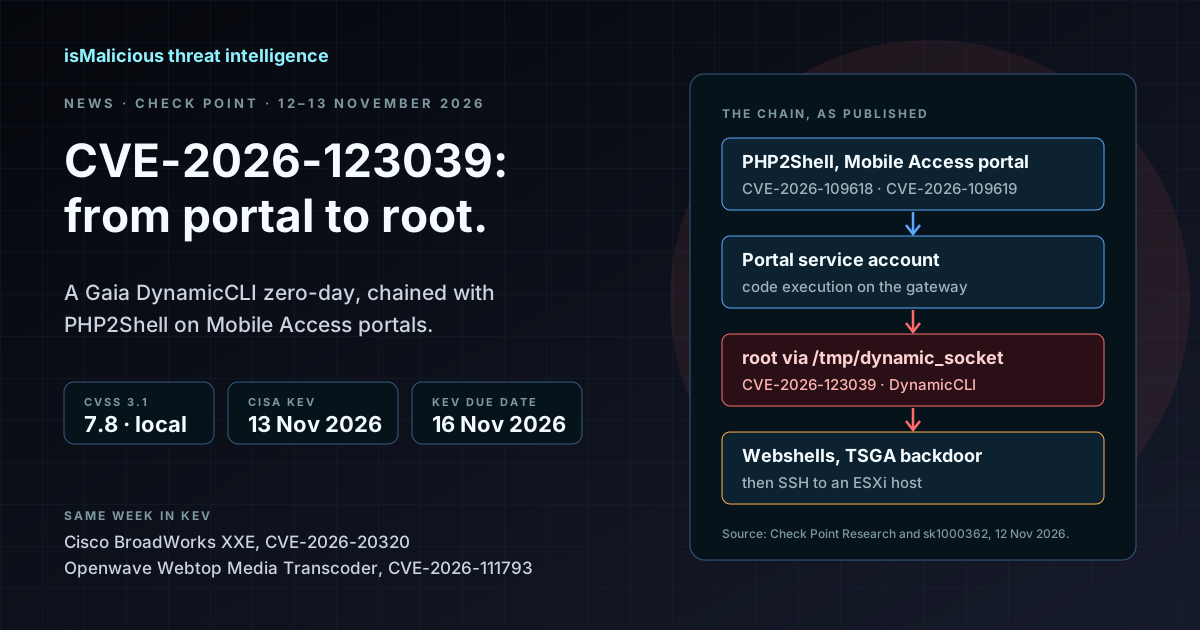
On 12 November 2026 Check Point disclosed CVE-2026-123039, a local privilege escalation in the DynamicCLI service of its Gaia operating system, and said it had observed the flaw exploited "against a couple of dozen customers". The attacker reached the gateways through PHP2Shell (CVE-2026-109618 and CVE-2026-109619) on internet-facing Mobile Access portals, then used CVE-2026-123039 to go from the portal's service account to root. The fix is in the November Jumbo Hotfix: R82.20 Take 14, R82.10 Take 52, R82 Take 132 and R81.20 Take 174. CISA added the flaw to its Known Exploited Vulnerabilities catalog on 13 November with a three-day deadline. A gateway that exposed a Mobile Access portal without the PHP2Shell fix needs a compromise check, not only the hotfix.
The same week, CISA listed two flaws in platforms that telecom operators run for their customers: an XXE in Cisco BroadWorks and a file-type bypass in the Openwave Messaging Webtop Media Transcoder. They are covered near the end.
What CVE-2026-123039 is
The Gaia dynamic, or extended, CLI is served by a root process, dynamic_server, which listens on a local socket at /tmp/dynamic_socket. According to Check Point's advisory sk1000362, on affected versions that socket is created world-writable (0777), the daemon does not authenticate the process that connects, and it runs as root whatever command string it receives. Any local user can therefore run commands as root by writing one request to the socket.
The flaw is not remotely exploitable on its own: the attacker needs code execution on the appliance first. That is why it scores CVSS 7.8 (AV:L/AC:L/PR:L/UI:N), and why it only mattered once PHP2Shell supplied the first step.
Check Point lists as affected its Force Firewalls (Security Gateways), Management and Log Servers, Multi-Domain Security Management and Multi-Domain Log Server, and Maestro Orchestrator, on R82.20, R82.10, R82 and R81.20, plus R81.10 and R81, both end of support. Spark Firewalls and Smart-1 Cloud are not affected. Management servers are affected by CVE-2026-123039 even though PHP2Shell does not reach them: sk1000302 lists Security Management and Log Servers as not impacted by the PHP flaws.
How the chain worked
Check Point Research (CPR) published its investigation on 12 November. The first signs of exploitation appeared on 30 October, on Mobile Access gateways of Israeli organizations, from 130.94.19[.]204. That was about a week after Check Point shipped its PHP2Shell hotfix, on 23 October. A second, broader scanning wave on 2 November reached organizations in several countries and sectors, with no destructive activity seen. Check Point's advisory post dates the activity from 30 October to 4 November and says a couple of dozen unpatched systems, in a single region, were compromised.
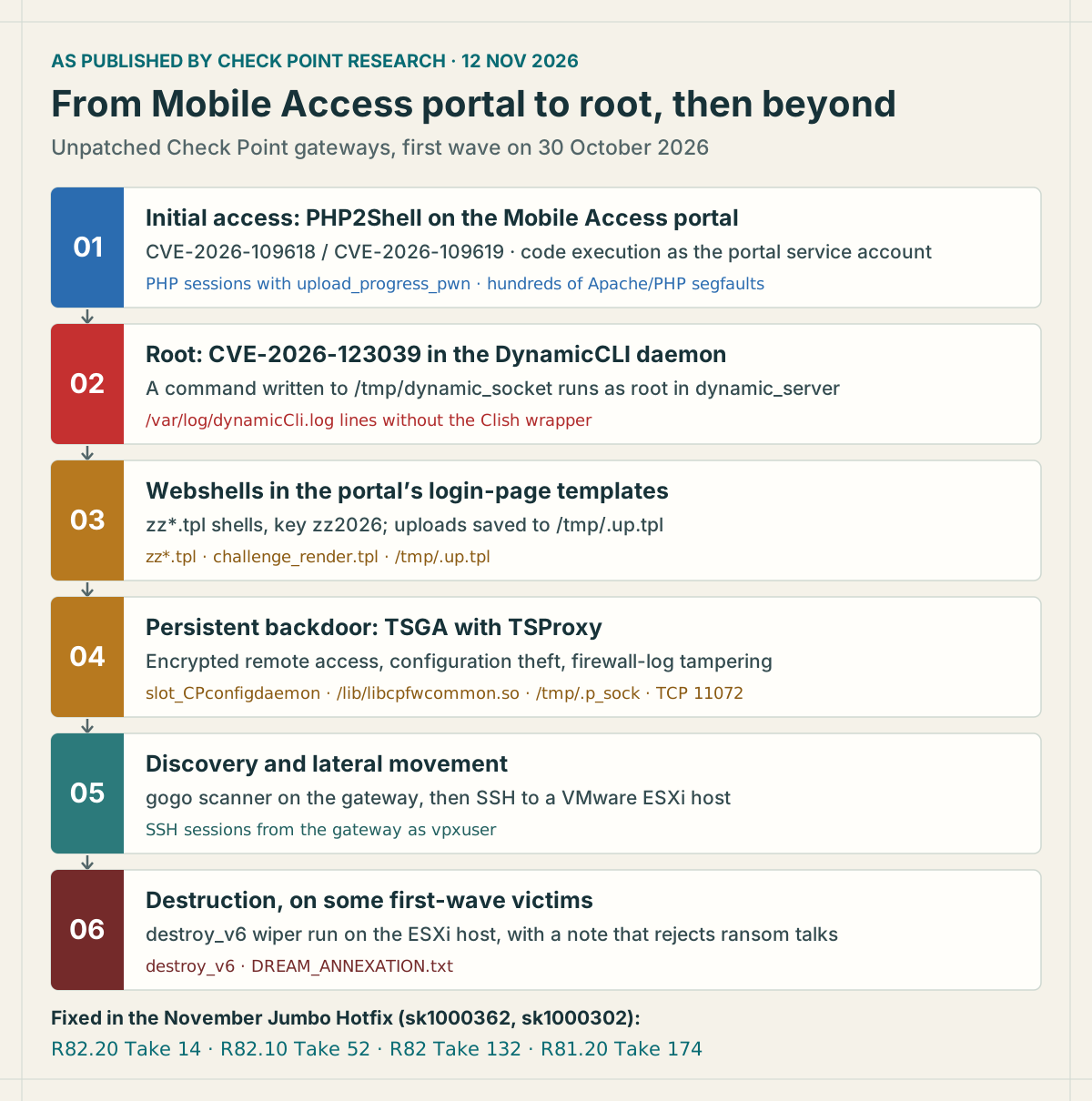
Step by step, as CPR describes it:
- Initial access through PHP2Shell on the Mobile Access portal. PHP session files containing the marker
upload_progress_pwnwere created under/opt/CPcvpn-R81.20/tmp/, and the portal's Apache/PHP workers logged hundreds of segmentation faults in the same window. - Root through CVE-2026-123039, from the portal's service account.
- PHP webshells written as
zz*.tplinto the directory the portal uses to build its login pages. The larger shell needs the keyzz2026, runs system commands and PHP code, and saves uploads to/tmp/.up.tpl, which the attackers then copied into the portal aschallenge_render.tpl. - A persistent backdoor, TSGA, started from
/tmp/CPconfigdaemonwith its output sent to/tmp/.bd.log, then relaunched asslot_CPconfigdaemonfrom the boot persistence directory. It writes its TSProxy component to/lib/libcpfwcommon.soand injects it into appliance processes, where it intercepts networking functions to serve marked attacker connections. TSGA listens on TCP 11072 on all IPv4 interfaces, uses the Unix socket/tmp/.p_sock, steals configuration and can tamper with binary firewall logs. - Discovery with the gogo scanner, then SSH from the gateway to a VMware ESXi host with the
vpxuserservice account. - On some first-wave victims, the
destroy_v6wiper on the ESXi host and a note namedDREAM_ANNEXATION.txtthat rejects any ransom negotiation.
CPR is careful about attribution. TSGA and TSProxy are modified variants of PhiliKit, a framework previously seen against Ivanti appliances and associated by ESET with the China-nexus group UNC5221, and the attacker's addresses sat on LightNode VPS infrastructure. But the destructive stage, the focus on Israel and the Hebrew note do not fit that group's known interests, and CPR leaves several scenarios open: one actor end to end, an initial access broker, or a false flag. We have nothing to add to that.
Fixed versions and the interim mitigation
| Release | CVE-2026-123039 fixed from |
|---|---|
| R82.20 | Jumbo Hotfix Accumulator Take 14 |
| R82.10 | Jumbo Hotfix Accumulator Take 52 |
| R82 | Jumbo Hotfix Accumulator Take 132 |
| R81.20 | Jumbo Hotfix Accumulator Take 174 |
| R81.10, R81 | No fix listed in sk1000362; both are end of support |
The same Takes carry the PHP2Shell fix, per sk1000302, so one Jumbo Hotfix closes both links of the chain. Check Point recommends installing it on all Management Servers and Security Gateways, starting with gateways that expose Mobile Access. Its advisory post lists two more vulnerabilities fixed in the November Jumbo Hotfix that it has not seen exploited: CVE-2026-107484, a privilege escalation in the Gaia Portal backend (CVSS 7.3), and CVE-2026-120490, a management-to-gateway privilege boundary bypass through a NAT rule (CVSS 3.8). If you installed the standalone PHP2Shell hotfix on R81.20 in October, sk1000302 says the package was updated on 28 October and that, with the Mobile Access portal, it must sit on Jumbo Hotfix Take 166 or higher.
Where the hotfix cannot go in at once, sk1000362 says to stop dynamic_server and keep it from restarting:
dbset process:dynamic_server
dbset :save
This breaks the Dynamic CLI commands listed in sk144112; dbset process:dynamic_server t followed by dbset :save restores them. Confirm in Expert mode that the process is gone with ps auxw | grep -v grep | grep 'dynamic_server'.
After patching, Check Point gives two checks that the box is fixed. ls -l /tmp/dynamic_socket should show srw-rw---- root config (0660), not srwxrwxrwx. And the patched daemon logs the callers it refuses:
grep "Rejected connection from unauthorized uid" /var/log/dynamicCli.log
A line with an unexpected UID (99 is nobody) is a blocked escalation attempt. Check Point asks that bursts of these be correlated with the portal, web and authentication logs to find the source.
Checking a gateway for compromise
The hotfix closes the socket. Nothing in the advisory says it removes what an attacker placed while holding root, so the compromise check is a separate task. The vulnerable daemon logs every command it receives to /var/log/dynamicCli.log, and legitimate requests come through a fixed Clish wrapper that begins . /opt/CPshared/5.0/tmp/.CPprofile.sh >> /dev/null; export SP_DISTRIBUTE=0; set -o noglob;. sk1000362 gives three searches to run on each gateway or cluster member:
grep "Received =" /var/log/dynamicCli.log \
  | grep -vF "CPprofile.sh >> /dev/null; export SP_DISTRIBUTE=0; set -o noglob;"

grep -F "Received = #return_value#" /var/log/dynamicCli.log

grep -EI "Received =.*(base64| id;| whoami| /etc/shadow| ncat| nc -| /dev/tcp| curl | wget | useradd| authorized_keys)" \
  /var/log/dynamicCli.log
The first lists commands that skipped the wrapper, the second the use of the system() sink, which is rare in legitimate traffic, and the third commands typical of exploitation attempts. Then look for what CPR and Check Point's advisory post describe:
- PHP session files containing
upload_progress_pwn, and a burst of Apache/PHP segmentation faults on the portal. zz*.tplfiles or an unexpectedchallenge_render.tplamong the portal templates, and/tmp/.up.tpl.- A file or process named
CPconfigdaemonorslot_CPconfigdaemon,/lib/libcpfwcommon.so,/tmp/.p_sock,/tmp/.bd.log, and a listener on TCP 11072. - Scanner or wiper tooling under
/tmp, and aDREAM_ANNEXATION.txtnote. - Gaps in firewall traffic logs, particularly after a crash of the logging daemon.
- SSH sessions from the gateway to internal hosts, ESXi hosts in particular, as
vpxuser.
Check Point is explicit that the absence of a match does not rule out compromise.
The published indicators are two scanning sources, 130.94.19[.]204 and 130.94.19[.]168, and eight SHA-256 hashes: the webshell, TSGA in both forms, gogo, the wiper, the note, and the PhiliKit philistine and libdssafe.so samples. On 15 November all ten were on isMalicious, each listed by AlienVault OTX and the Rösti MISP feed, and each in our data since 13 November, the day after the report: they arrived with the publication, not before it. Both addresses are in AS154177 (LightNode) and can be looked up with the IP reputation check, the hashes with the file hash reputation check. For the PHP2Shell infrastructure published before this campaign, see our check of the Amazon and Hunt.io PHP2Shell IOCs.
What our CVE catalog shows
The isMalicious CVE catalog, which feeds each CVE page linked from this article, holds for CVE-2026-123039 on 15 November 2026: published in the NVD on 12 November, CVSS 7.8 from Check Point as the CNA, CWE-732 and CWE-862, added to KEV on 13 November with a due date of 16 November, known ransomware use "Unknown", and an EPSS score of 2.2%. The catalog also recorded, on 14 November, a public GitHub repository named after the CVE; we have not reviewed it.
An EPSS of 2% on a vulnerability that is exploited and listed in KEV is the pattern our September and October KEV readout measured: on the day of listing, 40 of 62 scored additions were under 1%. KEV membership should override the score.
It is also Check Point's sixth entry in KEV in our catalog, and its fifth in 2026: CVE-2024-24919 (May 2024), CVE-2026-50751 (June), CVE-2026-16232 (July), CVE-2026-85102 and CVE-2026-93616 (both September), then this one. Every one of them is in a gateway or its management.
The same week: two telecom platforms in KEV
On 10 November CISA added two flaws in software that service providers run for their subscribers. Both are due on 24 November.
Cisco BroadWorks, CVE-2026-20320. BroadWorks is the call-control platform that service providers host to deliver cloud calling (Cisco DevNet). Cisco's advisory, first published on 19 August 2026, describes an out-of-band blind XXE in the Open Client Interface XML parser: external entity resolution is allowed by default, so an unauthenticated remote attacker can send a crafted XML message to the OCI-Provisioning service and read files with the privileges of the BroadWorks user. It scores CVSS 7.5. The Application Delivery Platform, Application Server, Profile Server and Xtended Services Platform are affected before release RI.2026.07, which is the first fixed release, and there is no workaround.
Cisco's wording moved twice that week. Version 1.1 of the advisory, on 12 November, said it reflected known active exploitation. Version 1.2, on 13 November, corrected that: it notes the KEV addition and states that "Cisco does not have direct evidence of active exploitation." The public account of exploitation is the report CISA attached to the NVD record: Malbear Labs' Operation Snowball, published on 8 November. It describes an AI agent, run by an operator the authors assess as Chinese-speaking, that sent a crafted OCI request to port 2208 of a European telecom provider's BroadWorks Xtended Services Platform and read its system identity private key and several SSL credential sets.
Openwave Webtop Media Transcoder, CVE-2026-111793. Openwave Messaging sells a white-label email and messaging platform to telcos, ISPs and other communication service providers (Lumine Group). Its Webtop Media Transcoder does not enforce the file-type restrictions an administrator sets for conversion, so an authenticated user who goes around the webmail interface can have unintended document types converted (Openwave advisory CAN-2026-2032674, CVSS 4.3). JPCERT/CC's JVNVU#93403064, published on 9 November, states that the developer has observed attacks exploiting it and that a specially crafted upload may expose sensitive information. CISA listed it the next day. Versions before 1.1.22.0 are affected, and Openwave tells customers to upgrade to the latest supported Media Server 2.0 release.
In our catalog on 15 November the two scored an EPSS of 1.0% and 0.6%.
Why the same kind of asset keeps coming back
Our catalog holds 12 KEV additions from 9 to 13 November. Besides these three, they include two Barracuda flaws, one of them in the Email Security Gateway, and a code injection in SignalWire FreeSWITCH, another piece of telephony software. Several sit in systems that face the internet or a provider's subscribers by design: a firewall's remote-access portal, a carrier calling platform, a carrier webmail, a mail gateway. In the Check Point case, the device meant to filter traffic became the foothold, and then the launch point toward a hypervisor. The argument for sorting a patch queue on exposure and exploitation rather than CVSS is in our Arista VeloCloud and FortiOS note, and the count is in the September and October readout: 28 of 79 KEV additions were network and security appliances. This week adds one more reason. A local, CVSS 7.8 flaw was the step that turned a known, patched PHP bug into root on a firewall.
What to do now
- List every Check Point gateway, management server and Maestro Orchestrator with its release and installed Jumbo Hotfix Take, and compare it with the table above. R81.10 and R81 have no fix in sk1000362: move them to a supported release.
- Patch first the gateways that run a PHP2Shell-exposed feature listed in sk1000302: Mobile Access Portal, Remote Access VPN with SSL Network Extender or SAML authentication, Identity Awareness Captive Portal, UserCheck Portal or Zero Phishing. Then the management servers, which CVE-2026-123039 affects as well.
- Where the Take cannot be installed today, stop
dynamic_serveras sk1000362 describes, and accept that the Dynamic CLI commands of sk144112 stop working. - Keep the Gaia Portal and SSH of every appliance reachable from management networks only, and turn off any portal feature the gateway does not need.
- On every gateway that exposed one of those portals before its PHP2Shell fix, run the three
dynamicCli.logsearches and the artifact checks above, whatever the patch level is today. - If anything matches, treat the gateway as compromised along with what it could reach: hosts it opened SSH sessions to, ESXi hosts in particular, and every credential stored in its configuration, which TSGA can steal.
- Search firewall, proxy and endpoint logs for the two published addresses and eight hashes, and keep in mind that the absence of a match proves nothing.
- For BroadWorks, upgrade the four affected components to RI.2026.07. Malbear Labs saw OCI requests on port 2208, so check who can reach the OCI-Provisioning service. For Openwave, move to the supported Media Server 2.0 release.
- Follow the due dates on /cve/kev: 16 November for CVE-2026-123039, already past, and 24 November for the BroadWorks and Openwave flaws.
Sources
- Check Point, sk1000362: CVE-2026-123039, affected products and versions, mitigation, indicators of compromise, fixed Takes (last modified 12 November 2026).
- Check Point, sk1000302: PHP2Shell on Check Point products, affected features, hotfix of 23 October, fixed Takes.
- Check Point, Security Advisory: Active Exploitation of PHP2Shell and Local Privilege Escalation, 12 November 2026.
- Check Point Research, PHP2Shell Exploitation on Check Point Gateway, 12 November 2026: chain, implants, attribution, IOCs.
- Cisco, cisco-sa-bworks-xxe-uwUd7CEt, version 1.2 of 13 November 2026.
- Malbear Labs, Operation Snowball: Inside an Autonomous AI Intrusion Campaign, 8 November 2026.
- JPCERT/CC, JVNVU#93403064, 9 November 2026, and Openwave, CAN-2026-2032674.
- CISA KEV dates, due dates, CVSS and EPSS: the isMalicious CVE catalog, read on 15 November 2026.
FAQ
Frequently asked questions
What is CVE-2026-123039?
A local privilege escalation in the DynamicCLI service of Check Point Gaia OS, scored CVSS 7.8. The root process dynamic_server listens on /tmp/dynamic_socket, which affected versions create world-writable, and runs as root any command a local process sends it. Check Point disclosed it on 12 November 2026 in sk1000362 and said it had observed it exploited against a couple of dozen customers. CISA added it to the KEV catalog on 13 November.
Which Check Point versions are affected and which Jumbo Hotfix fixes CVE-2026-123039?
R82.20, R82.10, R82 and R81.20, plus the end-of-support R81.10 and R81, on Security Gateways, Management and Log Servers, Multi-Domain servers and Maestro Orchestrator. The fix is in the Jumbo Hotfix Accumulator from R82.20 Take 14, R82.10 Take 52, R82 Take 132 and R81.20 Take 174. sk1000362 lists no fix for R81.10 or R81. Spark Firewalls and Smart-1 Cloud are not affected.
How did attackers get root on Check Point gateways?
According to Check Point Research, they first exploited PHP2Shell (CVE-2026-109618 and CVE-2026-109619) on internet-facing Mobile Access portals, which gave them code execution as the portal service account, then used CVE-2026-123039 to run commands as root. They planted PHP webshells in the portal templates, installed the TSGA backdoor and its TSProxy library, scanned the internal network and, on some victims, moved over SSH to a VMware ESXi host and ran a wiper.
How can I tell whether a Check Point gateway was compromised?
Search /var/log/dynamicCli.log for commands received without the standard Clish wrapper, for "Received = #return_value#" and for commands such as whoami, curl, wget or base64, as sk1000362 describes. Then look for PHP session files containing upload_progress_pwn, zz*.tpl files among the Mobile Access templates, files or processes named CPconfigdaemon, /lib/libcpfwcommon.so, a listener on TCP port 11072, gaps in firewall logs and SSH from the gateway to ESXi hosts. No match does not prove the gateway is clean.
Which Cisco BroadWorks and Openwave flaws did CISA add to KEV the same week?
On 10 November 2026 CISA added CVE-2026-20320, an unauthenticated XXE in the Cisco BroadWorks OCI XML parser that lets an attacker read files, fixed in release RI.2026.07, and CVE-2026-111793, a file-type restriction bypass in the Openwave Messaging Webtop Media Transcoder, fixed from version 1.1.22.0. Both are due on 24 November. Cisco says it has no direct evidence of exploitation; JPCERT/CC reports that Openwave observed attacks.
Related articles
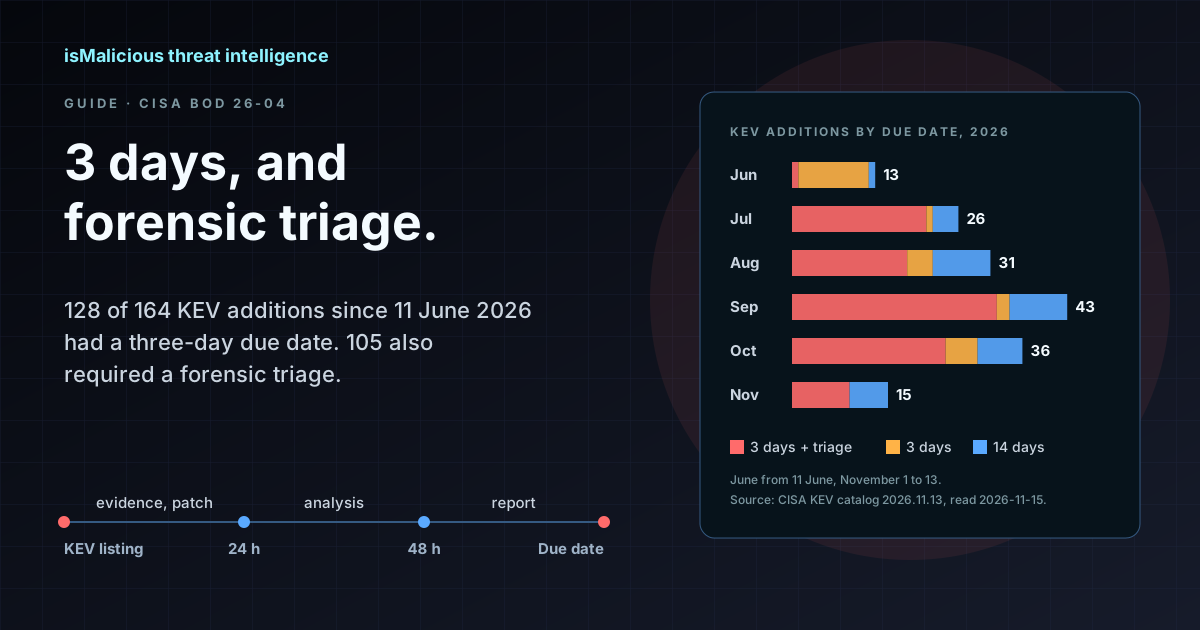 CISA BOD 26-04 Explained: The Three-Day KEV Deadline and Forensic Triage
CISA’s Binding Operational Directive 26-04 replaced BOD 22-01 on 10 June 2026. A KEV vulnerability on an internet-facing asset now gets three calendar days in most cases, and forensic triage when it grants total control. Since 11 June, 128 of 164 KEV additions carried a three-day due date and 105 were flagged for forensic triage. Here is what the directive says, what the data shows and how to run a three-day cycle.
 CVE-2026-63077 Puts Unauthenticated RCE on Every TeamCity On-Premises Server
A deserialization flaw in the agent polling protocol gives attackers TeamCity server privileges without credentials. JetBrains patched in 2025.11.7 and 2026.1.3 — CISA KEV and a 3-day federal deadline mean hunt now, not after the next release train.
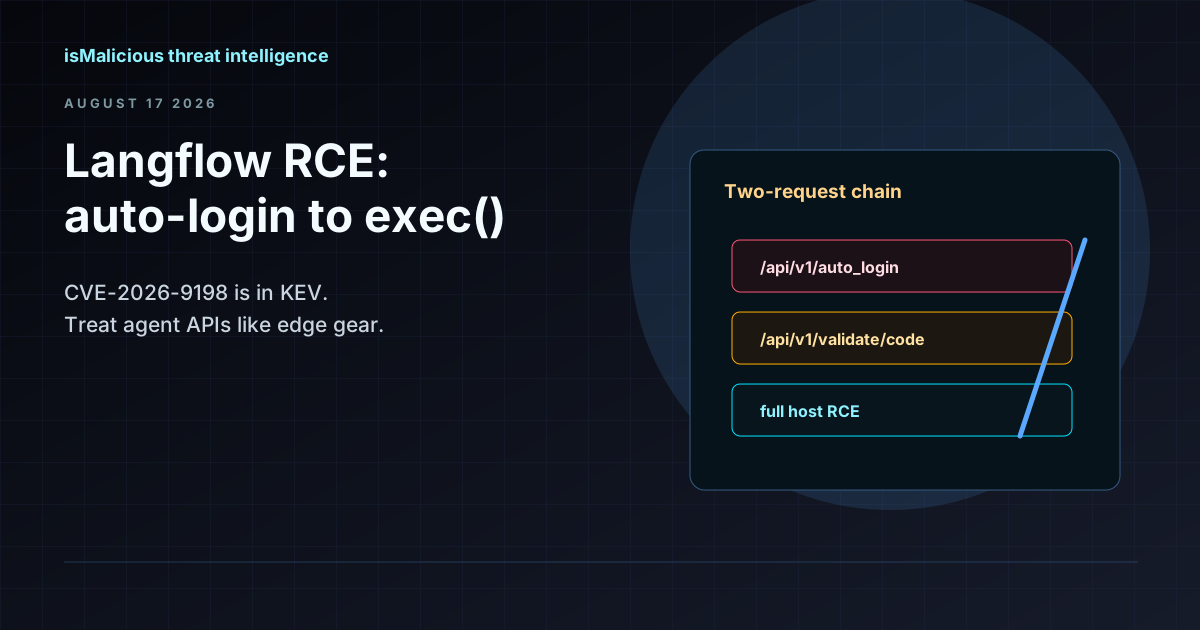 CVE-2026-9198 Gives Unauthenticated RCE in IBM Langflow OSS Agent Control Planes
A SUPERUSER token minted through /api/v1/auto_login chains with Python exec() in /api/v1/validate/code. Langflow 1.10.1 fixes the flaw — but internet-exposed instances need hunting now, not after the next sprint.
Check any IP or domain
See what our indexed threat intelligence records say about it.
Try the IP / Domain Checker