CISA BOD 26-04 Explained: The Three-Day KEV Deadline and Forensic Triage
CISA’s Binding Operational Directive 26-04 replaced BOD 22-01 on 10 June 2026. A KEV vulnerability on an internet-facing asset now gets three calendar days in most cases, and forensic triage when it grants total control. Since 11 June, 128 of 164 KEV additions carried a three-day due date and 105 were flagged for forensic triage. Here is what the directive says, what the data shows and how to run a three-day cycle.
 IsMalicious Team
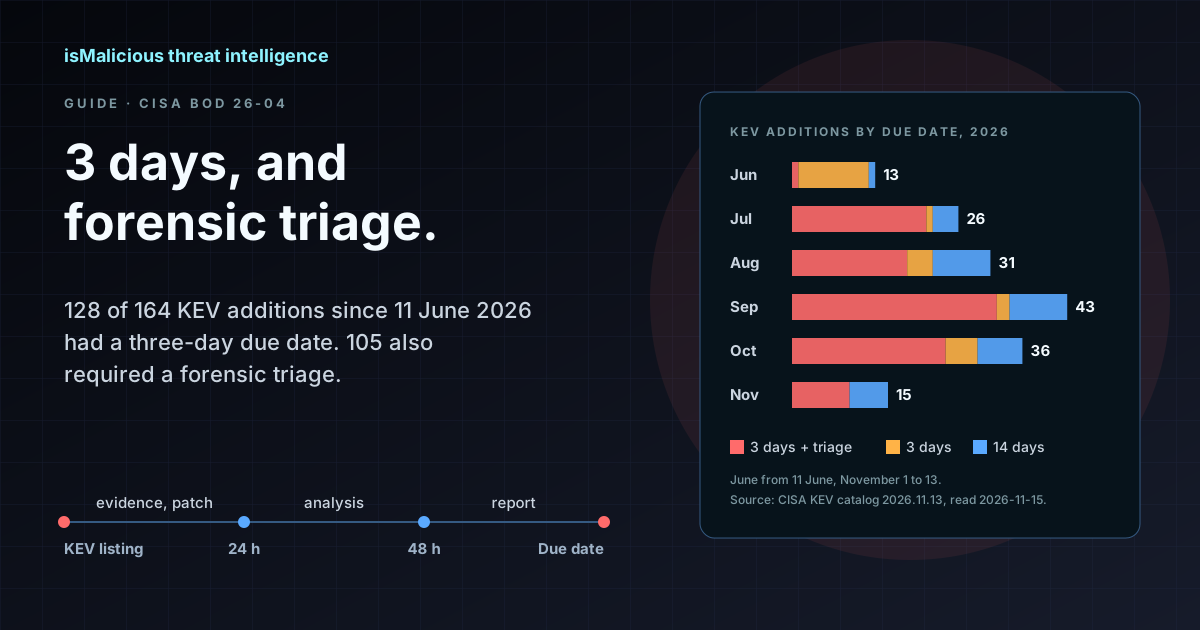
CISA’s Binding Operational Directive 26-04, issued on 10 June 2026, replaced BOD 22-01 as the rule that tells US federal agencies how fast to fix a vulnerability. The deadline now follows from four facts: whether the asset is publicly exposed, whether the CVE is in the Known Exploited Vulnerabilities (KEV) catalog, whether exploitation can be automated, and whether it gives the attacker total control. A KEV vulnerability on an internet-facing asset gets three calendar days unless it is neither automatable nor total control, and a total-control flaw adds a forensic triage: check the asset for compromise, not only patch it. In the catalog, 128 of the 164 KEV additions from 11 June to 13 November 2026 carried a three-day due date, and 105 were flagged for forensic triage.
This guide covers what the directive and its implementation guidance say, what the KEV data shows since the directive took effect, and how an organization outside the US government can run the same three-day cycle. For how KEV, EPSS and CVSS fit together in a patch queue, see EPSS vs CVSS vs KEV; for the KEV additions of September and October and their EPSS on listing day, see our two-month readout.
What BOD 26-04 replaced, and who it binds
A binding operational directive is a compulsory direction to federal executive branch agencies. BOD 26-04 applies to federal civilian systems, not to national security systems, and not to contractors unless their procurement contract says so. It revokes two earlier directives: BOD 19-02, which set deadlines for internet-accessible systems, and BOD 22-01, which created the KEV catalog in 2021.
The directive works in three phases. Agencies had to update their vulnerability management policies at once, update their processes within 60 days, and meet the new remediation timelines within 180 days of issuance, which is 7 December 2026. Asset tagging comes with the third phase: every agency asset reachable from outside its network is tagged with its organization, environment, exposure (public or internal) and asset type.
One line in CISA’s FAQ matters to anyone who still sorts by severity: “By revoking BOD 19-02, the FCEB no longer requires CVSS use for vulnerability prioritization.” A CVSS label such as critical or high is replaced by an explicit deadline under defined conditions.
The four questions behind every deadline
Each deadline in the directive’s Table 1 comes from four answers:
- Is the asset publicly exposed, reachable by unauthenticated or untrusted parties over a public network, wherever it sits? This one is the agency’s answer, about its own asset.
- Is the CVE in the KEV catalog?
- Is it automatable: can an adversary automate every step of exploitation?
- What is its technical impact: does exploitation give partial or total control of the software? Total includes an exploit that reliably reveals login credentials.
CISA publishes the last three for every CVE through its Vulnrichment program, which adds SSVC decision points to the CVE record. For a CVE in the catalog, the table reads as follows:
| Publicly exposed | Automatable | Technical impact | Deadline (calendar days) |
|---|---|---|---|
| Yes | Yes | Total | 3 days & forensic triage |
| Yes | Yes | Partial | 3 days |
| Yes | No | Total | 3 days & forensic triage |
| Yes | No | Partial | 14 days |
| No | Yes | Total | 3 days & forensic triage |
| No | Yes | Partial | 14 days |
| No | No | Total | 14 days |
| No | No | Partial | 14 days |
Outside the KEV, the same table gives 3, 14 or 60 days to exposed assets and 60 days or “fix on system upgrade” to internal ones. Three rules apply to every row:
- The clock starts when CISA adds the CVE to the KEV, or when the agency finds the vulnerability on an asset and reports it, whichever comes first.
- The deadline moves with the facts. Taking a system off the internet turns “publicly exposed” to no and pushes the timeline back; a KEV listing shortens it.
- Remediation means the vulnerability is gone: patched, the system decommissioned, or another action that eliminates it.
How CISA sets the KEV due date
The directive’s deadline is per asset, but a KEV entry carries a single dueDate. CISA’s implementation guidance explains the link: CISA computes the due date from the table, “using available data to determine whether there is evidence that the vulnerability is present in a publicly exposed asset”, and “the final determination for asset exposure is determined by the agency”. The KEV due date is CISA’s default for the CVE; the deadline for a given server depends on that server.
Every addition since 11 June carries the same required-action text, which cites BOD 26-04 and CISA’s forensic triage requirements. The text does not tell you whether triage applies. The catalog’s JSON feed does, in a forensicTriage field set to Yes or No.
Read from the KEV catalog JSON (version 2026.11.13) and cross-checked against the isMalicious CVE catalog on 15 November 2026, the additions since the directive look like this:
| Month added (2026) | Additions | 3 days, forensic triage | 3 days, no triage | 14 days |
|---|---|---|---|---|
| June, from 11 June | 13 | 1 | 11 | 1 |
| July | 26 | 21 | 1 | 4 |
| August | 31 | 18 | 4 | 9 |
| September | 43 | 32 | 2 | 9 |
| October | 36 | 24 | 5 | 7 |
| November, 1 to 13 | 15 | 9 | 0 | 6 |
| Total | 164 | 105 | 23 | 36 |
Four things stand out:
- Only two due dates appear: three days or fourteen. No KEV addition got 60 days, which the table reserves for CVEs outside the KEV.
- The forensic triage flag first reads
Yeson 25 June. Every flagged entry has three days; no fourteen-day entry is flagged. - In September and October, 63 of 79 additions had three days, 56 of them with triage. From 1 to 13 November, 9 of 15 had three days, all 9 with triage.
- In the twelve months before the directive, from 11 June 2025 to 10 June 2026, 31 of 253 additions had three days. Most had 21 days (148) or 14 (55).
What forensic triage asks
The directive defines “& forensic triage” as two obligations within the three days: complete the remediation or mitigation, and carry out a forensic triage of the asset to assess whether it is compromised. The guidance sets out six steps with target times counted from the KEV addition, and says plainly that “the specific timeline below is not required”: the requirement is an adequate triage.
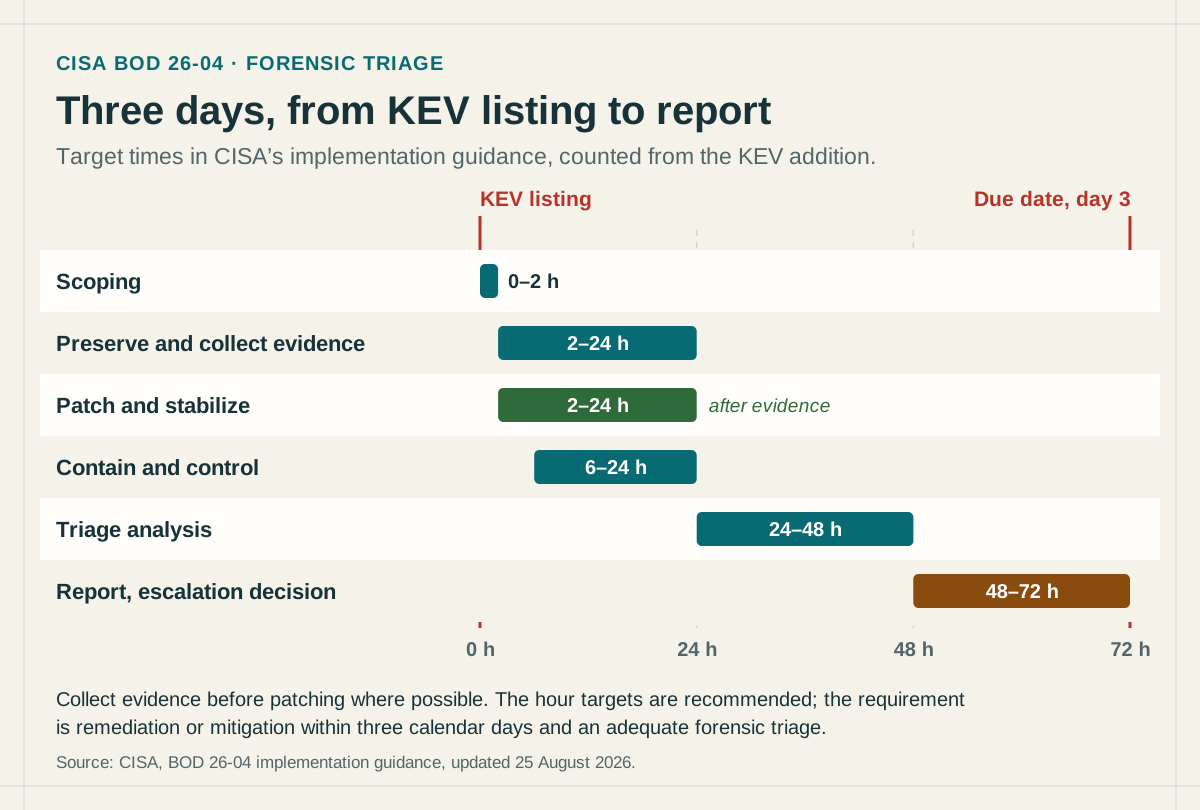
- Scoping, within 2 hours: decide whether the CVE meets the three-day threshold, activate the triage team, set the boundaries of affected systems and open an out-of-band communication channel that does not rely on possibly compromised infrastructure.
- Preserve and collect evidence, 2 to 24 hours: volatile data first (memory, caches, data in transit), then persistent data, limited to the systems in scope. Keep a collection log: each item, its system, the time and the collector. “Do not alter or remediate systems prior to evidence/artifact collection when possible.”
- Critical patching and stabilization, 2 to 24 hours: apply the available patches once the evidence is collected, because patching can destroy artifacts.
- Contain and control, 6 to 24 hours: isolate affected and suspected systems after the first collection, without alerting a possible intruder.
- Triage analysis, 24 to 48 hours: look for unauthorized access, attacker presence, lateral movement, persistence and data staging or exfiltration; verify each indicator of compromise and search for it elsewhere in the environment.
- Escalation decision, 48 to 72 hours: write a forensic triage report: incident timeline, actions taken, technical findings in “who, what, where, when” terms, containment and mitigation to date, and a recommendation. No evidence of compromise leads to heightened monitoring and completing remediation; a confirmed compromise is reported to CISA and moves to full incident response; a suspected one stays in triage with an escalation path.
When CISA has indicators or entry-specific forensic guidance for a KEV addition, the guidance says it adds them to the catalog entry, and agencies follow that guidance over the baseline steps.
One batch: the four additions of 9 November 2026
On 9 November 2026 CISA added four CVEs, all with a due date of 12 November and the forensic triage flag set. This is what a defender needs to act on them:
| CVE | Product | Added to KEV | Due date | Fixed in | Vendor advisory |
|---|---|---|---|---|---|
| CVE-2026-123158 | OpenBSD OpenSSH | 9 Nov 2026 | 12 Nov 2026 | Portable OpenSSH 10.6p2 | OpenSSH release notes |
| CVE-2026-102895 | GPUStack | 9 Nov 2026 | 12 Nov 2026 | gpustack 2.2.0 | GHSA-gj9m-f8ph-pmhr |
| CVE-2026-116779 | SignalWire FreeSWITCH | 9 Nov 2026 | 12 Nov 2026 | FreeSWITCH 1.11.3 | GHSA-mg63-h38w-8p9p |
| CVE-2026-123218 | IBM Aspera Faspex | 9 Nov 2026 | 12 Nov 2026 | Aspera Faspex 5.0.19 PL1 (Fix Pack 1) | IBM security bulletin 7295921 |
Two points for the patch queue. Every fix was out before the listing: GPUStack 2.2.0 on 18 June, FreeSWITCH 1.11.3 on 28 August, OpenSSH 10.6p2 on 5 November and IBM’s bulletin on 7 November. The three days went to deployment and triage, not to waiting for a vendor. And the version to look for is not always the upstream one: OpenSSH’s release notes limit the issue to some Linux systems that use musl libc with PAM disabled, and distributions ship the fix under their own package versions.
What it means outside the US federal government
The directive binds no one else. Its deadlines are a reference for other organizations, with one caveat the guidance makes explicit: the KEV due date reflects CISA’s view of exposure, not yours.
The table travels well, because three of its four inputs are public. KEV status is in the catalog; automatable and technical impact are in the CVE record’s CISA ADP container through Vulnrichment. The fourth, exposure, is the one only you can answer. An organization that knows which of its assets face the internet can compute the same deadline per asset, and two cases deserve attention:
- An internal asset is not automatically a slower one. A KEV flaw that is both automatable and total control gets three days and forensic triage even when the asset is not publicly exposed.
- An exposed asset with a 14-day KEV entry can still be urgent for you. CISA’s FAQ says agencies “with a lower tolerance for this risk may set shorter timelines”; the deadlines are maximums.
Two other points from the guidance carry over directly. The KEV is not the whole list: configuration weaknesses and many web application flaws do not get a CVE ID. And an old CVE added to the catalog does not necessarily mean CISA sees exploitation today, only that it qualifies.
Cloud providers selling to US agencies get the directive indirectly: the guidance states that FedRAMP will require its new vulnerability detection and reporting rules, aligned with BOD 26-04, by 7 December 2026.
Running a 72-hour cycle
The three days are short only if the work that does not depend on the CVE is already done.
Before any listing:
- Keep an inventory of exposed assets with the four tags the directive asks for: organization, environment, exposure and asset type. The guidance lists discovery sources: vulnerability scanners, cloud provider tags, active scanning, passive network discovery, EDR, NAC and device management. For internet-facing names, a subdomain scanner based on certificate transparency logs and passive DNS shows hosts that an internal inventory may have missed.
- Write the plan for critical systems in advance: who decides, which systems may be taken offline, and what evidence is collected from each kind of asset. The guidance asks for explicit risk decisions between availability and the consequences of exploitation.
Every day:
- Read the catalog once a day and match
dateAdded,dueDateandforensicTriageagainst your inventory by vendor and product. CISA says it aims to update the catalog within 24 hours of identifying a vulnerability that qualifies.
For each match:
- Collect before you change anything, then patch. Keep the collection log from the start; it becomes part of the report.
- When a patch cannot be applied in time, the guidance is blunt: besides the catalog’s required actions, the only known mitigation is to remove the asset from the network. It lists decommissioning, removing the vulnerable software, network segmentation, isolation, software-defined perimeters and proxies. Taking an asset off the internet also changes its exposure, and with it the deadline.
- Close with the report by hour 72, even when nothing is found: it is the record that the asset was checked and not only patched.
How isMalicious helps
These are the CVE pages as they stand on 15 November 2026:
- /cve/kev lists the KEV additions of the last 30 days, grouped by the day CISA added them, with CVSS, EPSS and CISA’s due date. Windows of 90 days and 12 months, a vendor filter, a page per month and the count of additions per month since November 2021 sit on the same page.
- Each CVE page, such as CVE-2026-123158, shows the KEV date added, the due date and CISA’s required action, a dated timeline from publication to listing, fixed versions per branch and the distribution packages published on OSV.dev. An “Am I affected?” check reads a version you enter, or the version a domain exposes in its public headers and pages.
- A Watch link on each CVE sends an alert when that CVE enters the KEV or is reported exploited, and a weekly email lists the new KEV entries every Monday.
The pages do not show the forensicTriage flag or Vulnrichment’s automatable and technical impact values. Read those from CISA’s JSON feed and the CVE record.
What to do now
- Check the four CVEs of 9 November against your inventory if you have not already: OpenSSH on musl-based Linux systems without PAM, GPUStack, FreeSWITCH and IBM Aspera Faspex.
- Add the
forensicTriagefield to whatever reads the KEV catalog, and routeYesentries to a process that collects evidence before patching. - Tag exposed assets with organization, environment, exposure and asset type, so that the deadline can be computed per asset rather than per CVE.
- Pull Vulnrichment’s automatable and technical impact values next to KEV status, and flag internal assets with an automatable total-control KEV flaw for the three-day track.
- Write the forensic triage report template now: timeline, actions, findings, containment, recommendation.
Sources
- CISA, BOD 26-04: Prioritizing Security Updates Based on Risk, 10 June 2026 (archived copy of 10 November 2026).
- CISA, BOD 26-04 implementation guidance, updated 25 August 2026 (archived copy of 13 November 2026).
- CISA, KEV catalog data, version 2026.11.13, and Vulnrichment.
- Vendor advisories linked in the table above.
Method: counts by dateAdded from 2026-06-11 to 2026-11-13 inclusive; the delay is dueDate minus dateAdded in calendar days. The isMalicious catalog held the same 1,781 KEV entries on 15 November 2026 and gave the same due dates for every month.
FAQ
Frequently asked questions
What is CISA BOD 26-04?
Binding Operational Directive 26-04, “Prioritizing Security Updates Based on Risk”, was issued by CISA on 10 June 2026. It binds US federal civilian executive branch agencies and revokes BOD 22-01, which created the KEV catalog in 2021, and BOD 19-02. It sets each remediation deadline from four facts: whether the asset is publicly exposed, whether the CVE is in the KEV catalog, whether exploitation is automatable, and whether the attacker gains partial or total control.
Which KEV vulnerabilities get a three-day deadline under BOD 26-04?
On a publicly exposed asset, a KEV vulnerability gets three calendar days unless it is both not automatable and limited to partial control, in which case it gets 14 days. When the vulnerability gives total control, the three days come with a forensic triage. On an asset that is not publicly exposed, a KEV vulnerability gets three days and forensic triage only when it is both automatable and total control; otherwise 14 days.
What does forensic triage mean in BOD 26-04?
The agency must complete remediation or mitigation within three days and carry out a forensic triage of the asset to assess whether it is compromised. CISA’s implementation guidance describes six steps, from scoping to a forensic triage report, and asks agencies to collect evidence before patching where possible. Its hour targets, ending with the report between 48 and 72 hours after the KEV addition, are recommended practice: the requirement is that an adequate triage is performed.
How many KEV additions have had a three-day due date since BOD 26-04?
From 11 June to 13 November 2026, CISA added 164 CVEs to the KEV catalog. 128 had a three-day due date and 36 had 14 days. 105 of the 128 carried the forensic triage flag, which first appeared on 25 June. Figures from the KEV catalog version 2026.11.13 and the isMalicious CVE catalog, read on 15 November 2026.
Does BOD 26-04 apply to private companies?
No. It binds US federal civilian agencies, and contractors only where their contract says so. Other organizations can still use its table: the KEV status, automatable and technical impact values are public, and an organization that knows which of its assets face the internet can compute the same deadlines for itself.
Related articles
 CVE-2026-63077 Puts Unauthenticated RCE on Every TeamCity On-Premises Server
A deserialization flaw in the agent polling protocol gives attackers TeamCity server privileges without credentials. JetBrains patched in 2025.11.7 and 2026.1.3 — CISA KEV and a 3-day federal deadline mean hunt now, not after the next release train.
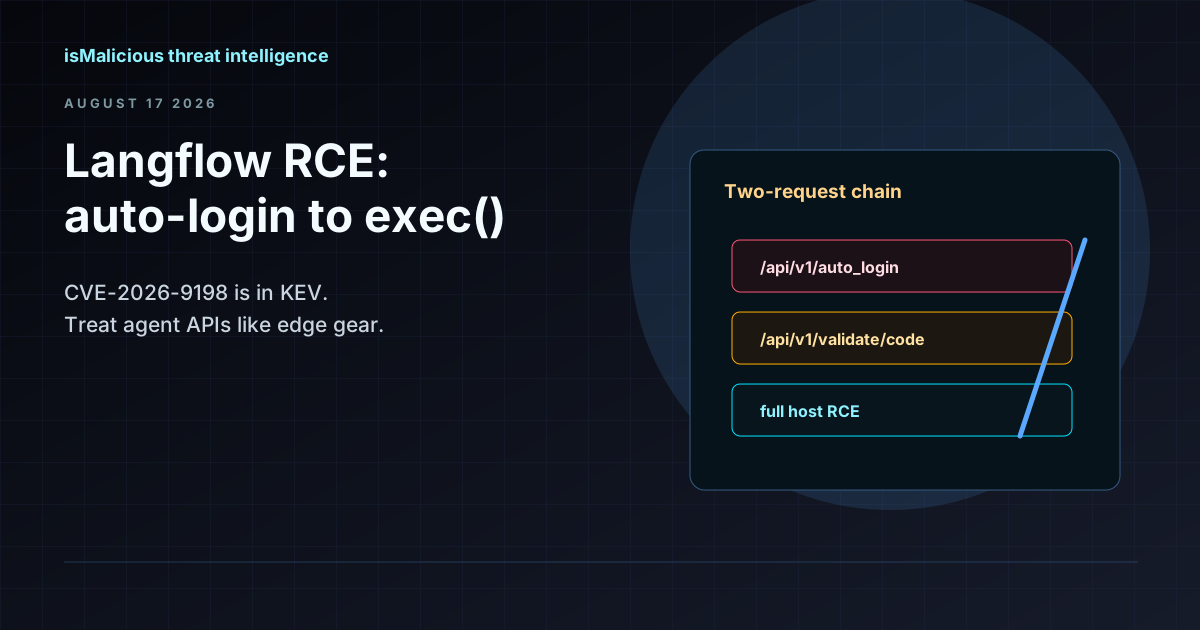 CVE-2026-9198 Gives Unauthenticated RCE in IBM Langflow OSS Agent Control Planes
A SUPERUSER token minted through /api/v1/auto_login chains with Python exec() in /api/v1/validate/code. Langflow 1.10.1 fixes the flaw — but internet-exposed instances need hunting now, not after the next sprint.
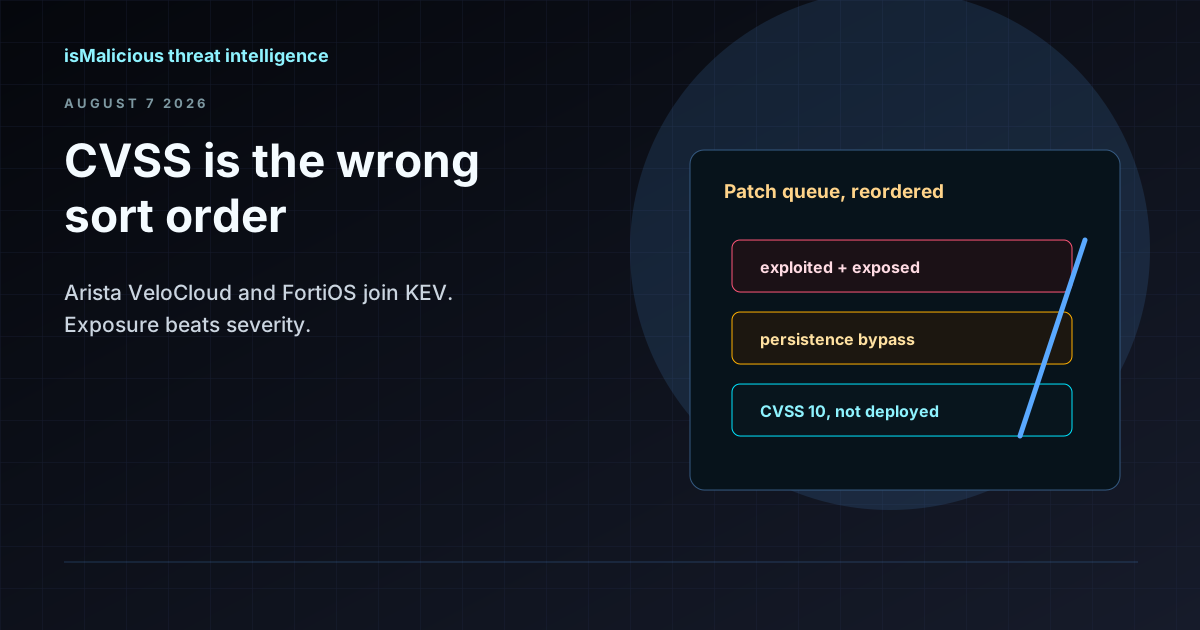 CISA KEV Adds Arista VeloCloud and FortiOS Flaws: Why CVSS Is the Wrong Sort Order
On 27 July 2026 CISA added a CVSS 10.0 command injection in Arista VeloCloud Orchestrator and a medium-severity FortiOS patch bypass to KEV. The pairing shows why exposure and persistence beat severity when ordering a patch queue.
Check any IP or domain
See what our indexed threat intelligence records say about it.
Try the IP / Domain Checker