isMalicious vs Shodan: Threat Reputation vs Attack Surface Discovery
Shodan maps internet-connected devices. isMalicious checks if IPs and domains are malicious. Compare these complementary threat intelligence tools across features, use cases, and pricing to choose the right one.


Shodan and isMalicious both deal with IP intelligence, but they answer fundamentally different questions. Shodan asks: "What services and devices are exposed on this IP?" isMalicious asks: "Is this IP, domain, or URL malicious?"
Despite this difference, security teams often compare them because both appear when searching for IP lookup tools and threat intelligence platforms. Understanding what each tool actually does — and doesn't do — helps you pick the right one for your use case.
Quick Comparison
| Feature | isMalicious | Shodan |
|---|---|---|
| Primary Focus | Threat reputation (is it malicious?) | Device/service discovery (what's running?) |
| Use Case | Block malicious traffic, validate entities | Map attack surfaces, find exposed services |
| Database | Indexed malicious IPs, domains, URLs | Internet-wide device/service scan data |
| Entity Types | IPs, domains, URLs, emails, hashes | IPs, services, devices, banners |
| Domain Reputation | Yes | No (device focus) |
| URL Scanning | Yes | No |
| CVE Correlation | Yes (vulnerability data) | Yes (based on detected services) |
| Free Tier | 500 lookups/month | 100 queries/month |
| Production Plan | Basic €49/month | $59/month |
| Higher Tier | Pro €99/month | $299/month |
| Enterprise | Custom | $899/month |
| Streaming API | Yes (Pro plan) | Yes (Enterprise) |
| Monitoring | Built-in watchlists | Shodan Monitor (paid) |
| API Response | Sub-100ms | Varies |
What is Shodan?
Shodan is an internet-wide scanner that crawls the entire IPv4 address space (and portions of IPv6) to identify what devices and services are accessible online. It indexes banners — the metadata that services broadcast when you connect — from HTTP servers, SSH daemons, databases, industrial control systems, IoT devices, and more.
Shodan excels at:
- Attack surface mapping — discovering what your organization exposes to the internet
- Service fingerprinting — identifying software versions, configurations, and potential vulnerabilities
- IoT and ICS discovery — finding industrial control systems, cameras, and other connected devices
- CVE correlation — matching detected services to known vulnerabilities
- Historical data — tracking how an IP's services have changed over time
What Shodan doesn't do:
- Shodan does not tell you if an IP is malicious. It tells you what's running on it.
- No domain reputation checking
- No URL scanning or phishing detection
- No threat categorization (phishing, malware, C2, etc.)
- Not designed for real-time threat blocking in production systems
What is isMalicious?
isMalicious is a threat reputation platform. When you query an IP, domain, or URL, it tells you whether that entity has been identified as malicious — and if so, what type of threat it represents (phishing, malware hosting, botnet C2, DDoS source, spam origin, etc.).
isMalicious excels at:
- Request-time reputation lookup — evaluating observables against indexed threat records
- Production-grade blocking — sub-100ms responses designed for inline security decisions
- Multi-entity coverage — IPs, domains, URLs, email addresses, and file hashes in one API
- Streaming and monitoring — real-time threat feeds and monitored items alerting
- Intelligence analysts can use — clear malicious/clean verdicts with threat categorization
What isMalicious doesn't do:
- It does not scan for open ports or exposed services
- No device or banner fingerprinting
- Not designed for attack surface management
- Does not identify what software is running on an IP
Different Tools, Different Questions
The core difference becomes clear when you look at what each tool returns for the same IP address:
Shodan for IP 203.0.113.50:
Open ports: 22 (SSH OpenSSH 8.9), 80 (HTTP nginx 1.22), 443 (HTTPS), 3306 (MySQL 8.0). Organization: Example Hosting. Country: Netherlands. Last seen: 2 hours ago.
This tells you the IP runs SSH, a web server, and an exposed MySQL database. Useful for attack surface assessment, but says nothing about whether the IP is sending malicious traffic.
isMalicious for IP 203.0.113.50:
Malicious: true. Threat categories: Malware distribution, Botnet C2. Risk score: 92/100. Sources: 14 blocklists. First seen: 2026-01-03. WHOIS: Registered to anonymous proxy service.
This tells you the IP is actively distributing malware and hosting botnet command-and-control infrastructure. Useful for deciding whether to block traffic from this IP.
Both results are valuable. Neither replaces the other.
Head-to-Head: Where They Overlap
IP Intelligence
Both platforms provide IP lookup, but the intelligence is fundamentally different:
- Shodan tells you the IP's technical profile: open ports, running services, SSL certificates, geolocation, ASN, and organization.
- isMalicious tells you the IP's threat profile: whether it's malicious, what type of threat, risk score, which blocklists flag it, and when it was first observed as malicious.
CVE and Vulnerability Data
Shodan identifies vulnerabilities by matching detected service versions to known CVEs. If it sees Apache/2.4.49, it can flag CVE-2021-41773 (path traversal).
isMalicious tracks vulnerability data differently — focusing on IPs and domains known to be actively exploiting vulnerabilities or hosting exploit kits.
Shodan's vulnerability detection is proactive (finding your own exposed vulnerabilities). isMalicious's is reactive (identifying threat actors exploiting vulnerabilities against you).
Monitoring
Both platforms offer monitoring capabilities:
- Shodan Monitor tracks your organization's internet-facing assets and alerts on changes (new ports, new services, new vulnerabilities). Focus: your own infrastructure.
- isMalicious Monitoring tracks entities on your monitored items and alerts when their threat status changes. Focus: external threats.
Pricing
| Plan | isMalicious | Shodan |
|---|---|---|
| Free | 500 lookups/month | 100 queries/month |
| Production | Basic €49/month | $59/month |
| Higher Tier | Pro €99/month | $299/month |
| Enterprise | Custom | $899/month |
This comparison isn't apples-to-apples: Shodan's pricing reflects the cost of continuously scanning the entire internet, while isMalicious's Pro plan reflects aggregation, curation, and production API workflows for threat reputation.
If your primary need is threat reputation checking, isMalicious gives you a focused production API for IP, domain, URL, and hash decisions instead of an attack-surface scanner.
When to Choose Shodan
Choose Shodan if:
- Attack surface management is your priority. You need to know what your organization exposes to the internet — open ports, misconfigured services, and vulnerable software.
- You're doing reconnaissance. Penetration testers and red teams use Shodan to map target infrastructure before engagements.
- IoT/ICS security matters. Shodan is unmatched for discovering industrial control systems, cameras, and other connected devices exposed online.
- You need service fingerprinting. Identifying specific software versions and configurations across internet-facing assets.
- Historical internet data is valuable. Shodan's historical data shows how an IP's services have changed over time.
When to Choose isMalicious
Choose isMalicious if:
- You need to block malicious traffic. Real-time reputation checking for IPs, domains, and URLs at sub-100ms speeds.
- Threat categorization matters. Knowing whether an entity is associated with phishing, malware, C2, or spam drives different response actions.
- You want affordable threat intelligence. Basic starts at €49/month and Pro at €99/month for production API access.
- Domain and URL coverage is needed. Shodan doesn't cover domain reputation or URL scanning.
- Real-time streaming feeds are important. Push-based threat events with under 5-second latency.
- You need production integration. SDKs, webhooks, and bulk APIs designed for application-level security.
The Best Approach: Use Both
Shodan and isMalicious are not competitors — they're complementary tools that address different layers of security:
- Use Shodan to understand your attack surface. Discover exposed services, identify vulnerable software, and monitor changes to your internet-facing infrastructure.
- Use isMalicious to evaluate incoming traffic. Look up relevant IPs, domains, and URLs against indexed threat records, then combine the result with your own telemetry before blocking.
Together, they provide both outward visibility (what you expose) and inward protection (what threatens you).
Example workflow:
- Shodan Monitor alerts that a new service appeared on one of your IPs.
- You investigate and find it's communicating with an external domain.
- isMalicious confirms the domain is associated with C2 infrastructure.
- You isolate the system and begin incident response.
Neither tool alone would have provided the full picture.
Conclusion
Shodan is a source-aggregated tool for internet-wide scanning and attack surface discovery. isMalicious is purpose-built for threat reputation and real-time malicious entity detection. They answer different questions, serve different workflows, and complement each other in a mature security program.
If you've been using Shodan for threat reputation checks, you may find that isMalicious provides faster, more results with recommended actions at a lower cost — while freeing up your Shodan quota for what it does best: mapping the attack surface.
Try isMalicious free. Look up an IP or domain against indexed threat records — no credit card required.
More Comparisons
Related articles
 Smart Lookup: Check Any Threat Indicator from One Search
Paste an IP, domain, URL, email, phone number, wallet, file hash, or a complete suspicious message. Smart Lookup routes each indicator to the right threat report.
 IPv6 Threat Intelligence: Reputation Beyond IPv4
Build IPv6 threat intelligence with correct normalization, prefix context, dual-stack logging, enrichment, and reputation decisions that avoid overblocking.
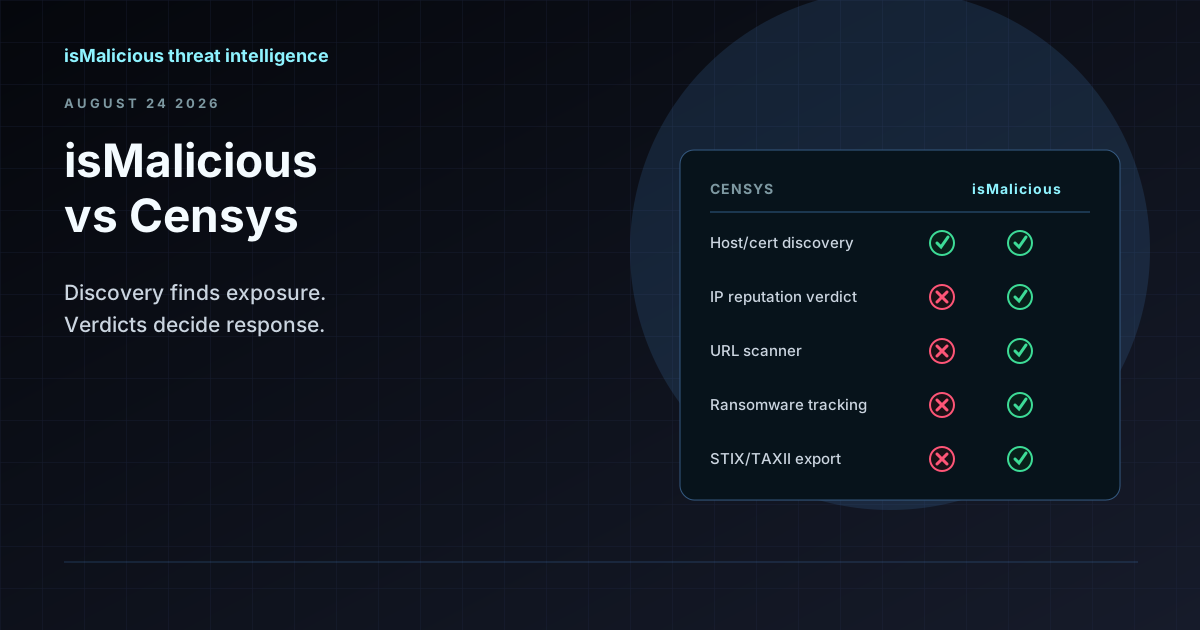 isMalicious vs Censys: Internet Discovery and Reputation Verdicts Are Different Jobs
Censys maps what exists on the internet — hosts, certificates, open ports. isMalicious assesses what is malicious. Most teams comparing the two need the second question answered, not the first.
Protect Your Infrastructure
Check any IP or domain against our threat intelligence database with indexed records.
Try the IP / Domain Checker