AbuseIPDB Alternative: IPs, Domains & URLs
AbuseIPDB covers IPs only. See how isMalicious compares on domain and URL coverage, free-tier limits, enrichment, and monitoring — side by side.


AbuseIPDB is a good choice when your only question is whether an IP address has community abuse reports. It becomes limiting when your SOC or product needs to check domains, URLs, file hashes, DNS history, WHOIS context, webhooks, or monitoring from the same workflow.
This comparison is for teams evaluating an AbuseIPDB alternative because they need broader reputation coverage without stitching together several APIs.
This comparison examines how isMalicious and AbuseIPDB differ — and where each tool fits best in your security workflow.
Quick Comparison
| Feature | isMalicious | AbuseIPDB |
|---|---|---|
| Primary Focus | IP + Domain + URL reputation | IP reputation only |
| Database Size | Indexed threat records | Community-reported IPs |
| Intelligence Sources | Configured intelligence feeds | Community submissions |
| IP Coverage | 250M+ malicious IPs | Extensive (community-driven) |
| Domain Coverage | 200M+ malicious domains | None |
| URL Scanning | Yes (with screenshot capture) | No |
| Free Tier | 500 lookups/month | 1,000 lookups/day |
| Entry Paid Plan | €49/month Basic | $5/month |
| Streaming API | Yes (Pro plan) | No |
| Webhooks | Yes (Pro plan) | No |
| Built-in Monitoring | Yes | No |
| Bulk API | All paid plans | Paid plans |
| WHOIS Data | Included | Not available |
| Geolocation | Included | Community-reported |
What is AbuseIPDB?
AbuseIPDB is a community-powered IP reputation database where users report abusive IP addresses. System administrators and security tools can then query the database to check if an IP has been reported for spam, brute-force attacks, DDoS participation, or other malicious behavior.
AbuseIPDB excels at:
- Community-driven IP abuse reporting with a large, active contributor base
- Simple, straightforward API for IP reputation checks
- Generous free tier (1,000 lookups per day)
- Well-established reputation in the sysadmin and hosting community
- Confidence scoring based on report frequency and recency
Where AbuseIPDB has limitations:
- IP addresses only — no domain, URL, or hash reputation
- Intelligence is community-reported, not curated from professional threat feeds
- No streaming API or real-time push capabilities
- No built-in monitoring or monitored items features
- Limited enrichment data (no WHOIS, SSL certificates, or DNS history)
What is isMalicious?
isMalicious provides reputation lookups for IPs, domains, URLs, and file hashes through one API. It aggregates configured threat feeds, security-vendor data, honeypots, and automated observations into source-attributed results.
isMalicious provides:
- Unified reputation checking for IPs, domains, URLs, and email addresses
- Configured professional and community intelligence sources
- Streaming API for real-time threat event delivery
- Built-in monitoring with alerting when threat status changes
- Rich enrichment: WHOIS, DNS history, SSL certificates, geolocation, ASN data
- Sub-100ms API response times
Head-to-Head: Where It Matters
Entity Coverage
This is the most significant difference between the two platforms.
AbuseIPDB focuses exclusively on IP addresses. If you need to check whether a domain like update-service-microsoft.com is a known phishing site, or whether a URL contains a malware payload, AbuseIPDB can't help.
isMalicious covers the full spectrum:
- 250M+ malicious IPs — including malware, phishing, botnet C2, DDoS, brute force, and spam sources
- 200M+ malicious domains — phishing sites, malware hosts, scam domains, adware, tracking domains, and C2 infrastructure
- 50M+ malicious hashes — file reputation checking by MD5, SHA1, or SHA256
- URL scanning — real-time URL analysis with screenshot capture and redirect chain tracking
For teams that need to validate more than just IP addresses, this broader coverage eliminates the need to stitch together multiple separate tools.
Data Quality and Sources
AbuseIPDB's community model means that data quality depends on the accuracy and timeliness of user reports. While the platform has mechanisms to handle false reports, the data inherently reflects what users choose to submit.
isMalicious aggregates configured intelligence sources including professional threat feeds, security-vendor databases, honeypot networks, and automated observations. Results show agreement and conflicts across sources so analysts can evaluate confidence.
Both approaches have merit: community data captures real-world abuse patterns as experienced by operators, while curated feeds provide broader coverage and professional validation.
API Features
AbuseIPDB API:
- Check endpoint for single IP lookups
- Report endpoint for submitting abuse reports
- Blacklist endpoint for bulk IP lists
- Check-block endpoint for CIDR range lookups
- Simple, clean API design
isMalicious API:
- Single lookup API for IPs, domains, URLs, and email addresses
- Bulk API for batch processing thousands of entities
- Streaming API for real-time threat event push (< 5 second latency)
- Webhooks for event-driven notifications
- Rich response data including risk scores, threat categories, WHOIS, geolocation, and source details
- Official TypeScript SDK (@ismalicious/sdk); other languages use REST or OpenAPI
The key differentiators are the Streaming API and Webhooks. If you need your security pipeline to react to new threats in real time without polling, isMalicious provides those capabilities in the Pro tier. AbuseIPDB does not offer real-time push mechanisms.
Pricing
| Plan | isMalicious | AbuseIPDB |
|---|---|---|
| Free | 500 lookups/month | 1,000 lookups/day |
| Entry Paid | €49/month Basic (2,000/month) | $5/month |
| Mid-Tier | €99/month Pro (10,000/month) | $25/month |
| Top Tier | Custom (Enterprise) | $150/month |
AbuseIPDB's free tier is more generous for IP-only lookups. Its paid plans are also cheaper at the entry level. However, comparing purely on price misses the coverage gap: AbuseIPDB's $150/month top tier still only checks IPs, while isMalicious Pro covers IPs, domains, URLs, file hashes, and includes streaming, webhooks, and monitoring.
Monitoring and Alerting
isMalicious includes built-in watchlists where you can add IPs, domains, or URLs and receive alerts when their threat status changes. This is useful for:
- Monitoring your own infrastructure's IP reputation
- Tracking domains associated with active threats
- Getting notified when a previously clean domain becomes malicious
AbuseIPDB does not offer native monitoring or alerting. To achieve similar functionality, you would need to build a polling mechanism that periodically re-checks entities against the API.
Enrichment Data
When you query an entity through isMalicious, the response includes rich context:
- Threat risk score and confidence level
- Threat categories (phishing, malware, C2, spam, etc.)
- WHOIS registration data
- DNS history
- SSL certificate information
- Geolocation and ASN data
- Source blocklists where the entity was found
AbuseIPDB returns the IP's abuse confidence score, report count, country, ISP, and usage type. The data is useful but more limited in scope, reflecting the platform's focused mission.
When to Choose AbuseIPDB
Choose AbuseIPDB if:
- IP reputation is your only need. If you exclusively check IP addresses and don't need domain or URL intelligence, AbuseIPDB is focused and effective.
- You want maximum free lookups. AbuseIPDB's free tier (1,000/day) is significantly more generous than most alternatives.
- Community-sourced data matters to you. The community reporting model captures real-world abuse patterns from system administrators and hosting providers.
- You're on a very tight budget. AbuseIPDB's $5/month entry plan is among the most affordable in the market for IP reputation.
When to Choose isMalicious
Choose isMalicious if:
- You need more than just IP reputation. Domains, URLs, and email addresses are equally important in modern threat landscapes.
- You want a unified API. One integration covers all entity types instead of stitching together multiple services.
- Real-time streaming is important. The Streaming API eliminates polling overhead and delivers threats in under 5 seconds.
- You need monitoring and alerting. Built-in watchlists with notifications are included, not a DIY project.
- Rich context matters. WHOIS, DNS history, SSL certificates, and detailed threat categorization help analysts make faster decisions.
Using Both Together
Some teams use AbuseIPDB alongside isMalicious to get the best of both worlds:
- AbuseIPDB for community-reported IP abuse data and its generous free tier
- isMalicious for domain/URL coverage, streaming, monitoring, and enriched threat context
This layered approach maximizes coverage while keeping costs reasonable. isMalicious's API makes it easy to cross-reference results from multiple sources in a single workflow.
Conclusion
AbuseIPDB is a reliable, community-trusted tool for IP reputation checking — and it deserves its strong reputation in the sysadmin community. But the modern threat landscape extends far beyond IP addresses. Phishing domains, malware-hosting URLs, and credential-harvesting sites are equally critical to detect and block.
If your security needs have outgrown IP-only reputation, isMalicious provides a unified platform that covers IPs, domains, and URLs with real-time streaming, monitoring, and rich enrichment data. For teams already using AbuseIPDB, adding isMalicious fills the domain and URL coverage gap without replacing a tool that works well for its intended purpose.
Want to see the difference? Check any IP or domain free — no credit card required.
More Comparisons
Related articles
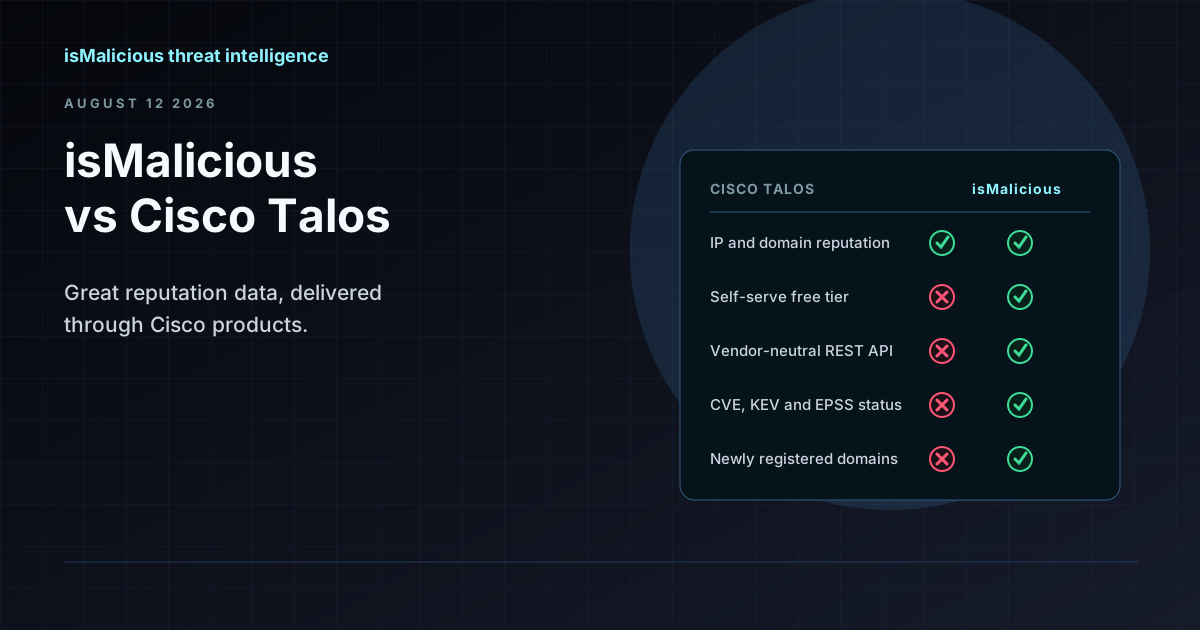 isMalicious vs Cisco Talos: Reputation Lookups Outside the Cisco Stack
Talos reputation is excellent and it lives inside Cisco products. If your stack is not Cisco, or you need an API rather than a web form, that is where the comparison starts.
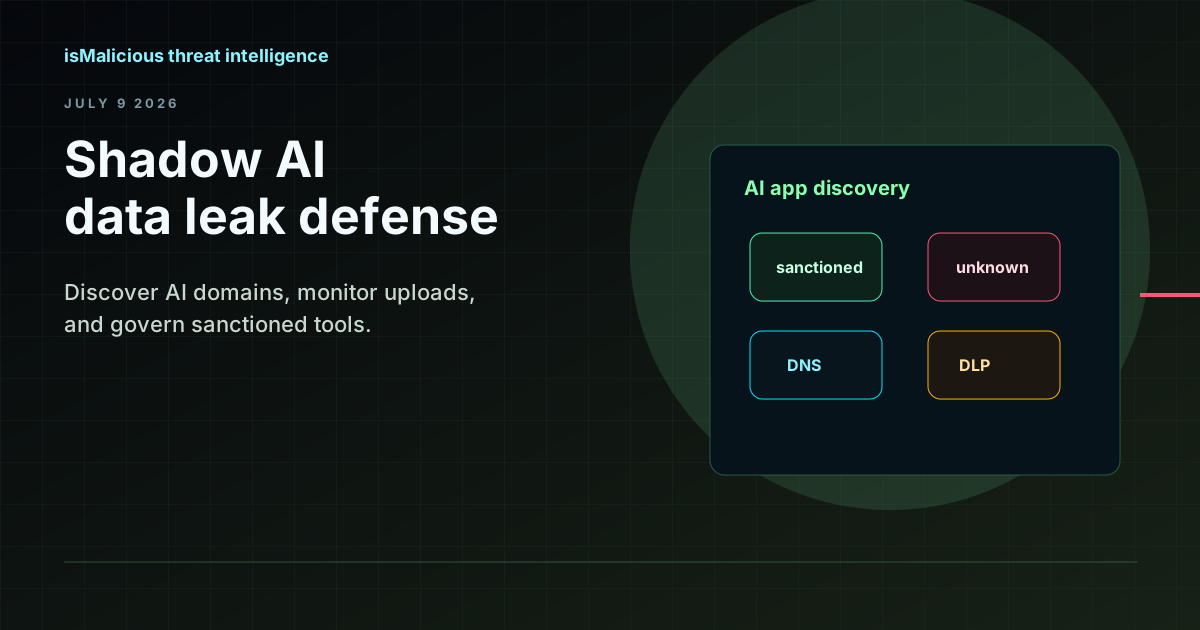 Shadow AI Data Leak Defense: Monitor Domains, URLs, And Unsanctioned AI Apps
Shadow AI has become a governance and data leakage issue. Security teams need discovery, DNS visibility, sanctioned app controls, and domain monitoring around AI tool usage.
 Security LLM and Agent Workflows: When (and How) to Check Malicious Domains, IPs, and URLs Before Acting
AI assistants in SOAR, IDEs, and browser extensions can exfiltrate data or run malicious code if they fetch the wrong link. This guide gives guardrails: schema for tool calls, policy tiers, and where threat intelligence checks belong in the loop.
Protect Your Infrastructure
Check any IP or domain against our threat intelligence database with indexed records.
Try the IP / Domain Checker