Quantum Computing Threats to Encryption: A 2026 Perspective
As quantum supremacy nears, the threat to RSA and ECC encryption becomes existential. This analysis explores Post-Quantum Cryptography (PQC) migration strategies for security teams and the immediate risks of Harvest Now, Decrypt Later (HNDL) attacks.
 IsMalicious Research Team
The Quantum Threat Horizon
The arrival of fault-tolerant quantum computers is no longer a theoretical "if" but a scheduled "when." For security teams (SOC/CSIRT) and researchers, the implication is clear: the cryptographic foundations of the internet—RSA and Elliptic Curve Cryptography (ECC)—are facing obsolescence.
In 2026, we are witnessing the acceleration of "Harvest Now, Decrypt Later" (HNDL) campaigns. Advanced Persistent Threats (APTs) are exfiltrating encrypted data today, anticipating the capability to decrypt it within the decade.
The Algorithm Breakers: Shor and Grover
Quantum computing challenges classical encryption security through two primary algorithms:
- Shor's Algorithm: Efficiently factors large integers and solves discrete logarithm problems. This directly dismantles asymmetric encryption schemes like RSA, Diffie-Hellman, and ECC. A sufficiently capable quantum computer could derive private keys from public keys in polynomial time.
- Grover's Algorithm: Offers a quadratic speedup for searching unstructured databases. While less catastrophic than Shor's, it effectively halves the security bit-strength of symmetric ciphers (e.g., AES-256 becomes AES-128) and hash functions.
Post-Quantum Cryptography (PQC) Migration
The National Institute of Standards and Technology (NIST) has standardized PQC algorithms (CRYSTALS-Kyber, CRYSTALS-Dilithium, etc.) to resist quantum attacks. Migration is not a simple patch; it requires a complete infrastructure overhaul.
Strategic Steps for Security Leaders:
- Cryptographic Inventory: deeply scan your infrastructure to identify all instances of vulnerable algorithms.
- Hybrid Implementation: Deploy PQC algorithms alongside classical ones (hybrid mode) to ensure backward compatibility and FIPS compliance during the transition.
- Crypto-Agility: Re-architect systems to allow for the rapid swapping of cryptographic primitives without rewriting codebases.
Threat Intelligence Defense: IP Reputation & Geolocation
While quantum-safe algorithms are the long-term fix, immediate defense requires strict IP and Domain Reputation monitoring.
- Identifying Exfiltration Nodes: HNDL attacks rely on exfiltrating encrypted data to specific servers. By monitoring the reputation of outbound IP addresses, security teams can detect and block data flows to known APT infrastructure.
- Geolocation Anomalies: Quantum research is geographically concentrated. Sudden, large encrypted data transfers to regions with high concentrations of adversarial quantum research facilities should trigger high-severity alerts.
- Threat Level Assessment: Assigning a 'Critical' threat level to any encrypted traffic traversing non-standard ports to low-reputation IPs is a key early warning system.
Protecting against the quantum threat requires acting before the hardware exists. The time to implement quantum-resistant encryption is now.
Related articles
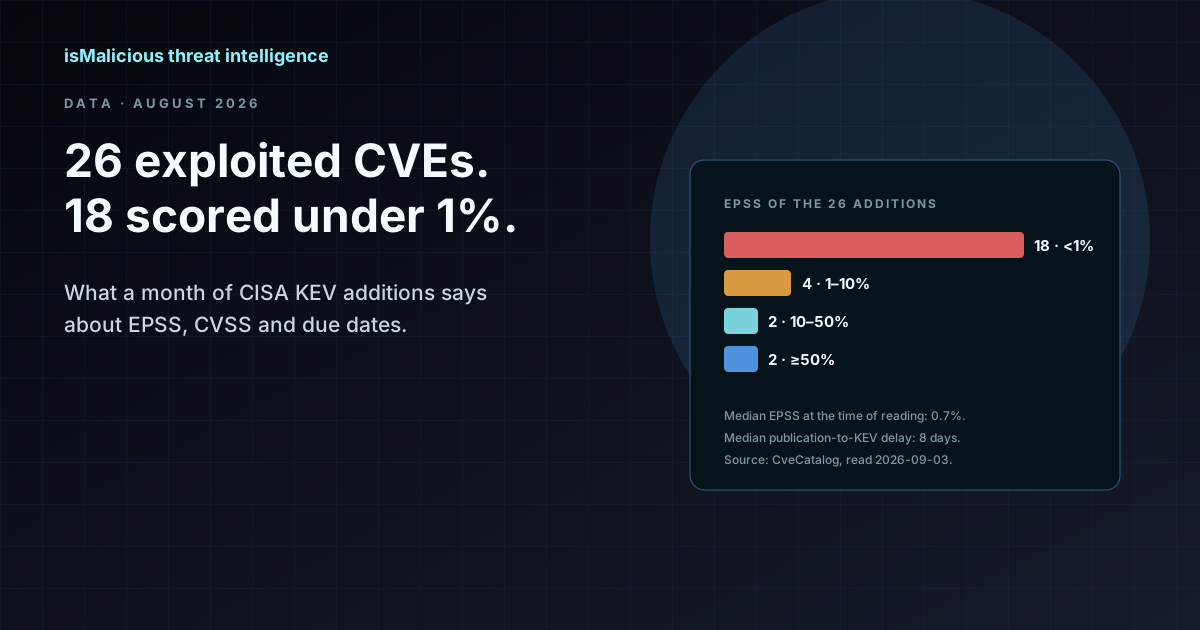 Exploited in August 2026: 26 KEV Additions, 18 With an EPSS Under 1%
A month of CISA KEV additions read against our CVE catalog: 18 of 26 exploited vulnerabilities score under 1% on EPSS today, 4 had no CVSS score when CISA added them, and CISA gave 18 of them a three-day deadline. The numbers, the method, and what they mean for a patch queue.
 Threats Dashboard: Turn Current Intelligence into Priorities
Use the isMalicious Threats dashboard to move from a broad threat picture to the sectors, ransomware groups, malware, victims, and evidence that matter to your team.
 Preparing for Q-Day: Post-Quantum Cryptography Explained
Quantum computers threaten to break the encryption that secures the internet. Discover what Post-Quantum Cryptography (PQC) is and how to prepare for the quantum future.
Protect Your Infrastructure
Check any IP or domain against our threat intelligence database with indexed records.
Try the IP / Domain Checker