Command & Control Infrastructure: Detecting C2 Traffic Before It Is Too Late
Once malware establishes a C2 channel, attackers have a persistent foothold in your environment. Understand how C2 infrastructure is built, how beacons evade detection, and how to identify malicious outbound connections using threat intelligence.


The moment malware establishes a command and control channel, the dynamics of a security incident fundamentally change. Before C2, an attacker has dropped a payload inside your perimeter. After C2, they have a live, interactive session — and the clock begins ticking on everything from data exfiltration to ransomware deployment.
Most organizations focus their defenses on preventing initial access: hardening endpoints, filtering email-borne payloads, and restricting execution. These are necessary and important controls. But malware inevitably gets through, and when it does, detecting the C2 channel before the attacker can act is the critical intervention point.
What Is Command and Control Infrastructure?
Command and control (C2) infrastructure is the communication backbone of malware operations. After successfully compromising an endpoint, malware requires a reliable channel to:
- Receive instructions from the attacker
- Exfiltrate stolen data
- Download additional payloads or tools
- Report operational status
- Receive updated configuration
C2 channels transform passive malware into an interactive attack tool. Without a functioning C2 connection, most modern malware is limited to whatever initial payload was delivered. With it, attackers gain persistent access and can adapt their operation in real time.
The Evolution of C2 Architecture
Early malware used direct TCP connections to static attacker-controlled IP addresses. This architecture was simple but brittle — sinkholing or blocking a single IP could neutralize an entire campaign, and the static addresses were easily shared between defenders.
Modern C2 architectures have evolved substantially in response to improved defenses.
Domain Generation Algorithms
Domain Generation Algorithms (DGAs) produce large numbers of pseudo-random domain names using a shared seed value (typically incorporating the current date). Malware cycles through hundreds or thousands of generated domains, attempting to connect until it reaches one the attacker has registered.
Defenders face an asymmetric challenge: attackers need to register only one domain to maintain C2 connectivity, but defenders must sinkhole or block every generated domain to prevent it. Security researchers reverse engineer DGA implementations to generate blocklists, but attackers continually introduce new algorithms with higher randomization or longer cycle times.
Fast-Flux DNS
Fast-flux DNS rapidly rotates the IP addresses returned for a given hostname. A single C2 domain might cycle through dozens or hundreds of IP addresses with TTLs measured in seconds, making IP-based blocking ineffective and complicating takedown efforts. The underlying infrastructure is typically distributed across thousands of compromised hosts acting as proxies.
Legitimate Cloud Services
Increasingly sophisticated C2 frameworks tunnel communications through legitimate cloud services: Dropbox as a file staging area, Google Docs as a command channel, Slack or Teams APIs for real-time instruction delivery. These channels blend into normal enterprise traffic because they use the service's legitimate domains and TLS certificates. Traditional proxy blocking approaches struggle because blocking the C2 channel would require blocking entire collaboration platforms.
Encrypted and Steganographic Channels
Modern C2 communications are universally encrypted. Many frameworks implement custom encryption on top of standard protocols, making payload inspection ineffective even when traffic is decrypted at a network inspection point. Some advanced malware encodes C2 communication using steganography — embedding instructions within innocuous-appearing data like image files or social media posts.
Understanding the Beacon
The fundamental unit of C2 communication is the beacon: periodic outbound communication from compromised host to C2 server. Understanding beacon characteristics is essential for detection.
A beacon serves two purposes: it signals the compromised host is alive and reachable, and it allows the C2 server to deliver queued instructions. Beacon design reflects a tension between operational needs and stealth.
Regular intervals make detection easier — statistical analysis of network connections can identify hosts making connections at precise intervals that no human user would produce. Jittered intervals add random variance to the beacon period, distributing connections across a time window rather than producing the telltale regular heartbeat signature.
Beacon content varies from minimal keep-alive packets to comprehensive status updates including network environment, installed software, and process lists. More data provides the attacker better situational awareness but produces more distinctive traffic patterns.
External connectivity checks are a common pre-beacon behavior. Many malware families test internet connectivity by querying legitimate infrastructure (DNS resolvers, known cloud endpoints) before initiating C2 contact. This behavior appears in behavioral analysis as unusual outbound connection patterns that do not match the application's normal network profile.
Detection Approaches
DNS Analytics
DNS is the most reliable C2 detection layer for several reasons. Most C2 infrastructure, regardless of delivery protocol, requires DNS resolution at some point. DGA-generated domains have distinctive properties: high entropy names, no matching offline registrations, unusual letter distribution. Statistical models trained on malicious and benign DNS traffic can identify DGA activity with high accuracy.
DNS resolution timing and frequency are also informative. Malware cycling through a DGA may generate dozens or hundreds of failed lookups (NXDOMAIN responses) before finding a registered domain — a pattern that is anomalous for normal user behavior and application traffic.
Passive DNS monitoring maintains historical records of DNS resolution activity, allowing analysts to correlate current C2 infrastructure with past campaigns. Many C2 domains are registered using shared infrastructure, payment methods, or registrar patterns that link them to known threat actors.
Network Behavior Baselines
Understanding what normal outbound traffic looks like for each host and application makes anomalous C2 traffic detectable by contrast. Key behavioral signals include:
Connection regularity: Applications maintaining C2 channels produce more regular connection patterns than human-driven browser traffic. Statistical analysis of inter-connection timing can reveal beaconing behavior even when intervals are jittered.
Destination profiling: Most enterprise hosts connect to a relatively stable set of external destinations. Connections to previously unobserved IP addresses, particularly those with poor reputation or unusual hosting characteristics, warrant investigation.
Data transfer asymmetry: Normal HTTPS browsing produces much more inbound than outbound data. C2 channels often show unusual outbound-to-inbound ratios — high upload volumes during data exfiltration, or minimal transfer (just keep-alive beacons) that differs from normal web browsing patterns.
Protocol misuse: C2 frameworks frequently tunnel communications over legitimate protocols — HTTP, HTTPS, DNS, ICMP. Traffic analysis can identify characteristic mismatches between protocol headers and actual content, unusual response codes, and abnormal field values.
Threat Intelligence Correlation
Real-time correlation of observed connection destinations against threat intelligence feeds provides the most reliable high-confidence C2 detection. Three categories of intelligence are particularly valuable:
IP reputation: C2 servers are frequently hosted on specific infrastructure types — bulletproof hosters, newly registered VPS instances, compromised legitimate systems. IP intelligence that tracks abuse history, hosting characteristics, and behavioral observations produces risk scores that elevate suspicious connections for investigation.
Domain reputation: Newly registered domains with high entropy names, suspicious registrar patterns, or associations with known malvertising or phishing infrastructure are over-represented in C2 operations. Domain intelligence that tracks registration patterns, certificate transparency logs, and DNS behavior provides early warning before domains appear on blocklists.
Known C2 frame indicators: Security researchers continuously analyze malware families and publish indicators for specific C2 frameworks including Cobalt Strike, Metasploit, Covenant, Sliver, and Brute Ratel. These include distinctive TLS certificate subjects, HTTP header patterns, URI structures, and response characteristics. Correlation against these framework signatures enables identification of C2 activity even when the specific infrastructure is not yet on blocklists.
Cobalt Strike: The Most Widely Observed C2 Framework
Cobalt Strike deserves specific discussion because it has become the dominant post-exploitation C2 framework across both red team operations and criminal actors who purchase or crack leaked copies.
Cobalt Strike's "team server" and "Beacon" payload are highly configurable and support extensive customization through "malleable C2 profiles" — configuration files that modify network communication patterns to simulate legitimate traffic. Profiles can make Cobalt Strike Beacon traffic mimic Amazon Web Services API calls, Microsoft Office telemetry, or CDN traffic.
Despite this flexibility, Cobalt Strike installations leave detectable fingerprints. Default configurations produce distinctive TLS certificate subjects, specific HTTP response structures, and characteristic jitter patterns. Framework detection services maintain signatures for thousands of Cobalt Strike configurations, enabling identification of C2 servers even when operators attempt to blend into legitimate traffic.
Responding to a Detected C2 Session
Detection is only the beginning. When a C2 channel is identified, incident response faces a critical decision point.
Immediate disconnection from the C2 channel stops attacker interactivity but may trigger destructive fallback behavior in some malware families designed to detect and respond to their C2 being severed. It also eliminates the opportunity to observe attacker actions.
Monitored operation allows observation of what the attacker does next — what data they access, what tools they deploy, what reconnaissance they conduct — while limiting their actual impact through network segmentation and data controls. This approach requires significant monitoring capability and carries risk if attacker activity escalates faster than defenders can respond.
Sinkholing — redirecting C2 communications to a defender-controlled server — allows observation of compromised host behavior and may reveal the full scope of compromise across an environment. This is typically reserved for large-scale threat actor tracking operations rather than individual incident response.
Building Detection Capabilities
Operationalizing C2 detection requires investment across several capabilities:
- DNS logging and analytics — full logging of all DNS queries with statistical analysis for DGA and anomalous resolution patterns
- NetFlow/traffic metadata collection — connection-level records that enable beacon detection and behavioral analysis without requiring full packet capture
- Threat intelligence integration — real-time feeds for IP and domain reputation, framework signatures, and known-bad indicators
- UEBA baselines — per-host and per-application behavior profiles that make anomalous outbound connections detectable by deviation
The ismalicious.com API can serve as a runtime reputation layer for outbound connections, evaluating destination IPs and domains against continuously updated threat intelligence and returning risk assessments that inform automated blocking or alerting decisions.
Conclusion
C2 channel establishment is not the end of an attack — it is the beginning of its most dangerous phase. The window between initial compromise and an attacker's successful use of their C2 session to cause real damage represents the intervention opportunity that defenders must optimize for.
The combination of DNS analytics, behavioral baseline monitoring, and real-time threat intelligence correlation creates a detection architecture that makes C2 activity visible across its lifecycle — from the first DNS resolution attempt through every beacon cycle. Building these capabilities requires investment, but the alternative — detecting C2 activity only after exfiltration or ransomware deployment — is a consequence most organizations can measure in millions.
Related articles
 Malicious Browser Extensions Are Stealing Session Cookies: Detection Guide
Rebranded browser extensions are harvesting session cookies and OAuth tokens after silent updates. Here is how to detect and respond before EDR ever sees it.
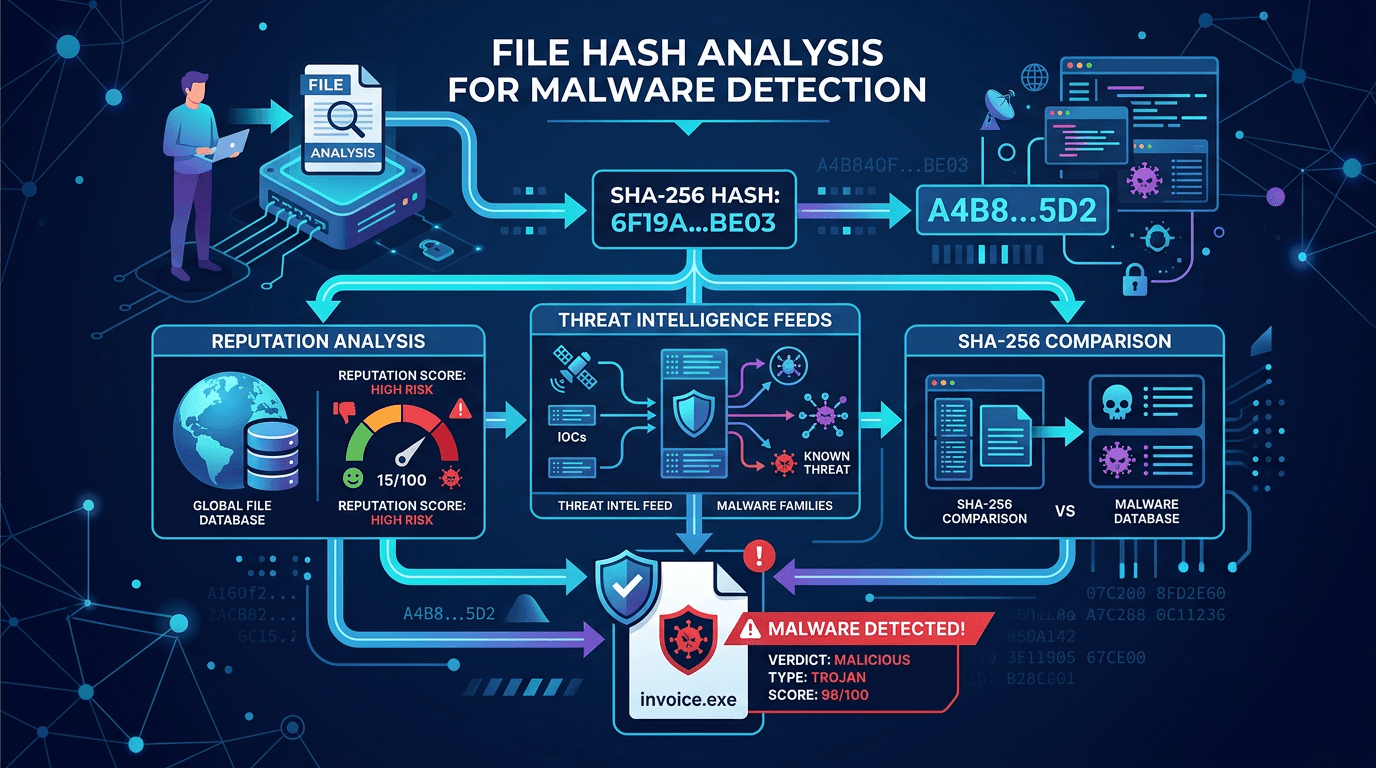 File Hash Check: Is This SHA-256 Malware?
How to check MD5, SHA-1, and SHA-256 hashes against threat intelligence, and how SOC teams use hash reputation to cut false positives.
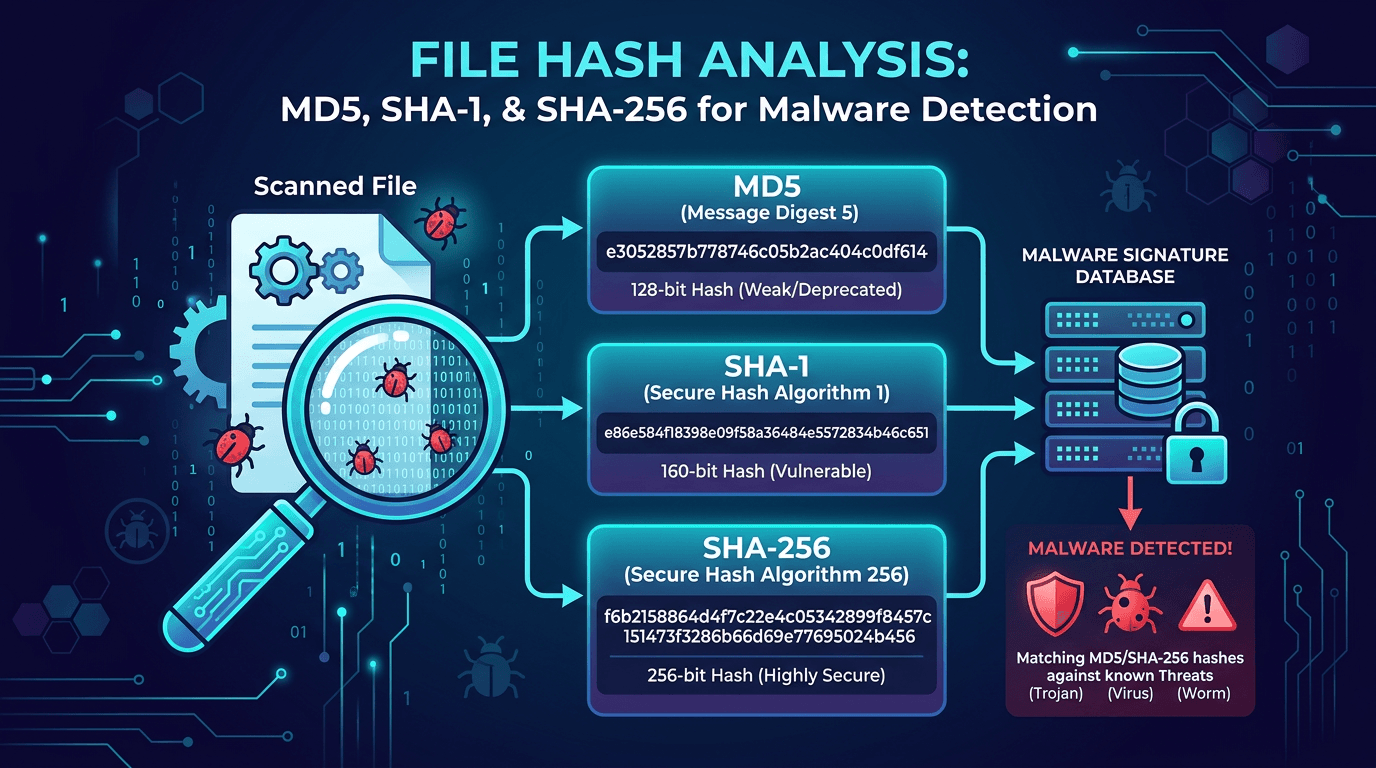 File Hash Analysis: MD5, SHA-1, and SHA-256 for Malware Detection and Threat Hunting
A practical guide to file hashes in cybersecurity—how MD5, SHA-1, and SHA-256 work, why they matter for malware detection, incident response, and threat hunting, and how to use hash lookups to enrich indicators of compromise.
Protect Your Infrastructure
Check any IP or domain against our threat intelligence database with indexed records.
Try the IP / Domain Checker