Healthcare IoT Security: The Critical Risk to Patient Safety
Connected medical devices (IoMT) introduce life-critical vulnerabilities into hospital networks. From MRI machines to insulin pumps, this guide analyzes the unique challenges of securing legacy firmware and unpatched operating systems.
 IsMalicious Research Team
The Intersection of Cyber and Physical Safety
The Internet of Medical Things (IoMT) has revolutionized patient care but created a terrifying attack surface. Unlike enterprise IT, where a server crash means downtime, in healthcare, a compromised device can mean patient harm or death.
The Legacy Problem
Many medical devices (FDA approved) run on outdated operating systems like Windows XP or embedded Linux 2.6.
- Unpatchable Vulnerabilities: Manufacturers often stop supporting devices long before hospitals retire them.
- Regulatory Hesitation: A misconception persists that patching requires FDA re-certification, leading to delayed security updates.
Attack Scenarios
- Ransomware: Hospitals remain the #1 target. Attackers encrypt patient records (EHR) and demand payment to restore access to life-saving data.
- Device Hijacking: Researchers have demonstrated the ability to alter dosages on infusion pumps or disrupt pacemaker functionality.
IoMT Security Strategy for 2026
- Micro-Segmentation: Isolate IoMT devices on their own VLANs. A compromised MRI machine should not have a route to the main hospital database.
- Behavioral Monitoring: Establish a baseline for device communication. An X-ray machine should only talk to the PACS server, not the internet.
- Vendor Risk Management: Demand Software Bill of Materials (SBOM) from device manufacturers to understand component risks.
Proactive Defense: Threat Intelligence for IoMT
Traditional antivirus cannot run on most medical devices, making network-level threat intelligence the primary defense.
- C2 Communication Blocking: Ransomware often relies on communicating with external C2 servers for encryption keys. Blocking outbound connections to known low-reputation IPs can neutralize the attack before data is encrypted.
- Geolocation Monitoring: If a CT scanner begins transmitting data to an IP address geolocated in a jurisdiction known for healthcare data theft, the connection must be severed instantly.
Related articles
 YellowKey and BitLocker Bypass: How Security Teams Should Re-Baseline Stolen-Device Risk
YellowKey made a quiet assumption loud again: encrypted endpoints still need vulnerability intelligence, asset context, and incident workflows. Here is how to respond when a last-resort control becomes a live risk.
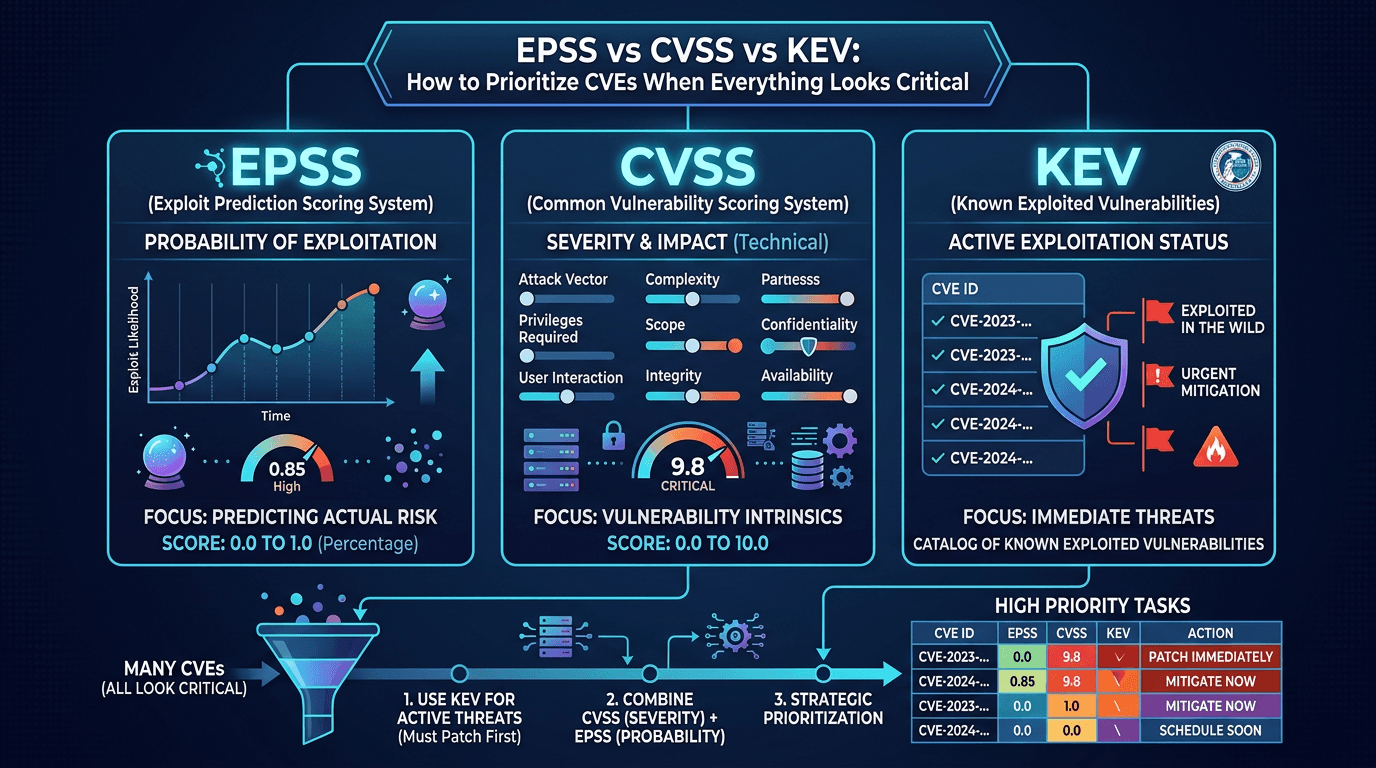 EPSS vs CVSS vs KEV: How to Prioritize CVEs When Everything Looks Critical
Cut through scoring confusion: compare CVSS severity, EPSS exploit probability, and CISA KEV active exploitation—and learn a practical model for patch and compensating-control decisions.
 Smart City Security: Protecting Critical Infrastructure from Cyber Attack
Connected traffic lights, sensors, and water systems create a vast attack surface in modern cities. We examine the vulnerabilities of smart city infrastructure and the cascading failures a cyberattack could cause.
Protect Your Infrastructure
Check any IP or domain against our threat intelligence database with indexed records.
Try the IP / Domain Checker