Domain Reputation Scoring: The First Line of Defense Against Phishing
Not all domains are created equal. Discover how real-time domain reputation scoring helps organizations proactively identify and block phishing infrastructure, fake websites, and parked domains used by cybercriminals.


Phishing remains the most prevalent and damaging initial access vector used by cybercriminals. Despite decades of security awareness training and traditional email filters, attackers still successfully trick employees into clicking malicious links.
Why? Because attackers have become exceptionally skilled at registering domains that look entirely legitimate. They use homoglyphs (characters that look alike), typo-squatting, and newly registered domains to bypass legacy security systems.
To combat this, modern security teams are turning to Domain Reputation Scoring—a data-driven approach that evaluates the trustworthiness of a domain in real-time, effectively serving as the first line of defense against phishing attacks.
What is Domain Reputation Scoring?
Domain Reputation Scoring is the process of algorithmically analyzing hundreds of data points associated with a domain name to generate a numerical "trust" or "risk" score.
Unlike simple blocklists that categorize a domain as only "good" or "bad," a reputation score provides a granular assessment. A brand new domain registered yesterday using a free registrar in a high-risk jurisdiction might receive a "High Risk" score, even if it hasn't officially launched a phishing campaign yet.
Key Factors in Calculating Domain Reputation
How does an intelligence engine know a domain is suspicious before it attacks? It looks at the metadata surrounding the domain's existence:
- Domain Age: Over 70% of domains used in phishing campaigns are less than 30 days old. Attackers register a domain, use it aggressively for a few days, and abandon it before security researchers can classify it as malicious. A newly registered domain inherently carries high risk.
- Registrar and Hosting Provider History: Threat actors gravitate toward specific "bulletproof" hosting providers and registrars that accept cryptocurrency and ignore abuse complaints. A domain hosted in a neighborhood known for cybercrime gets a lower reputation score.
- Lexical Analysis (Typo-squatting): Does the domain closely resemble a known brand? If a domain is
secure-paypaI.com(using a capital 'I' instead of 'l'), the scoring engine recognizes the attempted deception immediately. - DNS History and Volatility: Does the domain frequently change its IP addresses (Fast Flux)? Does it have MX records pointing to suspicious mail servers? Volatile DNS behavior is a strong indicator of malicious intent.
How Domain Reputation Prevents Phishing
By integrating Domain Reputation Scoring into your security posture, you shift from reactive detection (waiting for a user to report an email) to proactive prevention.
Integrating with Secure Email Gateways (SEGs)
When an email arrives, your SEG can extract all URLs within the body and query a Reputation API. If any domain in the email returns a high-risk score—even if the email content seems benign—the SEG can quarantine the message, strip the links, or flag it with a prominent warning banner for the user.
This is incredibly effective against "Zero-Day" phishing campaigns using freshly registered domains that aren't on any static blocklists yet.
Protecting Web Traffic via DNS Firewalls
Phishing doesn't only happen over email; it occurs via SMS (smishing), social media messaging, and malvertising.
By integrating domain reputation into your corporate DNS servers or Secure Web Gateway (SWG), you can prevent users from resolving high-risk domains entirely. When an employee clicks a malicious link in an SMS on their corporate phone, the DNS query is intercepted, the reputation is evaluated in milliseconds, and the connection is dropped, displaying a "Blocked by Security Policy" page.
Automating Incident Response
Security Operations Centers (SOCs) are overwhelmed with alerts. When a SIEM generates hundreds of alerts for "suspicious network connection," analysts waste hours manually investigating domains.
By enriching SIEM logs with Domain Reputation APIs, SOC teams can automatically triage alerts. Alerts involving highly reputable domains (like google.com) can be de-prioritized, while connections to domains with a dismal reputation score can automatically trigger high-priority paging and containment workflows.
The Advantage of Real-Time APIs
The speed at which threat actors operate means that static databases of "bad domains" are obsolete the moment they are compiled. A domain might be benign at 9:00 AM, compromised and used to host a phishing kit by 10:00 AM, and suspended by noon.
You cannot rely on daily updates. You need a Real-Time Threat Intelligence API.
Modern APIs evaluate the domain at the exact microsecond the query is made, pulling the latest DNS records, checking for recent abuse reports on that infrastructure, and calculating a fresh score.
Securing Your Organization
Phishing will continue to evolve, with attackers using AI to generate more convincing lures and automation to spin up infrastructure at unprecedented speeds.
To defend your organization, you must evaluate the infrastructure attackers rely on. Implementing Domain Reputation Scoring ensures that even the most convincing phishing email falls flat because the underlying domain simply isn't trusted by your network.
Take control of your network's trust boundaries. Integrate the isMalicious Domain Reputation API to automatically score, analyze, and block phishing infrastructure before it reaches your end-users.
Related articles
- Parked Domains: Assess the Risk Before Blocking
Distinguish domain parking, expiration, and malicious behavior. Examine actual use and choose a restriction supported by the evidence.
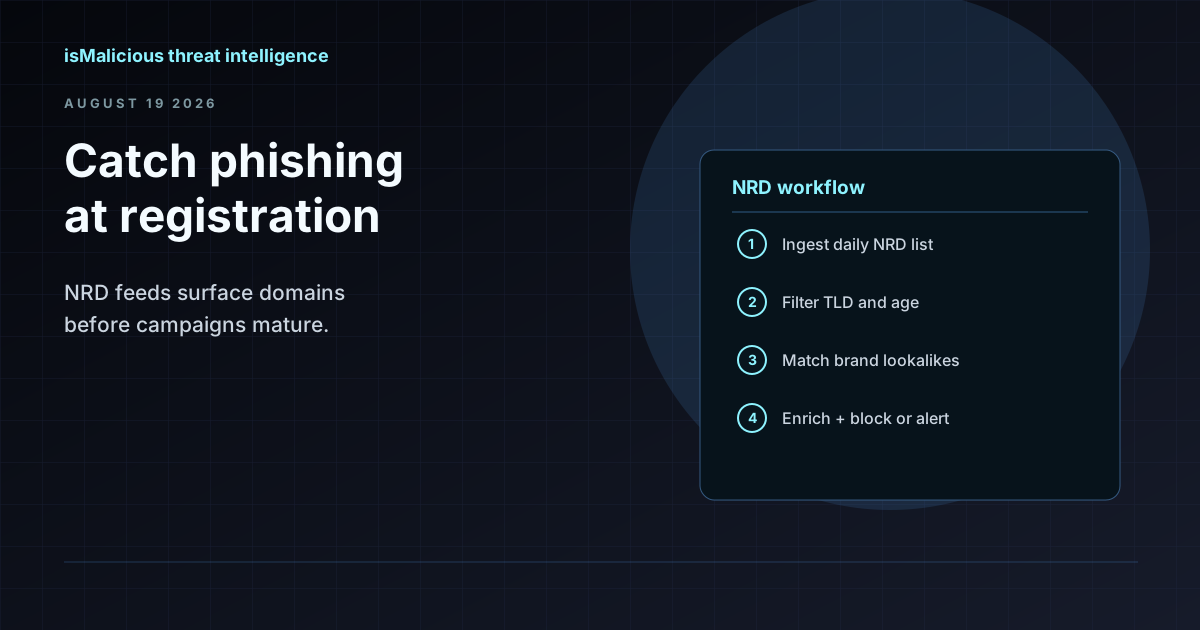 How to Use an NRD Feed to Catch Phishing Before It Lands in the Inbox
Newly registered domains are where most phishing campaigns start. This guide walks through NRD feed workflows for brand monitoring, mail gateway hygiene, and SOC triage — without treating domain age as a blunt block rule.
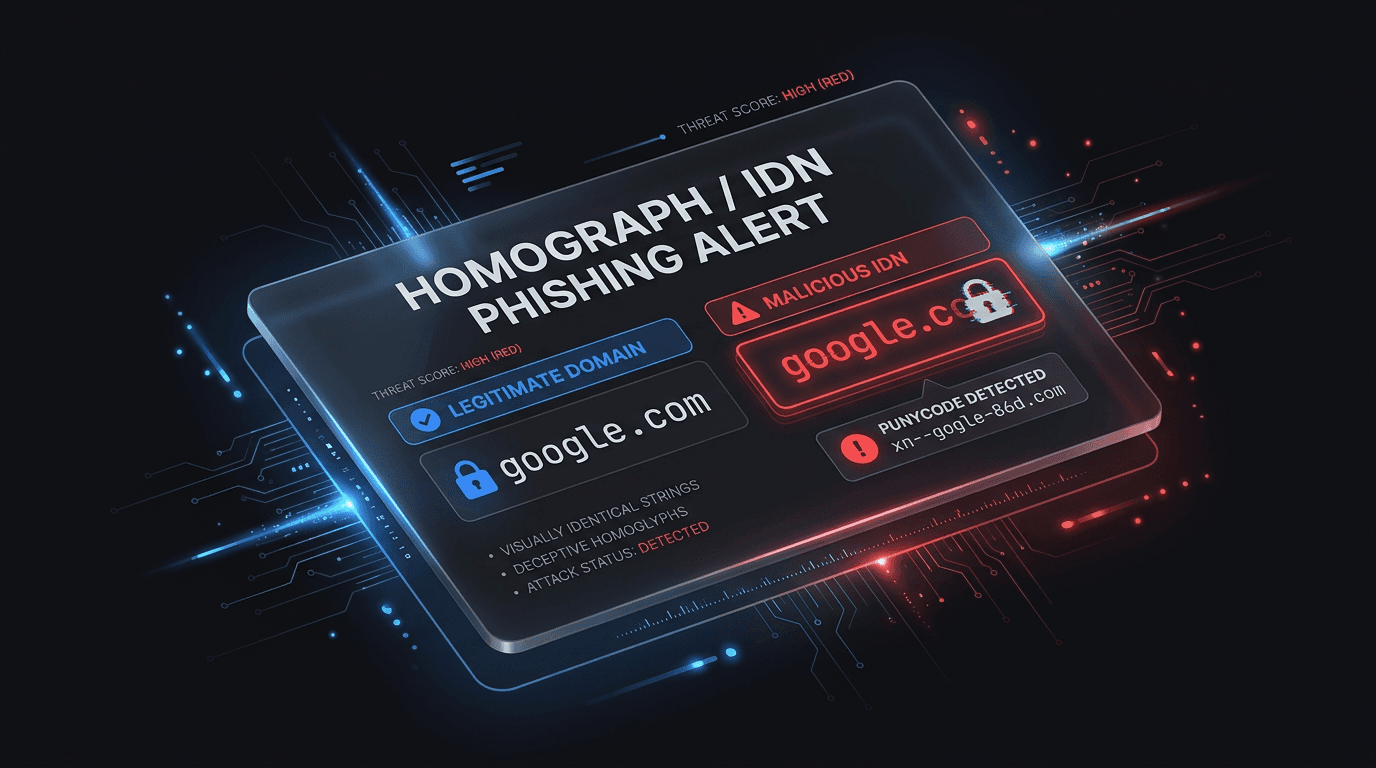 IDN and Homograph Phishing: When the Domain Looks Right But Is Wrong
Internationalized domain names and look-alike characters let attackers spoof trusted brands in the address bar. Learn how homograph attacks work and how to defend users and SOC teams.
Protect Your Infrastructure
Check any IP or domain against our threat intelligence database with indexed records.
Try the IP / Domain Checker