Automotive Cybersecurity: Hacking Connected Cars in 2026
With cars becoming data centers on wheels, the attack surface expands into the powertrain, infotainment, and OTA update systems. We analyze CAN bus injection vulnerabilities and the security risks of V2X communication protocols.
 IsMalicious Research Team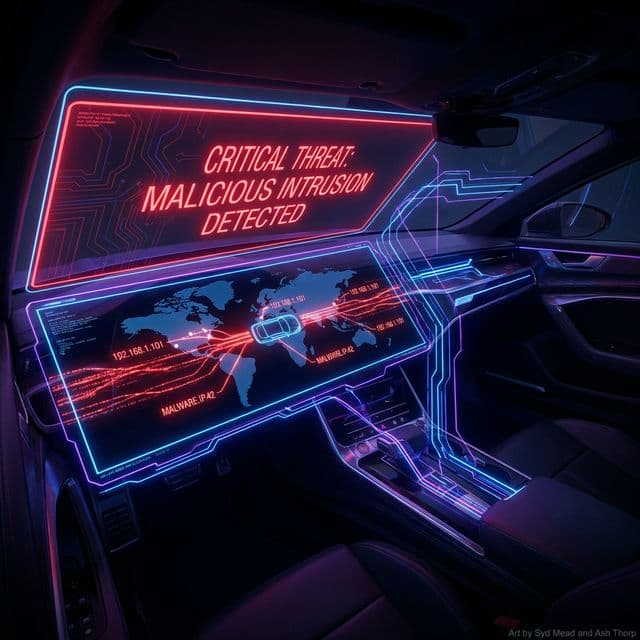
The Car as an Endpoint
Vehicles are no longer just mechanical; they are sophisticated endpoints in the Internet of Things (IoT), running millions of lines of code. For cybersecurity researchers and automotive OEMs, this means the risk of remote exploit is very real.
CAN Bus Injection & ECU Compromise
The Controller Area Network (CAN) bus remains the backbone of vehicle communication, yet it was designed decades ago without security in mind.
- Lack of Authentication: Messages on the CAN bus are typically broadcast without authentication. If an attacker gains access (e.g., via the infotainment system or OBD-II port), they can inject malicious frames to control brakes, steering, or acceleration.
- Gateway Security: Modern vehicles use gateways to segregate critical ECUs (engine, brakes) from non-critical ones (radio, GPS). However, vulnerabilities in these gateways can allow attackers to bypass segmentation.
Over-The-Air (OTA) Risks
OTA updates are essential for patching vulnerabilities but introduce new attack vectors:
- Man-in-the-Middle (MitM): If update servers are compromised or the communication channel is not properly secured with mutual TLS, attackers can push malicious firmware to thousands of vehicles simultaneously.
- Code Signing Weaknesses: Implement rigorous code signing processes. If signing keys are stolen, attackers can sign malicious updates that the vehicle will trust.
Vehicle-to-Everything (V2X) Communication
As V2X rolls out for autonomous driving support, cars will communicate with traffic lights, other cars, and pedestrians. This creates a large attack surface for data spoofing, which could cause accidents or gridlock. V2X PKI needs fault-tolerant certificate handling and a migration path to post-quantum algorithms.
Recommendations for Automotive Security
- Intrusion Detection Systems (IDS): Implement CAN bus IDS to detect anomalous message patterns.
- Hardware Security Modules (HSM): Store cryptographic keys securely in dedicated hardware on ECUs.
- Secure Boot: Ensure that only signed and trusted firmware can run on vehicle controllers.
The Role of IP Reputation in V2X
As vehicles connect to external infrastructure (V2I) and OEM clouds, IP reputation becomes a critical defense layer.
- OTA Source Validation: Updates should only be accepted from known, high-reputation IP blocks owned by the OEM. Any connection attempt from a residential IP or anonymizing proxy should be flagged as a critical threat level event.
- Geofencing C2: Malware infecting a vehicle often phones home to a Command and Control (C2) server. If a vehicle in Berlin attempts to connect to an IP geolocated in a non-standard region for automotive services, the connection should be severed immediately.
Related articles
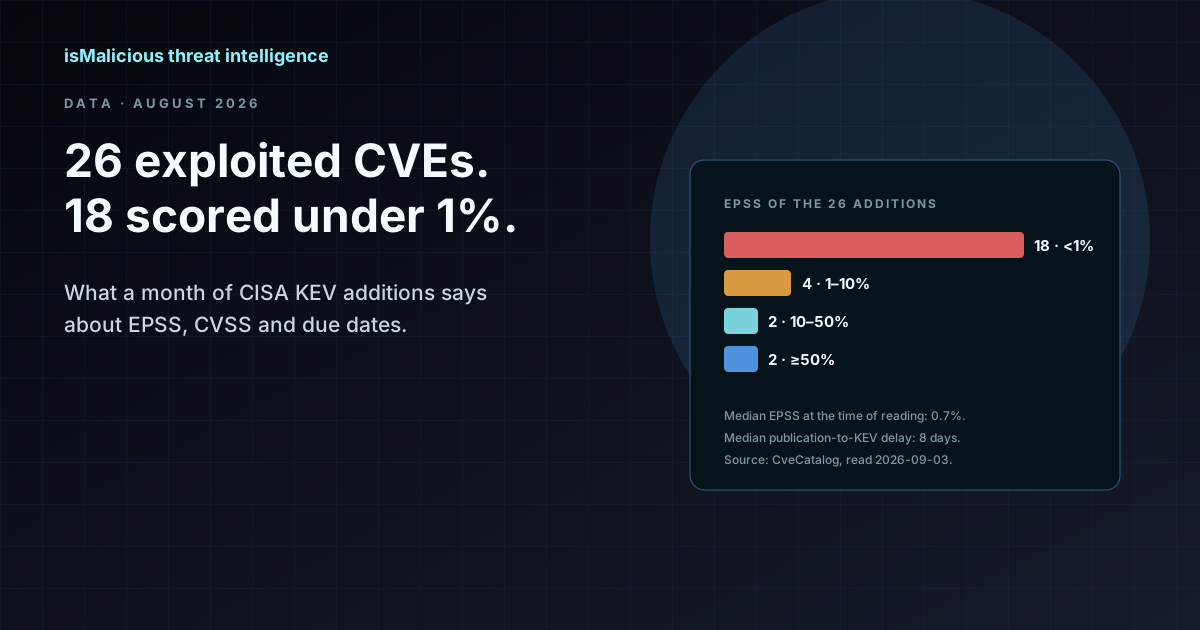 Exploited in August 2026: 26 KEV Additions, 18 With an EPSS Under 1%
A month of CISA KEV additions read against our CVE catalog: 18 of 26 exploited vulnerabilities score under 1% on EPSS today, 4 had no CVSS score when CISA added them, and CISA gave 18 of them a three-day deadline. The numbers, the method, and what they mean for a patch queue.
 BlueHammer Defender Exploitation: July 2026 Patch SLA For Windows Fleets
BlueHammer coverage shows why endpoint patching, CISA KEV context, CVE Watch, and IOC enrichment have to work together when local privilege escalation becomes ransomware tradecraft.
 Answer-Engine Optimization for Cybersecurity: How to Get Cited by ChatGPT, Perplexity, and Claude in 2026
Traditional SEO is not enough when users ask large language models for vendor comparisons and step-by-step security guidance. Learn how to structure threat intelligence and security content so AI systems can parse, trust, and cite your brand without hype or ambiguity.
Protect Your Infrastructure
Check any IP or domain against our threat intelligence database with indexed records.
Try the IP / Domain Checker